
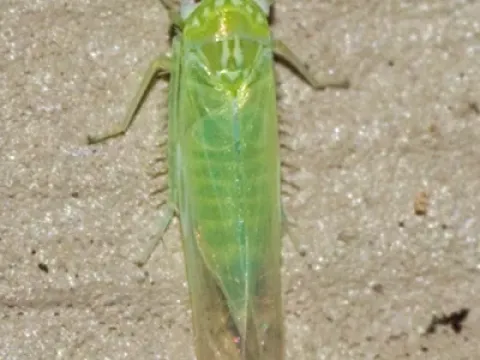
Potato leafhopper
Empoasca minuenda
The potato leafhopper (Empoasca minuenda) is a small, wedge-shaped insect belonging to the order Hemiptera. Adult leafhoppers are about 3 mm long and possess a bright light-green color, which provides excellent camouflage.
What the section contains
Potato leafhopper
These insects are highly mobile; they are known for their ability to jump and fly quickly when disturbed. Their wings are transparent and held roof-like over their body while at rest.
Nymphs, or immature leafhoppers, resemble adults but lack functional wings. They are usually found on the underside of leaves and move sideways with a distinctive crab-like motion.
The life cycle progresses through egg, nymph, and adult stages. Females lay eggs inside plant veins, which protects the developing embryos from predators and environmental stress.
Depending on the ambient temperature, the generation time can be as short as three weeks, allowing the population to increase rapidly during the mid-summer months.
Potato leafhoppers feed on a wide range of hosts, including potatoes, tomatoes, beans, and various weed species. They are among the most persistent pests in vegetable farming.
Damage is caused by both adults and nymphs piercing the leaf epidermis and sucking out phloem sap. This feeding process removes essential nutrients and moisture from the plant tissues.
A toxic saliva injected by the insect during feeding causes localized cell death and disrupts the plant’s nutrient transport system, leading to stunted growth and reduced yields.
These pests are also known carriers of various plant pathogens, including viruses and phytoplasmas, which can cause secondary infections and complete plant failure.
Severe infestations reduce the plant's ability to photosynthesize, resulting in smaller tubers and significantly lowering the market value of the harvested crop.
The hallmark sign of an infestation is known as "hopper burn." This starts as a yellowing or whitening at the tips of the leaves, which then spreads down along the margins.
Leaves affected by hopper burn eventually curl upward, turn brown, and become brittle, creating the appearance of a severe drought stress or sun-scorched injury.
Close inspection of the underside of the leaf often reveals the presence of cast-off white skins (exuviae) left behind by developing nymphs during their molting process.
Infested fields exhibit patchy or general yellowing, and affected plants often appear wilted even when soil moisture levels are adequate for normal growth.
Disturbing the foliage will typically reveal numerous small green insects jumping or flying away from the plant, confirming the presence of an active infestation.
Effective management relies on the regular monitoring of fields using sticky traps to detect the arrival of migrating adults early in the season.
Systemic insecticides are the most effective chemical control, as they are absorbed by the plant and kill the leafhoppers as they feed on the sap.
Cultural practices, such as removing weeds from field edges and avoiding close proximity to other host crops, help to break the life cycle and reduce re-infestation rates.
Encouraging natural predators, such as lady beetles, lacewings, and parasitic wasps, can help maintain leafhopper populations below economic threshold levels.
In cases of high pest density, multiple applications of approved insecticides may be necessary, ensuring strict adherence to pre-harvest intervals to ensure food safety.