
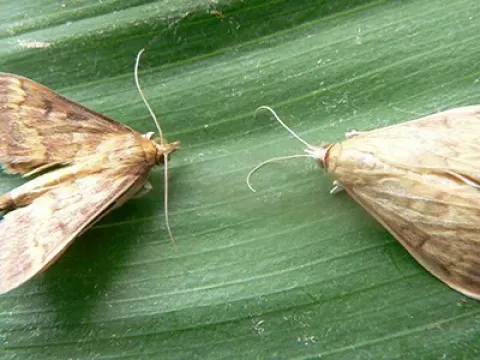
Proceras stem borer
Proceras
The stem borer of the genus Proceras belongs to the Crambidae family. This serious pest is morphologically similar to other stem-boring species, characterized by yellowish-brown forewings with distinct patterns.
What the section contains
Proceras stem borer
Adult moths are primarily nocturnal. The wingspan of the imago is approximately 20–30 mm, with a slender body typical of the Crambinae subfamily. These moths are adapted to warm climatic conditions.
The larvae progress through several instars, reaching a length of up to 25 mm at maturity. They have a pale body with dark spots arranged along each segment and a well-developed head capsule.
Newly hatched larvae are highly mobile and quickly bore into plant tissues, which makes early detection difficult once they move inside the stalk.
Accurate species identification often requires genital analysis of the adult moths, as Proceras can be confused with other related crambid species inhabiting similar ecological niches.
The primary host crops for Proceras stem borers include various members of the Poaceae family. Maize, sugarcane, and rice are among the most frequently affected crops.
Larvae bore into the stalks, feeding on the parenchyma and vascular bundles. This disrupts the plant's nutrient transport system, directly leading to reduced vigor and lower yields.
When young plants are infested, the growing point may be destroyed, resulting in "dead heart" symptoms, secondary sprouting, or complete cessation of growth in the affected stalk.
Heavy damage during the grain-filling or sugar-accumulation stage leads to significant economic loss, as the vascular system becomes unable to support the metabolic needs of the maturing plant.
In addition to direct tissue destruction, the larval tunnels serve as entry points for secondary fungal and bacterial pathogens, which further degrade the structural integrity and quality of the crop.
The biology of Proceras is highly dependent on ambient temperature and moisture. In tropical and subtropical regions, the pest can complete multiple generations in a single year.
The flight of the first generation adults typically coincides with the active growth phase of the host plants. Females lay eggs in clusters on the undersides of leaves, covering them with protective scales.
Embryonic development is rapid, usually lasting between 5 to 10 days, depending on heat unit accumulation. Optimal conditions include stable temperatures and high humidity.
The species survives the off-season as mature larvae, typically sheltering in crop residues, stalks of stubble, or within alternative host weeds until conditions become favorable again.
As temperatures rise, larvae pupate within their protective tunnels. The pupal stage lasts approximately two weeks, after which the new generation of adults emerges to continue the life cycle.
The initial signs of infestation are rows of small, circular holes in the leaves, which are caused by larvae feeding on the developing plant tissues while they are still in the whorl.
External stalks often exhibit entry holes surrounded by fine, brownish frass (larval excrement mixed with plant debris), which is a clear indicator of active feeding inside.
A classic symptom is the "dead heart," where the central leaf or the entire top of the plant suddenly wilts and dies because the stem has been hollowed out at the base.
- Premature yellowing and drying of leaves surrounding the point of entry.
- Stalk lodging or breaking during high winds due to the weakened structural integrity caused by internal tunneling.
- Discovery of larval galleries filled with frass upon splitting the infested stalks during field inspections.
Regular visual monitoring of the underside of leaves for egg masses is essential for early detection before the larvae penetrate the protective stalk environment.
Effective management of Proceras requires an integrated pest management (IPM) approach that combines cultural, biological, and chemical strategies.
Cultural practices include the thorough destruction of crop residues after harvest through shredding and deep plowing, which effectively destroys overwintering sites for the larvae.
Utilizing resistant crop hybrids with denser stalk tissues can make it harder for larvae to penetrate and establish themselves within the plant.
Biological control methods, such as the release of Trichogramma wasps, can be highly effective by parasitizing the eggs and preventing the development of the next generation of larvae.
Chemical control should be targeted at the period before larvae bore into the stalks. Once the larvae are safely inside the plant tissue, contact insecticides become ineffective, necessitating the use of systemic products.