
Potato tuber moth (Phthorimaea melanoplintha)
Phthorimaea melanoplintha
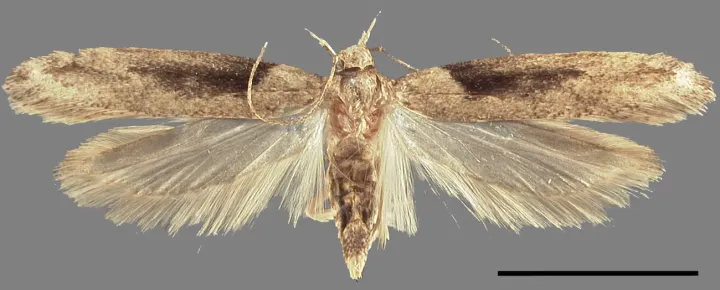
Description
How to identify
The potato tuber moth (Phthorimaea melanoplintha) belongs to the order Lepidoptera and the family Gelechiidae. Adult moths are small, with narrow wings characterized by a distinct fringe along the posterior edge.
The coloration of the adults is typically grey-brown, which provides excellent camouflage against soil particles or dry plant debris.
The wingspan of the moth is usually between 12 and 15 millimeters, making them quite difficult to spot in the field without using specialized traps.
The eggs are microscopic and oval in shape, usually laid singly or in small clusters on the underside of potato leaves or directly on tuber skin.
The larvae progress through several instars. They are typically yellowish-white or pale green with a dark head and a well-developed prothoracic plate.
What it damages
This pest primarily attacks plants within the Solanaceae family, with potatoes being the most susceptible and economically important host.
In the field, the larvae consume the parenchyma of the leaves, which hinders photosynthesis and weakens the overall health of the potato plants.
The most severe damage occurs when larvae penetrate the tubers through eyes or cracks in the skin, creating intricate galleries filled with excrement.
Stored potatoes are highly vulnerable, as the moth can continue its life cycle in storage facilities, potentially leading to total destruction of the harvest.
The galleries created by the larvae provide easy entry points for secondary pathogens, leading to rapid decay and the spread of bacterial or fungal rots.
When it appears
Adult moth activity typically commences when the weather warms up, coinciding with the emergence of potato seedlings in the spring.
Population density often peaks during the second half of the summer, as high temperatures accelerate the reproductive cycles of the moth.
The pupation of the first generation often occurs in the soil or within sheltered areas of plant residue, which determines the timing for future infestations.
In temperature-controlled storage facilities, the life cycle of the moth can continue year-round, posing a constant threat to stored potatoes.
The emergence of adults from overwintering sites is synchronized with soil temperature thresholds, allowing them to exploit the crop at the optimal time.
Signs of infestation
The first sign of infestation in a potato field is the presence of "mines" on the leaves, appearing as translucent or silver patches where the tissue has been eaten.
Tubers exhibit small entry holes, often covered with silk webbing and deposits of dark frass (larval excrement), indicating that the insect is inside.
If an affected tuber is sliced open, clear internal tunnels and the presence of the white or green-tinted larvae can be easily observed.
Premature wilting of individual stems, even when soil moisture is adequate, may indicate that larvae are feeding on the stolons or subterranean stems.
Finding adult moths or silk webbing on the sacks or walls of an storage facility is a definitive indicator of a current infestation needing immediate intervention.
Control measures
The first line of defense is the use of high-quality, pest-free seed potatoes to ensure that the infestation is not introduced from the start.
Deep plowing after the harvest helps to bury pupae, reducing their survival rate and disrupting the lifecycle for the following season.
Proper hilling or earthing-up of the potato rows is essential to provide a thick layer of soil that prevents larvae from reaching the developing tubers.
- Deploying pheromone traps to monitor adult population levels and mass-trap males.
- Applying biological insecticides containing Bacillus thuringiensis for environmentally friendly control.
- Strategic chemical sprays during the peak flight of adults to prevent egg-laying.
Strict sanitation in warehouses, including cleaning up all crop debris and disinfecting storage bins, is crucial to protecting the potatoes during winter storage.
Discussion
No discussions yet — be the first.