
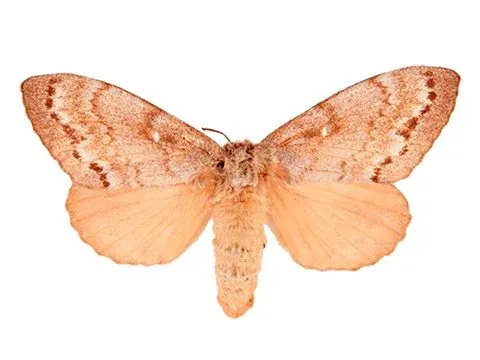
Siberian silk moth
Dendrolimus segregatus
The Siberian silk moth (Dendrolimus segregatus) belongs to the family Lasiocampidae. Adult moths have a wingspan ranging from 60 to 90 mm, with coloration varying from light brown to nearly black, often featuring a distinct white spot on the forewings.
What the section contains
Siberian silk moth
The larvae, or caterpillars, go through several stages, reaching up to 100 mm in length. They are characterized by a dense covering of hairs that can cause skin irritation in humans and possess dark transverse stripes across their segments.
The biological life cycle of this species typically spans two to three years depending on climate conditions. This extended cycle allows the population to build up slowly before reaching epidemic levels, which is a key characteristic of the species.
Pupation occurs within thick, silken cocoons attached to tree branches or bark. These cocoons are highly resistant to environmental stressors and protect the pupae during the transformation stage.
Overwintering occurs primarily in the larval stage. Caterpillars descend to the forest floor and bury themselves in the leaf litter, which provides significant thermal insulation against harsh winter frosts.
This pest primarily attacks coniferous trees, including larch, cedar, fir, and spruce. Mass outbreaks can result in complete defoliation of large forest stands, causing devastating ecological and economic impacts.
Late-instar larvae are particularly voracious, consuming vast amounts of needles in a short period. This rapid loss of photosynthetic tissue stresses the trees severely and prevents them from producing sufficient energy for defense.
Chronic defoliation over consecutive seasons often leads to widespread tree mortality. Even if trees survive the initial attack, their growth is severely stunted, and they lose their vitality for many years.
Trees weakened by the Siberian silk moth become highly susceptible to secondary invaders, such as bark beetles and wood-boring beetles, which often land the final blow to the tree's health.
The resulting accumulation of dry, dead timber significantly alters the forest ecosystem and drastically increases the risk of catastrophic forest fires, complicating post-outbreak restoration efforts.
A primary indicator of infestation is the presence of frass (caterpillar excrement) on the forest floor. During heavy feeding, the falling frass creates a continuous sound, similar to light rain, audible under the tree canopy.
Visual inspection of the canopy reveals uneven thinning of needles. As the population grows, the crown foliage becomes sparse, and eventually, branches are stripped bare, leaving only the woody structure visible.
During the flight season, which usually occurs in mid-summer, a large number of moths can be observed at night, as they are strongly attracted to artificial light sources near forest edges.
The presence of empty cocoons on the bark or branches serves as a clear historical marker of previous generations. These cocoons remain visible long after the moths have emerged.
As the infestation progresses, trees take on a reddish-brown hue due to the remaining damaged or dried needle stumps before they drop completely, leaving the forest looking barren and gray.
Aerial spraying with biological agents, specifically those targeting lepidopteran larvae, is the most common method to manage large-scale outbreaks. This method is prioritized to minimize impacts on non-target species.
Integrated Pest Management (IPM) relies heavily on pheromone monitoring systems. By tracking the number of moths caught in traps, forestry managers can predict the scale of the next generation and intervene accordingly.
Conservation of natural enemies is a vital component of control. Parasitoid wasps and predatory insects that feed on eggs and larvae can naturally suppress minor outbreaks if habitat conditions are favorable.
Silvicultural practices, such as maintaining a diverse mix of tree species, help improve forest resilience. Reducing the density of highly susceptible tree hosts can hinder the rapid spread of the moth.
In extreme cases, sanitation logging of infested trees may be conducted. While labor-intensive, this approach aims to reduce the population density in small, localized pockets before they expand into full-scale epidemics.