
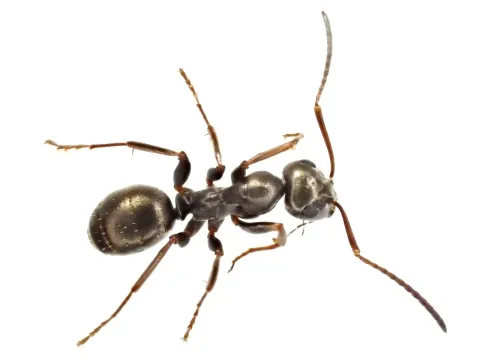
Silky ant
Formica fusca
The silky ant (Formica fusca) belongs to the order Hymenoptera, family Formicidae. It is a medium-sized insect, with worker ants typically measuring between 4 to 7 mm in length.
What the section contains
Silky ant
Visually, this species is characterized by a uniform dark coloration, ranging from dark brown to black. The body has a distinctive matte sheen, and the cuticle surface is almost hairless.
The colony founders (queens) are slightly larger than the workers, with lengths reaching 9–10 mm. This species is monogynous, meaning there is only one egg-laying queen in each nest.
These insects prefer to build nests in the soil, under rocks, in decaying wood, or in leaf litter. They are extremely cautious and quickly abandon the nest when threatened, showing little aggression.
The biology of the species is well-studied: the development cycle includes egg, larva, pupa, and adult stages. Ants overwinter deep in soil chambers, below the freezing level of the ground.
While the silky ant is not a primary agricultural pest, it causes significant indirect damage. Its main harmful impact lies in a close symbiosis with sap-sucking pests.
Ants actively tend colonies of aphids, mealybugs, and scale insects on fruit-bearing shrubs and trees. They provide protection against natural enemies such as ladybirds and lacewings.
During their activity, ants transport these pests to healthy young shoots, which facilitates the rapid spread of aphids across the entire garden or greenhouse.
The damage manifests as stunted plant growth, leaf deformation, the development of sooty mold on the honeydew (excrement) produced by aphids, and subsequent yield reduction.
Furthermore, their digging activity in the root zone can damage fine absorbing rootlets, weakening the plant and making it more susceptible to various diseases.
Ant activity begins in early spring as soon as the soil warms up to 8–10 degrees Celsius. Worker ants are the first to emerge to scout for food resources.
The peak of activity and mass reproduction of winged individuals (males and females) for mating usually occurs in mid-summer, typically June or July, depending on the region.
In late summer and early autumn, insects concentrate their efforts on gathering resources for winter. During this period, their activity in moving aphids to new plant areas becomes particularly noticeable.
With the onset of steady cold (below +5°C), the entire colony enters a state of diapause. Ants move to the deepest chambers of the nest and stop surfacing.
The duration of the active season depends heavily on the climatic zone, although in temperate regions, ants remain active from April through October inclusive.
A primary sign of colony presence is the existence of persistent ant trails leading from the nest to fruit trees or flower beds where aphids are found.
The presence of large numbers of ants moving along tree trunks is a direct signal that an aphid or scale insect "farm" is necessarily present on the branches.
In nesting areas on the ground, one can notice specific holes with characteristic piles of excavated soil or small plant debris serving as entrances to underground galleries.
- Sticky spots on leaves and fruits (honeydew).
- Curled, yellowed, or deformed shoot tips.
- The appearance of a black coating (sooty mold) on leaves near aphid colonies.
- Large clusters of ants on tree trunks protecting pests.
Infested areas often show lower productivity, as plants divert vital energy to recover from attacks by sap-sucking insects supported by ants.
Effective protection of the area from Formica fusca requires a comprehensive approach targeting both the ants themselves and their "protégés" — the aphids.
Mechanical control includes installing sticky bands on tree trunks, which physically prevent ants from moving up into the plant canopy to reach aphid colonies.
For controlling aphids, it is recommended to use contact and systemic insecticides, as well as eco-friendly solutions based on soap or horticultural oils.
The use of poisoned baits containing slow-acting insecticides allows foraging ants to carry the toxin deep into the nest and eliminate the queen, which guarantees colony liquidation.
An important preventive measure is maintaining a high level of agronomic practices: timely weeding, soil cultivation, and removal of plant debris that serves as cover for new ant nests.