
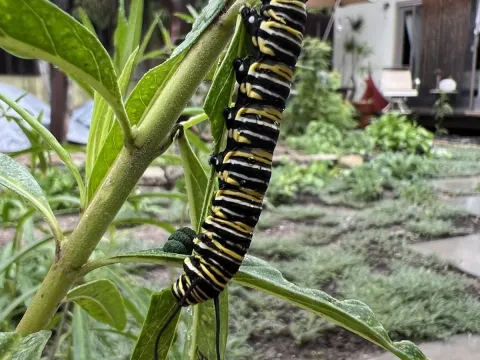
Monarch butterfly
Danaus archippus
The Monarch butterfly (Danaus archippus) belongs to the order Lepidoptera and the family Nymphalidae. It is a large, iconic butterfly with a wingspan of up to 10 cm, recognized by its vibrant orange and black pattern.
What the section contains
Monarch butterfly
The caterpillars are easily identifiable by their distinct yellow, black, and white bands, which serve as a warning to predators about their chemical defenses.
These insects rely almost exclusively on plants within the milkweed family (Asclepias) during their larval stage, which defines their ecological distribution.
The life cycle encompasses a complete metamorphosis, moving through the stages of egg, larva, pupa, and adult, with each stage highly dependent on environmental factors.
Monarchs are globally renowned for their long-distance migration patterns, which allow them to exploit diverse habitats across the North American continent.
In large-scale industrial agriculture, the Monarch is generally not classified as a significant pest, as its host range is strictly limited to non-crop plants.
However, in specialized nurseries or horticultural settings where milkweed is cultivated for ornamental or medicinal purposes, larvae can cause substantial damage.
Heavy larval feeding results in rapid defoliation, which severely reduces the plant's capacity for photosynthesis and its overall physiological health.
The aesthetic value of ornamental plantings is drastically compromised, leading to economic losses for producers of specific botanical garden crops.
By consuming leaf tissue, the larvae expose the plant to secondary pathogens, increasing the likelihood of bacterial or fungal infections.
The seasonal presence of Monarchs is dictated by their complex migration cycle and local weather conditions that influence plant phenology.
In spring, adults emerge and move northward, initiating the breeding season as soon as temperatures allow for the growth of milkweed hosts.
Multiple generations occur throughout the summer months, leading to a cumulative increase in larval population density within suitable habitats.
As autumn approaches, the final generation shifts physiological focus from reproduction to energy storage in preparation for the migration to overwintering sites.
Monitoring for the presence of eggs and early-instar larvae during the peak of the growing season is critical for effective management.
The primary indicator of a Monarch infestation is the presence of dark, granular frass deposited on the leaves below the area of active larval feeding.
Leaves exhibit irregular margins or complete consumption of the blade, often leaving only the tough, primary veins remaining on the stem.
The presence of jade-green chrysalises, adorned with characteristic gold spots, is a definitive sign that the population is established in the vicinity.
Adult butterflies gathering in high concentrations on nectar-rich plants signal the potential for future egg-laying activity in nearby host plants.
Early morning scouting is the most effective way to detect the larvae, as they are most active during the cooler hours of the day.
Management strategies focus on minimal intervention to maintain environmental integrity while protecting high-value horticultural crops.
Manual removal of caterpillars is highly recommended for small-scale plantings, as it prevents damage without the use of toxic chemicals.
Biological control agents, such as microbial sprays containing Bacillus thuringiensis, provide a targeted and environmentally safe solution for larval management.
Strategic management of milkweed populations near production areas can help divert the pest pressure away from sensitive horticultural plants.
- Manual removal of larvae.
- Application of biological insecticides.
- Regular crop monitoring.
- Weed management near crops.
- Use of physical barriers.