
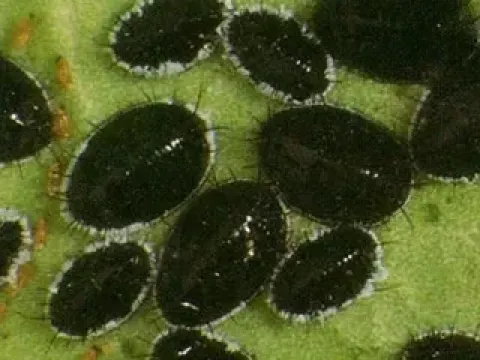
Punjab whitefly
Aleurocanthus punjabensis
The Punjab whitefly, taxonomically known as Aleurocanthus punjabensis, belongs to the Aleyrodidae family within the order Hemiptera. It is recognized as a significant pest in subtropical regions.
What the section contains
Punjab whitefly
Adult insects are characterized by their small size and dark-colored wings often dusted with a waxy powder, setting them apart from more common greenhouse whitefly species.
The developmental stages include mobile crawlers and sessile puparia. These puparia are typically found on the undersides of leaves and exhibit a flat, oval appearance that can be mistaken for scale insects.
Correct identification often requires expert analysis of the puparia's microscopic features, as the genus Aleurocanthus contains several closely related species with similar host ranges.
Thriving in warm and humid climates, this whitefly utilizes these conditions to accelerate its life cycle, leading to multiple overlapping generations throughout the growing season.
This pest is primarily specialized in attacking citrus plants, with various species of the Citrus genus serving as its preferred hosts in commercial orchards.
Damage is inflicted by the nymphal stages, which extract phloem sap from the leaves. This feeding process directly reduces the plant's nutritional reserves and vigor.
Severe infestations result in heavy leaf drop and fruit abscission, which leads to significant losses in fruit production and negative economic outcomes for growers.
As the plant loses vitality, it becomes increasingly susceptible to environmental stressors and secondary pathogenic infections that exploit the weakened plant tissue.
Indirect damage includes the development of sooty mold, which grows on the honeydew excreted by the whiteflies, further hindering the photosynthetic efficiency of the tree.
The presence of dense, dark-colored colonies of nymphs on the undersides of citrus leaves is the most direct diagnostic sign of an active infestation.
Sticky honeydew secretions appearing on the leaves and stems are a hallmark of whitefly activity, providing a substrate for the growth of secondary fungi.
A black, velvety layer of sooty mold on the foliage is a late-stage visual indicator, often signalling that the pest population has reached a high, damaging level.
When shaking infested branches, a cloud of adults typically rises into the air, making them easily detectable during regular scouting of the orchard.
Observable yellowing and curling of young, tender leaves are common responses of the plant to the intense feeding pressure exerted by the whitefly colonies.
Strict quarantine measures are essential to prevent the introduction of this pest into non-infested citrus production zones via imported nursery stock.
Cultural control strategies include proper pruning to maintain open canopies, which increases airflow and creates a less favorable microclimate for whitefly development.
Biological control plays a key role, utilizing predatory beetles and parasitic wasps (e.g., Encarsia spp.) that naturally regulate whitefly population density in managed orchards.
Chemical control programs should focus on systematic insecticides applied during the vulnerable crawler stage to ensure efficacy against the protected larval forms.
- Deploying yellow sticky traps for population monitoring and timing of treatments.
- Application of horticultural oils to physically coat and smother the nymphs.
- Integrated Pest Management (IPM) rotation of systemic insecticides to prevent resistance.