
Snail-killing fly
Tetanocera elata
Description
How to identify
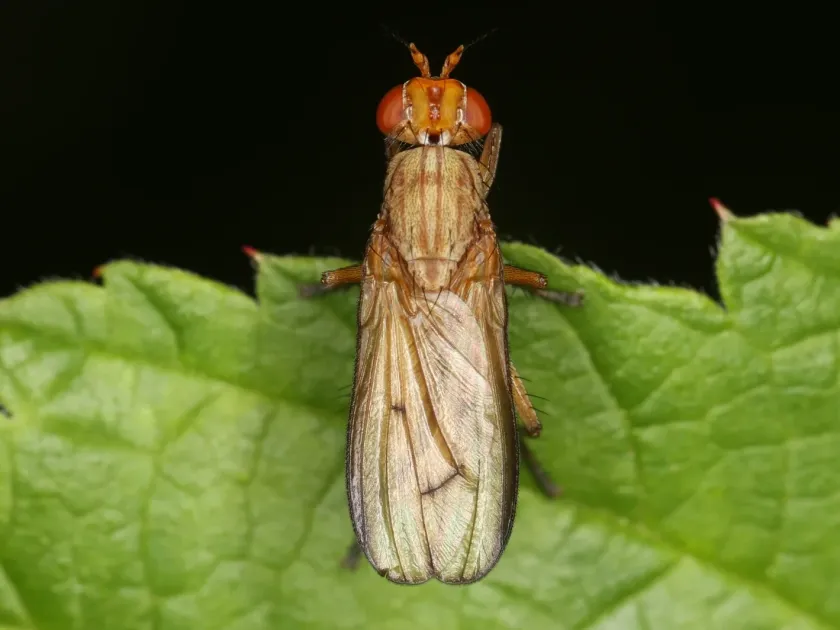
The snail-killing fly (Tetanocera elata) belongs to the family Sciomyzidae, within the order Diptera. These flies are easily recognized by their slender, yellowish-brown bodies, typically measuring between 8 and 10 mm in length.
Their wings often display characteristic dark patterns or mottling, which provides camouflage while resting on vegetation near water sources or moist habitats.
The head features prominent bristles and often exhibits a distinct greenish tint to the eyes, which is a morphological trait contributing to their common name in various languages.
The larvae are typically creamy-white, legless, and adapted for aquatic or semi-aquatic environments where they actively hunt their prey, specifically snails and slugs.
Their life cycle consists of complete metamorphosis, including egg, three larval instars, pupa, and adult. They spend the winter in the puparial stage, protected within the soil or debris.
What it damages
Tetanocera elata does not cause any damage to agricultural crops, garden plants, or ornamental greenery. It is classified strictly as a beneficial insect.
The species acts as a specialized predator targeting gastropod mollusks. The larvae prey upon slugs and snails, which are notorious pests that devour tender foliage and seedlings.
By consuming these mollusks, the snail-killing fly provides a valuable ecosystem service, naturally limiting the populations of garden pests without the need for synthetic chemicals.
Their predatory behavior makes them an essential component of integrated pest management (IPM) strategies, especially in humid regions where slug populations can thrive.
As they do not feed on plant tissues, their presence in a garden or farm should be encouraged rather than managed through elimination.
When it appears
The adults are most active from late spring through the early autumn months, preferring humid environments such as meadows, pond edges, and dense garden foliage.
Mating and egg-laying occur in areas where snail and slug activity is high, ensuring that larvae have immediate access to food sources upon hatching.
Depending on ambient temperatures and food availability, multiple generations can occur during a single growing season, allowing the population to track prey numbers effectively.
The peak of larval predatory activity often coincides with periods of heavy rainfall or high humidity when slugs and snails are most mobile and problematic for gardeners.
With the arrival of winter, the species undergoes diapause as a puparium, safely waiting for the following spring to emerge and continue the cycle.
Signs of infestation
Identifying the presence of Tetanocera elata involves observing the flies resting on low vegetation in damp areas during the early morning or evening hours.
A positive sign of their activity is a reduction in slug-related damage on leafy vegetables, such as hostas, lettuce, and kale, indicating that natural predators are at work.
Finding empty snail shells, especially those showing signs of larval feeding, suggests that snail-killing flies are successfully inhabiting your local ecosystem.
There are no specific signs of damage to crops caused by this fly, making it easy to distinguish from harmful pests that typically leave holes, wilting, or excrement on plants.
Monitoring for these flies helps farmers gain a better understanding of the natural pest control dynamics operating within their fields.
Control measures
No control measures are necessary for Tetanocera elata, as it is a beneficial insect that contributes to the ecological health of the garden or farm.
To support and increase their population, it is highly recommended to avoid the use of broad-spectrum insecticides that may kill beneficial insects alongside pests.
Maintaining moist areas and a diverse landscape provides the necessary habitat for these flies to thrive and continue suppressing snail and slug populations.
If chemical control for slugs is required, utilize baits that are specifically formulated to be safe for non-target predatory insects and other wildlife.
Promoting a balanced habitat where natural predators like the snail-killing fly can flourish is a cornerstone of sustainable and ecological agriculture.
Taxonomy
- Latin name
- Tetanocera elata
- Order
- Diptera (flies)
- Family
- Sciomyzidae
- EPPO code
- TTNCEL
Discussion
No discussions yet — be the first.