
Oriental white-eye
Zosterops palpebrosus
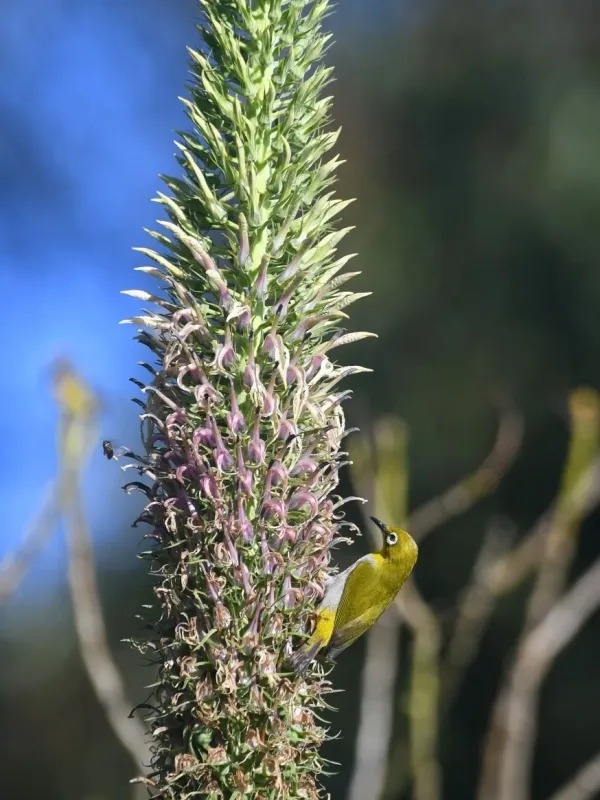
Description
How to identify
The Oriental white-eye (lat. Zosterops palpebrosus) is a small passerine bird belonging to the white-eye family (Zosteropidae). It is easily identified by the distinctive white ring around its eyes, which gives the species its common name.
The plumage is typically olive-green on the back and wings, with a vibrant yellow throat and underparts. Measuring only about 8 to 10 cm in length, these birds are highly agile and often remain concealed within the dense canopy of trees.
They are highly social birds, frequently seen in active flocks while foraging. While they primarily consume insects, their sharp, slender beaks are well-adapted for piercing the skin of fruits and berries, making them a nuisance in agricultural settings.
As a member of the Passeriformes order, this species is widespread across tropical and subtropical Asia. Their ability to thrive in modified landscapes allows them to easily colonize orchards and vineyards in search of food.
Their high activity level and rapid movement between branches make them a noticeable presence in gardens, especially during the fruiting season when they shift their diet from invertebrates to sugar-rich plant matter.
What it damages
The Oriental white-eye is known to cause significant damage to grapes, peaches, figs, guava, and various other soft-skinned fruits. They represent a substantial economic threat to small-scale and commercial orchard owners alike.
Damage occurs when the birds pierce the skin of ripe fruits to consume the sweet pulp inside. By breaking the protective outer layer, they expose the fruit to rapid decay, fungal growth, and bacterial infections.
Once a fruit is punctured, it quickly becomes unmarketable. The birds often move systematically through a cluster of grapes or a tree of peaches, leaving behind dozens of ruined fruits in a very short period.
The intensity of the damage is often exacerbated by the flock behavior of the species. When a group of white-eyes descends upon a tree, they can strip a significant portion of the harvest within a few hours, leaving producers with heavy losses.
This pest is particularly damaging to crops grown near their natural nesting grounds or wooded areas, where the birds have established resident populations.
When it appears
The pest activity of the Oriental white-eye is highly seasonal and coincides with the maturation of fruit crops. During the ripening phase, when fruit sugar levels are at their highest, the birds become most problematic.
Throughout the spring and early summer, white-eyes are generally beneficial to the orchard as they primarily hunt for insects, caterpillars, and aphids. During this time, they contribute to natural pest control within the garden ecosystem.
As summer progresses into the harvest season, the birds transition their foraging behavior toward fruits. This shift is driven by the need for high-energy food sources required for juvenile development and energy replenishment.
In regions with multiple harvest cycles, the pressure from these birds can persist over several months, depending on the specific varieties of fruits being cultivated on the farm.
The danger usually subsides once the harvest is complete, as the birds revert to their natural food sources or migrate to other feeding areas once the primary supply of accessible fruit is depleted.
Signs of infestation
Identifying an Oriental white-eye infestation requires careful observation of both the birds and the physical damage they leave behind on the fruit trees.
- Small, clean punctures on the surface of ripe fruits are a classic sign of white-eye feeding.
- Accumulation of partially eaten, decaying fruit on the ground beneath the trees.
- High-pitched, rapid vocalizations and chirping in the tree canopy, indicating the presence of a foraging flock.
- Clusters of withered or rotting fruits that show clear evidence of bird beak marks.
- Visual sightings of small, olive-green birds with yellow throats darting quickly between fruit-bearing branches.
Control measures
Effective management of the Oriental white-eye requires a multi-faceted approach, as the birds are quite intelligent and can adapt to simple deterrents over time. Physical exclusion remains the most effective strategy.
Netting with fine mesh is the gold standard for protecting grapes and fruit trees. By physically preventing the birds from reaching the fruit, farmers can ensure a high-quality yield without the need for toxic chemicals.
Visual deterrents, such as reflective streamers, CDs, or realistic predator decoys, provide temporary relief. For these to be effective, their placement must be changed frequently to prevent the birds from becoming accustomed to them.
Sound-based deterrents, including ultrasonic devices or the playback of distress calls, can disrupt flock activity. However, these methods are often less reliable than physical barriers and should be used as part of a rotation.
Good orchard sanitation is also vital. Promptly harvesting ripe fruits and cleaning up dropped produce minimizes the available food source, making the orchard less attractive to opportunistic bird species.
Taxonomy
- Latin name
- Zosterops palpebrosus
- Family
- Zosteropidae
- EPPO code
- ZOSTPA
Discussion
No discussions yet — be the first.