
Japanese white-eye
Zosterops japonica
Description
How to identify
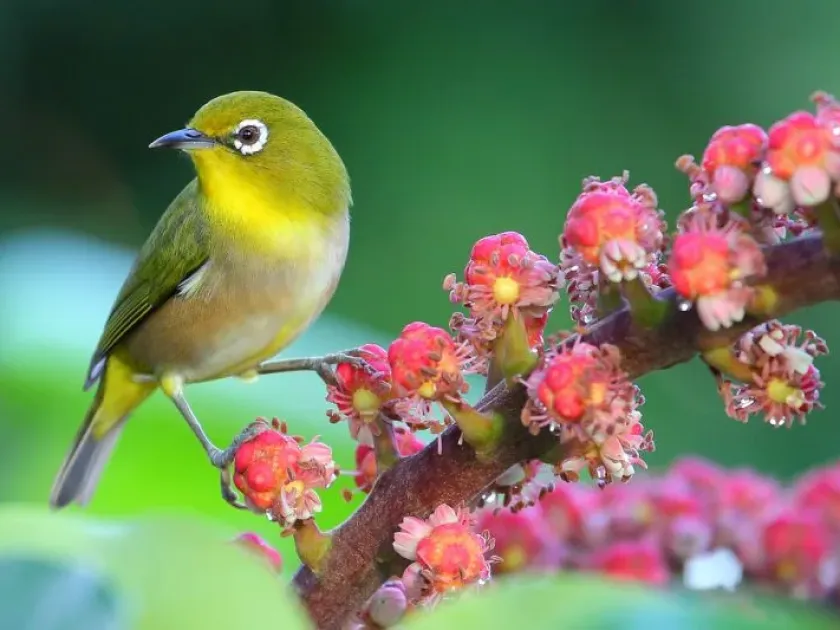
The Japanese white-eye (Zosterops japonica) is a small passerine bird belonging to the Zosteropidae family. It is easily identified by a distinctive white ring of feathers around its eyes, which gives the species its common name.
Adults reach approximately 10–12 cm in length. Their plumage consists of olive-green upperparts with yellow throat and under-tail coverts, providing excellent camouflage within the foliage of trees.
Equipped with a slender, sharp bill, these birds are naturally evolved to feed on small insects and nectar. However, they are opportunistic feeders and highly adaptable to agricultural environments.
While often viewed as a charismatic species, their foraging habits in orchards cause them to be classified as agricultural pests in many regions where they have become abundant.
They are highly social birds, often foraging in noisy, energetic flocks. This group behavior allows them to rapidly exploit food sources, making them a challenge for orchard managers.
What it damages
The Japanese white-eye causes significant economic losses by damaging various fruit and berry crops during their ripening stage, including grapes, persimmons, figs, and stone fruits.
The birds peck small, deep, and precise holes into the skin and pulp of the fruit. This damage ruins the aesthetic quality of the harvest, rendering the fruit unsellable.
Beyond physical damage, the punctures created by the birds serve as entry points for mold, fungi, and bacterial pathogens. This often leads to rapid decay that spreads throughout the fruit cluster.
In unprotected orchards, particularly those near woodland edges or parks, these birds can devastate a significant percentage of the yield within a few days of intensive feeding.
The damage is particularly problematic for high-value export crops, where even slight surface blemishes can lead to the rejection of the entire batch of produce.
When it appears
The period of greatest concern coincides with the ripening and harvesting stages of fruit crops. Activity levels spike in late summer and autumn when fruits reach their peak sugar content.
The annual life cycle involves nesting during the spring and summer months. Once the breeding season concludes, the birds congregate into larger flocks, which then travel in search of food.
Daily activity is most intense during the early morning and late afternoon hours. During the midday heat, they may remain hidden within the tree canopy, making monitoring difficult.
Migratory movements within their range are driven by the availability of food sources. As forests lose their natural fruits, the birds shift their attention to commercial orchards.
Agricultural monitoring programs should be intensified as soon as fruit begins to soften and accumulate sugars, as this is the precise moment when the threat level increases.
Signs of infestation
The most reliable sign of a white-eye presence is the appearance of small, precise, deep holes in the fruit skin. These marks are often clustered and distinct from insect damage.
- Increased presence of fallen fruit on the ground beneath the trees.
- Sudden emergence of rot or fermentation in ripening fruit clusters.
- High-pitched, rapid chirping sounds heard within the orchard canopy.
- Observing small flocks characterized by white eye-rings moving between fruit trees.
Damaged fruit often attracts secondary pests, such as wasps, bees, and fruit flies, which further exacerbate the loss by feeding on the exposed sugary pulp.
Agronomists are advised to inspect the periphery of the orchard, specifically rows adjacent to hedgerows or wild bushes, as these are common entry points for the flocks.
Early detection of these symptoms allows for the deployment of deterrent measures before the flock establishes a feeding pattern and recruits more individuals.
Control measures
Physical exclusion remains the most effective control method. Anti-bird netting, installed to cover individual trees or entire vineyard rows, provides a nearly 100% barrier against access.
Visual deterrents, including holographic reflective tape, flash ribbons, and predator decoys, can be used. However, they should be rotated frequently to prevent the birds from habituating to them.
Acoustic deterrent systems that broadcast distress calls or raptor sounds can be effective, provided they feature variable intervals to maintain the surprise effect on the flock.
Good agricultural practices, such as prompt harvesting, help minimize the duration during which the fruit is exposed to potential damage.
Orchard hygiene is also critical; removing damaged or fallen fruit from the ground helps reduce the attractiveness of the orchard as a food source for the birds.
Taxonomy
- Latin name
- Zosterops japonica
- Family
- Zosteropidae
- EPPO code
- ZOSTJA
Discussion
No discussions yet — be the first.