
Silvereye
Zosterops lateralis
Description
How to identify
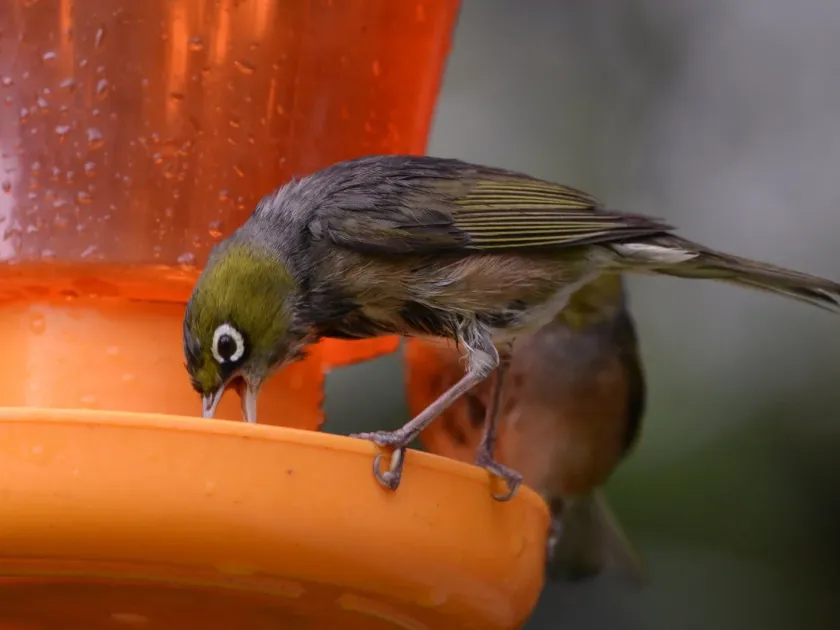
The Silvereye (Zosterops lateralis) is a small passerine bird belonging to the Zosteropidae family. It is easily identified by the distinctive ring of white feathers surrounding its eyes.
These birds measure approximately 10–12 cm in length, featuring an olive-green back and greyish flanks. Their sharp, slender beaks are adapted for gleaning insects as well as piercing fruit skins.
While playing a beneficial role as insectivores in wild habitats, they become a significant agricultural pest in orchards and vineyards where they forage in flocks.
Silvereyes are highly social and agile, allowing them to navigate dense foliage and descend on crops in large groups to feed on ripening fruits.
Their high mobility and intelligence make them difficult to manage, as they can quickly relocate to unaffected parts of the plantation once disturbed.
What it damages
The Silvereye is a primary pest for grapevines and various orchard crops, causing substantial losses during the ripening stages of fruit production.
The birds use their beaks to puncture the skin of grapes and orchard fruits, consuming the soft pulp and leaving the fruit highly susceptible to fungal infections and secondary pests.
Besides grapes, they are known to attack stone and pome fruits such as peaches, nectarines, apples, and cherries, often destroying entire fruit bunches.
Damaged fruits are effectively ruined for commercial sale, as they suffer from rapid decay, aesthetic loss, and the risk of pathogen transmission via bird saliva and beak damage.
In high-density fruit production areas, a single flock of Silvereyes can devastate a significant percentage of the yield in a matter of a few days.
When it appears
The damage caused by Silvereyes is most intensive from late spring through autumn, coinciding with the maturation of various fruit and berry varieties.
During the earlier parts of the season, their diet is primarily insect-based, but it shifts heavily toward sugary fruits as soon as they reach maturity.
In hot and dry conditions, their foraging activity increases as they seek out fruits not only for nutrition but also as a crucial source of hydration.
The influx of juvenile birds mid-summer significantly increases flock sizes, leading to a peak in crop damage during the final stages of the harvest season.
The duration of the pest pressure can vary depending on local climate conditions and the staggered ripening schedules of different fruit cultivars.
Signs of infestation
The most evident sign of Silvereye activity is the presence of numerous small punctures or partially hollowed-out sections on fruits and grapes.
One may observe skeletal fruit remains or hanging skins, which are indicative of the bird's efficient and destructive feeding habits.
High-pitched twittering and the sight of small birds flitting rapidly among the canopy of trees or rows of vines are clear indicators of their presence.
Fallen fruit under the trees or vines often shows signs of being pecked, attracting flies and encouraging localized rot and fermentation.
The sudden development of grey mold or yeast infections on grape clusters that were previously healthy is a classic secondary symptom of bird-induced damage.
Control measures
The most effective strategy for managing Silvereyes in commercial agriculture is the installation of bird-proof exclusion netting, which provides a physical barrier against access.
While visual and acoustic deterrents such as reflective tapes or sound cannons exist, their efficacy is often limited as birds tend to habituate to them over time.
- Installation of specialized anti-bird netting for vineyards and orchards.
- Strategic monitoring of bird flock density during the veraison and ripening phases.
- Accelerated harvest schedules to minimize the exposure time of vulnerable fruits.
- Implementation of integrated pest management (IPM) to combine barriers with scare tactics.
In professional settings, physical exclusion remains the gold standard, as it provides consistent and measurable protection for the ripening crop.
Taxonomy
- Latin name
- Zosterops lateralis
- Family
- Zosteropidae
- EPPO code
- ZOSTLA
Discussion
No discussions yet — be the first.