
Pygmy mole cricket
Xya variegata
Description
How to identify
The pygmy mole cricket (Xya variegata) belongs to the order Orthoptera and the family Tridactylidae. It is a tiny insect that resembles a miniature mole cricket, though it is significantly smaller in scale.
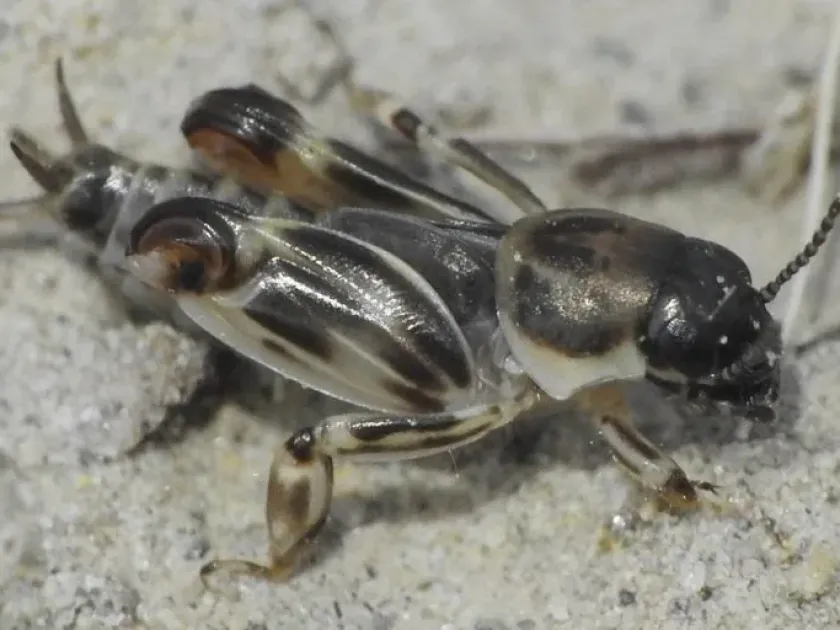
Adult individuals reach a length of only 4–6 mm. Their body is compact, with a color ranging from dark brown to almost black, featuring distinctive mottled patterns that provide excellent camouflage on moist soil.
A key characteristic of this species is the strongly developed hind legs designed for jumping. The forelegs are also adapted for digging, which draws parallels to the lifestyle of larger mole crickets.
Their sensory organs are well-developed, allowing them to quickly react to soil vibrations. Wing development can vary, and they often exhibit shortened wings.
Nymphs look very similar to adults but are distinguished by their smaller size and the lack of developed sexual organs. The entire life cycle occurs in close proximity to water sources.
What it damages
The main damage caused by the pygmy mole cricket is observed in nurseries, greenhouses, and areas with excessive soil moisture. These insects prefer the banks of water bodies and irrigated areas.
They damage young seedlings of various vegetable and flower crops. They pose a particular threat to rice crops, vegetable transplants, and small seeds that are just beginning to germinate.
Both adults and nymphs feed on the underground parts of plants, severing roots or damaging the hypocotyl at the soil-contact zone. This leads to wilting and the subsequent death of young plants.
Beyond direct mechanical injury, their active burrowing activities disrupt the soil structure around the root system, creating voids that lead to root dehydration.
In cases of mass outbreaks, these populations can destroy a significant portion of crops on small plots, making them a serious risk factor in intensive vegetable farming.
When it appears
Insect activity begins with the warming of the soil in the spring. Optimal conditions for reproduction are created at air temperatures above 20 degrees Celsius and high humidity.
Several generations can develop during a season, depending on the climatic conditions of the region. Population peaks often coincide with the periods of most intensive irrigation of agricultural crops.
The insects overwinter in the soil, burrowing to a shallow depth below the frost line or within the root zones of plants capable of retaining moisture during the winter.
Reproduction occurs in soil tunnels where females lay their eggs. Upon hatching, the nymphs immediately begin active feeding, remaining in areas with high moisture levels.
In the autumn, as temperatures drop, individual activity decreases and they enter diapause, preparing for overwintering in areas protected from freezing.
Signs of infestation
The primary sign of the pest's presence is the appearance of small, winding tunnels or holes on the surface of moist soil near plant seedlings.
Visually, affected plants wilt rapidly, turn yellow, and are easily pulled from the ground due to the severed root system, which is a critical symptom of damage.
Upon inspecting the root collar, one can find characteristic bite marks or traces of shallow tissue scraping, distinguishing them from damage caused by wireworms.
In areas of insect concentration, small mounds of displaced soil are often visible, which look like miniature traces of mole cricket activity.
The presence of adults can be detected by carefully inspecting the soil during the early morning hours or in cloudy weather, when insects may move across the surface.
Control measures
The main measure of control is adherence to agrotechnical standards aimed at regulating soil moisture and eliminating stagnant water zones in the field.
Deep autumn plowing is an effective practice that destroys the wintering sites of the pests and contributes to their mortality due to low winter temperatures.
Regular cultivation of inter-row spaces not only improves soil aeration but also destroys insect tunnels, preventing their free movement toward the roots of cultivated plants.
In greenhouse conditions, it is advisable to use nets or physical barriers to prevent the entry of pests from the outside environment through ventilation openings.
In cases of high infestation, the use of soil-applied granular insecticides or systemic treatments via irrigation is possible, though chemical methods must be strictly dosed.
Taxonomy
- Latin name
- Xya variegata
- Order
- Orthoptera (locusts)
- Family
- Tridactylidae
- EPPO code
- XYAXVA
Discussion
No discussions yet — be the first.