
Pygmy mole cricket
Neotridactylus apicialis
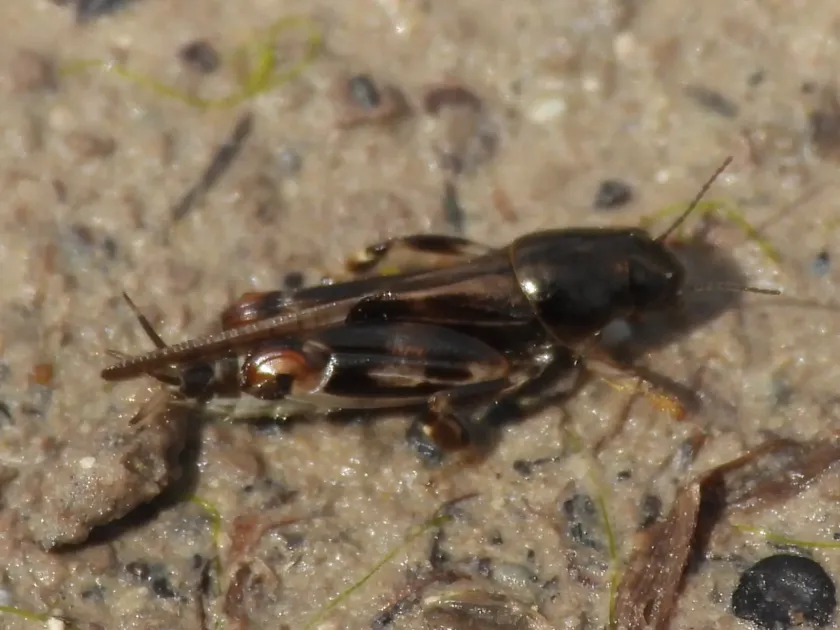
Description
How to identify
The pygmy mole cricket (Neotridactylus apicialis) belongs to the order Orthoptera and the family Tridactylidae. These are tiny insects, often resembling miniature crickets, typically measuring between 5 and 10 millimeters in length.
The defining feature of this species is its powerful hind legs, which enable it to jump significant distances when disturbed. Their body coloration ranges from brown to black, often featuring mottled patterns that provide excellent camouflage on moist soil surfaces.
The body is covered in a smooth, chitinous exoskeleton, and the head is equipped with strong, chewing mouthparts. Unique anatomical features include specialized front tibiae adapted for digging through soft, moist soil substrates where these insects reside.
Unlike most Orthoptera, these insects are semi-aquatic. They prefer shoreline areas, irrigated fields, and low-lying damp sites where the soil remains loose, friable, and rich in organic matter.
The life cycle involves egg-laying in subterranean chambers. The nymphs resemble adults in appearance but are smaller and lack wings, progressing through several growth stages before reaching maturity.
What it damages
The primary damage occurs in the root zone of plants growing in waterlogged areas. They are frequently found in seedling vegetable crops, grain fields, and nurseries where high soil moisture is maintained consistently.
The insects feed on underground parts of stems, young roots, and emerging sprouts by carving galleries through the tissues. High population densities can lead to the complete destruction of stands in localized spots.
Root damage causes the plants to wilt, leaves to turn yellow, and growth to slow down significantly. Furthermore, compromised plant tissues become highly susceptible to soil-borne pathogens, including various types of root rot.
Pygmy mole crickets are most dangerous during the early stages of crop development. Even minor mechanical damage to the root collar can prove fatal for young plants that lack the resources for rapid tissue recovery.
In addition to direct feeding, their tunneling activity disrupts soil structure and capillary action. This negatively impacts the plant's ability to absorb water and nutrients, leading to overall physiological stress.
When it appears
Activity is highly dependent on temperature and soil moisture levels. In temperate regions, the pygmy mole cricket begins to show activity as soon as the soil temperature rises to approximately 12–15 degrees Celsius.
The peak population density usually occurs during the spring and summer months when weather conditions combine warmth with high soil moisture. During dry spells, the pest migrates deeper into the soil or toward water sources.
The life cycle is closely linked to precipitation patterns. Heavy rainfall encourages nymphs to emerge from soil refuges, often causing localized outbreaks in fields located in low-lying, damp depressions.
As temperatures drop in autumn, these insects enter diapause. Their metabolic rate slows, and they move to deeper soil layers, well below the frost line, to survive the winter months.
The best time to monitor for this pest is during the early morning or evening hours when the insects are most active on the soil surface, engaging in feeding or mating behaviors.
Signs of infestation
The primary sign of infestation is the appearance of small holes and tunnels on the surface of damp soil surrounding crops. In some cases, disturbed or "loose" patches of dirt appear, contrasting with the surrounding firm soil.
Wilting plants that show no signs of aerial infection or insect attack often suggest root collar damage. Excavating around such plants usually reveals characteristic eaten-out tissue, similar to mole cricket damage but smaller in scale.
Direct sightings of the insects on the soil surface are the most accurate way to confirm an infestation. Because they jump quickly when approached, they are easily spotted during a walk-through inspection of moist areas.
Uneven growth in nursery seedlings or greenhouse crops with automated irrigation is another indicator. Consistent moisture creates an ideal breeding ground for Neotridactylus apicialis.
- Localized yellowing and collapse of seedlings.
- Presence of small entry holes in moist soil.
- Sightings of tiny, jumping insects on the ground.
- Disrupted soil surface structure.
- Evidence of gnawed roots or stem bases upon inspection.
Control measures
The most important control measure is water management. Improving field drainage and avoiding chronic over-irrigation make the environment less hospitable for the survival and reproduction of this pest.
Deep autumn plowing with soil inversion helps destroy a large portion of the overwintering population. Disrupting the soil chambers where nymphs reside effectively reduces the overall pest pressure for the following season.
Cultural practices such as crop rotation play a significant role. By planting crops that are less attractive to the pygmy mole cricket, farmers can break the feeding and breeding cycles of the insect.
In cases of high infestation, soil insecticides may be used. Such applications should be carefully targeted to the affected areas and must comply with local safety regulations to minimize environmental impact.
Biological controls, including entomopathogenic nematodes or specialized fungal products, are increasingly used. These methods target the nymphs within the soil and offer an eco-friendly alternative for integrated pest management.
Taxonomy
- Latin name
- Neotridactylus apicialis
- Order
- Orthoptera (locusts)
- Family
- Tridactylidae
- EPPO code
- NTRIAP
Discussion
No discussions yet — be the first.