
Wiseana jocosa
Wiseana jocosa
Description
How to identify
Wiseana jocosa belongs to the order Lepidoptera and the family Hepialidae, commonly known as ghost moths. It is a significant subterranean pest known for its larvae that live within the soil profile.
Adult moths are nocturnal with a wingspan that varies across populations. Their wing patterns are typically camouflaged in shades of brown or grey, allowing them to blend seamlessly into bark or dry grasses during the day.
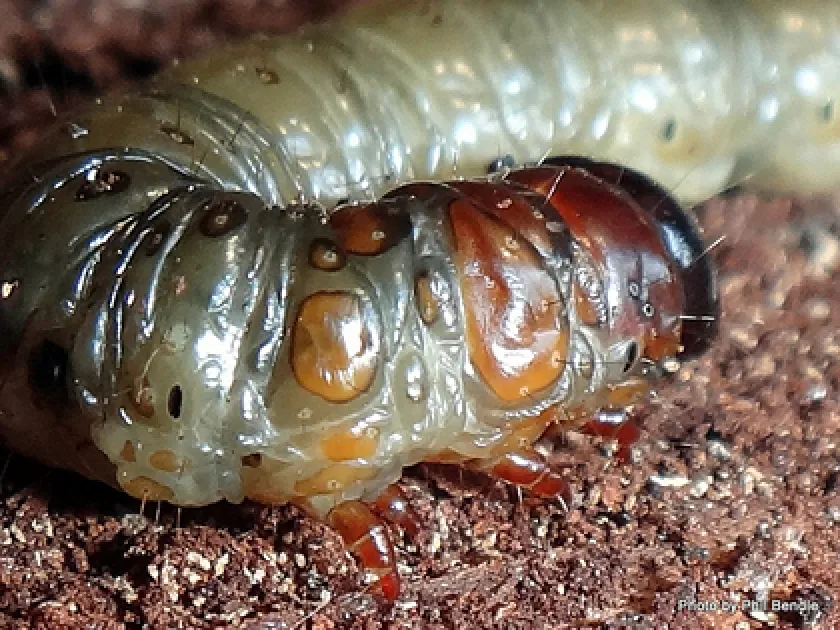
The larval stage is characterized by a cylindrical body with well-developed thoracic legs, which enable rapid movement through subterranean tunnels. The head capsule is highly sclerotized, aiding the larvae in burrowing through dense soil.
Pupae also develop underground within specialized vertical chambers. Before adult emergence, the pupa moves upwards through the tunnel to facilitate the successful exit of the moth onto the surface.
The species' biology is strictly linked to soil moisture, as larvae are highly sensitive to desiccation. In temperate climates, the life cycle is completed over one year, with development synchronized by seasonal temperature shifts.
What it damages
The primary damage is caused by larvae, which are major pests of pasture grasses and grain crops. They feed mainly on underground plant structures, severing roots and crowns, which leads to total plant death.
Under high population densities, these pests can destroy large areas of grazing land, leaving bare patches that drastically reduce productivity and often require expensive reseeding.
Beyond wild grasses, larvae may damage young grain seedlings, especially when crops are planted on newly broken land. The severity of damage increases during years with mild winters and adequate soil moisture.
Feeding occurs mostly at night; larvae emerge partially from their tunnels to pull vegetation towards the entrance. This behavior allows them to consume biomass while remaining shielded from daytime predators.
Indirect damage involves the disruption of the turf structure, which promotes soil erosion. In heavily infested areas, the soil becomes more susceptible to leaching and compaction due to the loss of root systems.
When it appears
The activity of Wiseana jocosa adults peaks during the summer, marking the time for mating and egg-laying. Females scatter eggs while flying over the vegetation.
Larval development begins in autumn and continues throughout the winter and spring. This is the period when larvae reach their maximum mass and cause the most significant damage to root systems.
In spring, as soil temperatures rise, larval feeding activity accelerates. They continue to feed intensively until pupation, which typically occurs in early summer before the next reproductive cycle begins.
Soil temperature is the critical factor determining adult emergence dates. Prolonged cold springs can delay development, stretching the flight period of the moths over several weeks.
Seasonal rainfall patterns also dictate the survival of early-instar larvae, which are particularly susceptible to dry conditions. High autumn moisture is conducive to larger larval outbreaks.
Signs of infestation
The first sign of an infestation is the emergence of yellowing or wilting patches in pasture fields. These patches gradually expand in size if no management actions are implemented.
Inspecting the soil reveals vertical tunnels or burrows, often accompanied by larval frass near the entrance. In dry conditions, these tunnel entrances may be covered by a fine silken web.
A classic diagnostic sign is the ease with which damaged plants can be pulled from the soil. The roots will appear severed, and the crown may show clear evidence of chewing.
At night, larvae can be detected on the surface during their feeding activity. They are highly alert and will quickly retreat into their burrows at the slightest vibration or exposure to artificial light.
The presence of empty pupal cases on the soil surface at the end of spring indicates that the adult emergence phase has completed and the population is prepared for the next generation.
Control measures
Deep tillage is an effective mechanical method to destroy larval tunnels and cause direct injury to the pest, making it a viable option for fields being converted to grain production.
High-density grazing can help compress the soil surface, hindering larval movement and access to plants. This is a standard management practice in sustainable pasture systems.
Biological control agents, including entomopathogenic fungi or bacteria like Bacillus thuringiensis, can significantly reduce population numbers with minimal environmental impact.
Chemical intervention is recommended only when economic injury thresholds are exceeded. Targeted insecticides applied during the active feeding phase before pupation are the most effective.
- Strict adherence to crop rotation cycles.
- Timely mowing of pasture and grasses.
- Monitoring adult population using light traps.
- Conservation of natural predators such as birds and parasitoids.
Taxonomy
- Latin name
- Wiseana jocosa
- Order
- Lepidoptera (butterflies)
- Family
- Hepialidae
- EPPO code
- WISEJO
Discussion
No discussions yet — be the first.