
New Zealand subterranean grass caterpillar
Wiseana despecta
Description
How to identify
The New Zealand subterranean grass caterpillar (Wiseana despecta) belongs to the order Lepidoptera and the family Hepialidae. Despite the common name, it is a type of ghost moth whose larval stage resides permanently underground.
Adult moths are relatively large with a wingspan of 40–50 mm. They possess cryptic coloration, typically shades of brown and grey, which serves as camouflage when they are resting on vegetation or soil during the day.
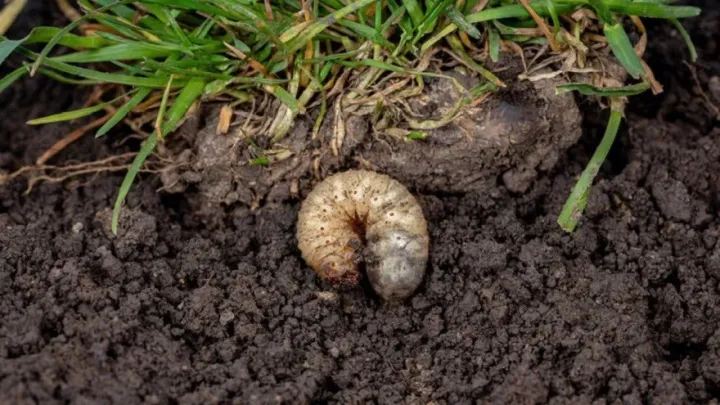
The larvae, which act as the primary pests, can grow up to 60–80 mm in length. They feature a cylindrical body, brownish-grey in colour, with a distinct, heavily sclerotized dark head used for feeding on plant roots.
The lifecycle is generally univoltine, meaning there is one generation per year. Female moths distribute eggs randomly over pastures during their flight, and the hatching larvae immediately burrow into the soil.
In the soil, larvae construct deep, vertical tunnel systems. They use these tunnels as a protective refuge during the day, emerging at night to feed on the root systems and the base of the stems.
What it damages
The main host plants include pasture grasses such as ryegrass and clover. Infestations can cause significant economic losses in the livestock industry by reducing forage yield and quality.
Beyond pastures, Wiseana despecta also poses a threat to cereal crops, especially when they are sown into paddocks that were previously established in permanent grassland.
Larvae consume roots, rhizomes, and the crown of the plants. This feeding pattern disrupts the plant's ability to uptake water and nutrients, eventually leading to death.
High population densities often result in large, bare patches in fields, effectively destroying the pasture and necessitating costly reseeding efforts.
Plants weakened by larval feeding are significantly more susceptible to drought stress and secondary infections, compromising overall stand persistence.
When it appears
The flight period for adult moths typically occurs during the late spring and summer months, which is the critical time for mating and egg deposition.
Larval development occurs throughout the autumn and winter. The caterpillars remain active feeders throughout these months, provided the soil temperature remains suitable.
The peak of larval damage usually occurs in late winter and early spring, as the caterpillars reach their final instar stages and require maximum nutrition before pupation.
Pupation takes place within the existing soil tunnels towards the end of spring, marking the conclusion of the developmental cycle for the season.
Environment plays a key role; humid and mild autumn conditions favour the survival of early-instar larvae, leading to higher infestation rates in the subsequent season.
Signs of infestation
The presence of Wiseana despecta is often indicated by small piles of soil and frass (larval droppings) left at the surface entrance of their burrows.
Visible signs in the field include irregular patches of yellowing or withered grass that appear similar to drought-affected areas, despite adequate rainfall.
In heavily infested areas, the turf becomes loose and can be easily pulled away from the soil, confirming that the root system has been severed by the larvae.
Night-time scouting using a torch may reveal larvae emerging from their tunnels to feed on the green leaf biomass at the base of the plant.
Monitoring adult moth populations using light traps during the flight season is a reliable way to assess the risk for the coming year.
Control measures
Tillage and cultivation are highly effective mechanical methods, as they destroy the vertical tunnels and expose larvae to desiccation and natural predators like birds.
Intensive grazing management can also help reduce larval numbers, as the physical trampling of the turf disrupts the larvae and damages their habitat.
Biological control using entomopathogenic nematodes (such as Steinernema species) has shown promising results in managing populations under appropriate soil moisture conditions.
Chemical control is generally difficult due to the subterranean lifestyle of the larvae, requiring precise timing of applications to target them when they are near the surface.
- Frequent mowing to reduce the vegetative cover.
- Crop rotation to break the life cycle.
- Systematic monitoring of moth populations.
Taxonomy
- Latin name
- Wiseana despecta
- Order
- Lepidoptera (butterflies)
- Family
- Hepialidae
- EPPO code
- WISEDE
Discussion
No discussions yet — be the first.