
Water strider (Velia)
Velia
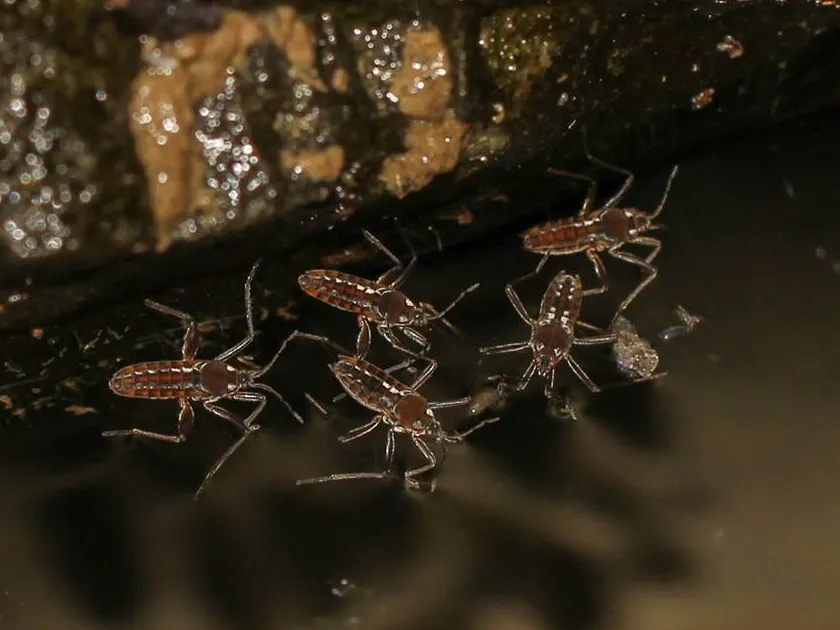
Description
How to identify
The water strider of the genus Velia belongs to the family Veliidae, order Hemiptera. These insects are specialized predators that live on the water surface.
The adult body is elongated, typically brown or grayish with dark markings. The length of individuals ranges from 3 to 8 mm depending on the species.
A distinctive feature is the presence of specific hairs on their legs, which allow them to stay on the water surface using surface tension.
The biology of these insects is closely tied to the aquatic environment: they prefer quiet backwaters, edges of irrigation canals, and rice paddies where the lack of strong currents favors hunting.
The life cycle includes the egg stage, five larval instars, and the adult stage. Development occurs near water bodies, and adults are capable of flight to find new habitats.
What it damages
Although Velia is primarily a predator feeding on small invertebrates, at high population densities in rice fields, it can cause damage to young shoots.
The insects pose the greatest threat to young rice seedlings, especially during the flooding period of the fields, when they congregate massively on the water surface.
Damage is indirect: the bugs can injure the tender tissues of stems and leaves at the attachment points, disrupting the integrity of the plant's epidermis.
The harmfulness is aggravated by the fact that mechanical injuries to the stem create entry points for secondary fungal and bacterial infections.
Massive reproduction of the species in rice agroecosystems leads to stunted plant growth and reduced overall crop productivity during early vegetative stages.
When it appears
The activity season of Velia begins in the spring when water and air temperatures rise to comfortable levels for insect metabolism.
The peak of population density usually occurs in mid-summer, which coincides with the period of active growth of rice crops and maximum water heating in the fields.
Overwintering occurs in the adult stage in soil cracks or under plant residues on land, far from water bodies, where they hide from low temperatures.
In spring, with the onset of warm weather, overwintered individuals return to water bodies for breeding and laying eggs on aquatic vegetation or the substrate.
Depending on the climatic zone, one to several generations can develop per season, which requires monitoring of population density throughout the growing period.
Signs of infestation
The first sign of infestation is the presence of a large number of active individuals on the water surface between plant rows, moving rapidly at the slightest disturbance.
On rice leaves and stems, microscopic punctures can be observed, which subsequently turn yellow and undergo necrosis due to disturbed tissue metabolism.
When inspecting plants near the water level, feeding traces can be found, accompanied by brown spots or slight deformation of the shoots.
A general slowdown in crop development despite proper water management is an indirect signal that the insects are causing stress to the crop.
The presence of larvae of different ages on the water surface near damage sites is direct confirmation of active pest reproduction.
Control measures
The primary control method is an agrotechnical approach: timely drying of the fields, which drastically reduces the population density by depriving them of their habitat.
The use of chemical protection is justified only when the economic injury level is reached, where the density of bugs exceeds a threshold.
An effective method is to keep water bodies free from weeds, which serve as shelters and substrates for Velia egg-laying.
The use of biological methods, such as attracting natural entomophages or applying biopesticides, allows for population suppression without damaging the ecosystem.
Systematic monitoring using traps or visual observation allows for the early detection of outbreaks and the implementation of localized treatments.
Taxonomy
- Latin name
- Velia
- Order
- Hemiptera (bugs, aphids, leafhoppers)
- Family
- Veliidae
- EPPO code
- VELISP
Discussion
No discussions yet — be the first.