
Microvelia douglasi
Microvelia douglasi
Description
How to identify
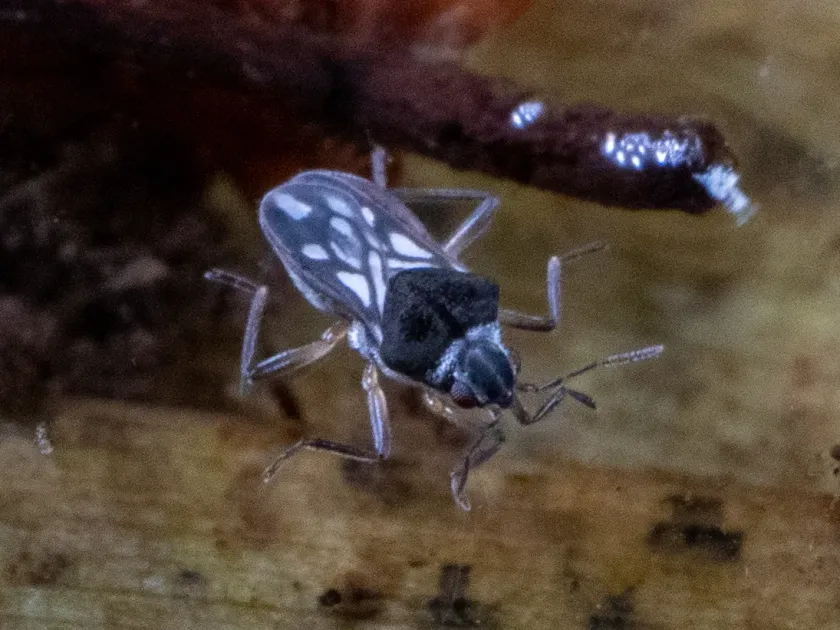
Microvelia douglasi is a small hemipteran insect belonging to the Veliidae family. Often referred to as a riffle bug or water strider, it thrives in stagnant or slow-moving water environments.
The adults are very small, typically measuring between 2 to 3 mm in length. Their bodies are elongated and dark in color, sometimes displaying distinctive pale markings on the thorax.
These insects are well-adapted to life on the water surface, utilizing non-wetting hairs on their legs to glide across the water film without sinking, a key survival trait.
Their life cycle consists of egg, five nymphal instars, and the adult stage. Eggs are usually deposited on the undersides of floating leaves or submerged vegetation within the rice paddies.
The population is highly mobile; many individuals possess wings, enabling them to colonize new flooded areas quickly when favorable environmental conditions arise.
What it damages
The primary concern regarding Microvelia douglasi in agriculture is its impact on young rice plants during the flooded stages of cultivation.
These insects feed by inserting their needle-like mouthparts (proboscis) into the succulent tissues of rice leaves and stems, extracting vital plant sap.
Such feeding behavior causes mechanical injury to the plant cells, leading to localized chlorosis, leaf curling, and overall stunting of the rice seedlings.
When infestation levels are high, the cumulative effect of thousands of insects feeding on the same crop can significantly reduce the vigor and development of the rice plants.
Beyond direct feeding damage, the injury sites often become entry points for secondary bacterial or fungal pathogens that can further weaken the crop during its early vegetative phase.
Signs of infestation
The most immediate sign of an infestation is the presence of numerous tiny, black, fast-moving specks scattered across the surface of the rice paddy water.
Careful inspection of rice leaves that touch the water surface reveals small, discolored spots, which indicate areas where the insects have been feeding.
Stunted growth and uneven patches of development in a field compared to healthier, non-infested areas are strong indicators of significant pest pressure.
The yellowing or drying of lower leaf tips, particularly those submerged or resting on the water, often correlates with high densities of Microvelia.
Observing high activity of small aquatic bugs during the daylight hours, especially in the early stages of rice growth, is a warning sign to initiate monitoring protocols.
Control measures
Water management is the most effective cultural control method. Periodic drainage of the rice fields disrupts the breeding cycle of these aquatic insects and forces them to move elsewhere.
Chemical control with selective insecticides may be required during severe outbreaks, though applications must be timed carefully to avoid damaging the beneficial aquatic ecosystem.
Maintaining clean paddy fields by removing weeds and debris reduces the availability of sheltered areas for egg-laying and resting, thus limiting the population growth.
- Regular scouting using surface water nets to estimate population density.
- Adjusting planting times to avoid peak pest activity periods.
- Promoting biodiversity in and around the farm to encourage natural predators.
Integrated Pest Management (IPM) strategies emphasize low-toxicity alternatives, ensuring that interventions remain compatible with any integrated aquaculture practices, such as fish-in-rice systems.
Taxonomy
- Latin name
- Microvelia douglasi
- Order
- Hemiptera (bugs, aphids, leafhoppers)
- Family
- Veliidae
- EPPO code
- MICVDO
Discussion
No discussions yet — be the first.