
Sow thistle aphid
Uroleucon sonchi
Description
How to identify
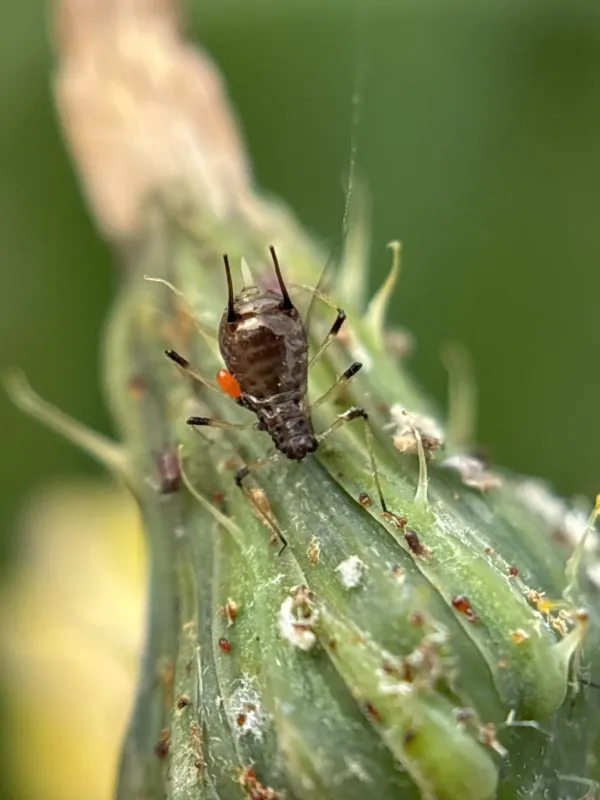
The sow thistle aphid (Uroleucon sonchi) is a member of the family Aphididae. It is a distinctive insect, usually characterized by its reddish-brown to dark brown coloration, which makes it easily visible against the green foliage of its host plants.
Adult aphids measure between 2.5 and 3 mm in length and possess a pear-shaped body. The most notable morphological features include long, dark cornicles (siphunculi) and long antennae that often exceed the length of the body itself.
These aphids reproduce primarily through parthenogenesis, allowing populations to expand rapidly under favorable environmental conditions. The life cycle consists of several nymphal stages before reaching adulthood.
The species exists in both apterous (wingless) and alate (winged) forms. The winged forms are crucial for the dispersal of the colony to new host plants, especially when the initial food source becomes overpopulated or starts to degrade.
Development is highly temperature-dependent, with optimal conditions leading to a rapid generation turnover, allowing a single colony to reach epidemic levels in just a few weeks.
What it damages
The primary host for this species is the sow thistle (Sonchus species), but the aphid is also known to infest various ornamental and agricultural crops when they grow in proximity to infected weeds.
Feeding occurs primarily on the phloem sap of young shoots, flower stalks, and the undersides of leaves. By extracting vital nutrients, the aphid causes physiological stress, wilting, and stunted growth.
The saliva injected by the aphid during feeding often contains phytotoxic components that result in leaf curling, yellowing (chlorosis), and distorted plant architecture, significantly reducing the plant's aesthetic and economic value.
Furthermore, Uroleucon sonchi acts as a vector for several plant viruses. The movement of alate forms between plants facilitates the rapid spread of viral pathogens throughout a field or garden.
The accumulation of honeydew secreted by the aphids provides a substrate for sooty mold fungi, which coat the leaves in a black layer, obstructing photosynthesis and interfering with plant respiration.
Signs of infestation
The earliest signs of an infestation include the curling and twisting of terminal leaves. Affected plants often exhibit a lack of vigor and an overall stunted appearance compared to healthy specimens.
Dense clusters of dark brown insects can be observed on stems and the undersides of leaves. These colonies are often tended by ants, which protect the aphids from predators in exchange for the nutrient-rich honeydew.
Sticky, shiny residues on the leaves indicate the presence of honeydew, which is a clear indicator of a widespread aphid population. Eventually, black, dusty-looking sooty mold will cover the affected areas.
- Distorted, curled terminal foliage
- Clusters of brown-colored insects on stalks
- Sticky, sweet honeydew residue
- Presence of black sooty mold fungus
- Increased ant activity on the plant
In severe infestations, the aphid feeding leads to bud drop and the failure of flowers to bloom properly, which is particularly detrimental to sensitive horticultural crops.
Control measures
Effective control starts with strict weed management, specifically the removal of sow thistles from the vicinity of crops. This eliminates the primary reservoir for the aphid population.
Biological control methods involve encouraging natural predators such as lady beetles, lacewings, and hoverflies. Maintaining areas with flowering plants can help support these beneficial insects in the field.
Chemical control should be implemented as a last resort when threshold levels are exceeded. Systemic insecticides are generally effective because they move through the plant's tissues and reach the aphids directly.
Rotating chemical classes is essential to manage resistance in aphid populations. Applications should be timed for early morning or evening to minimize exposure to non-target pollinating insects.
Regular monitoring of the growing tips of plants allows for early detection of initial colonies, enabling spot treatments that prevent the need for broad-spectrum insecticide usage.
Taxonomy
- Latin name
- Uroleucon sonchi
- Order
- Hemiptera (bugs, aphids, leafhoppers)
- Family
- Aphididae
- EPPO code
- DACTSN
Discussion
No discussions yet — be the first.