
Goldenrod aphid
Uroleucon rudbeckiae
Description
How to identify
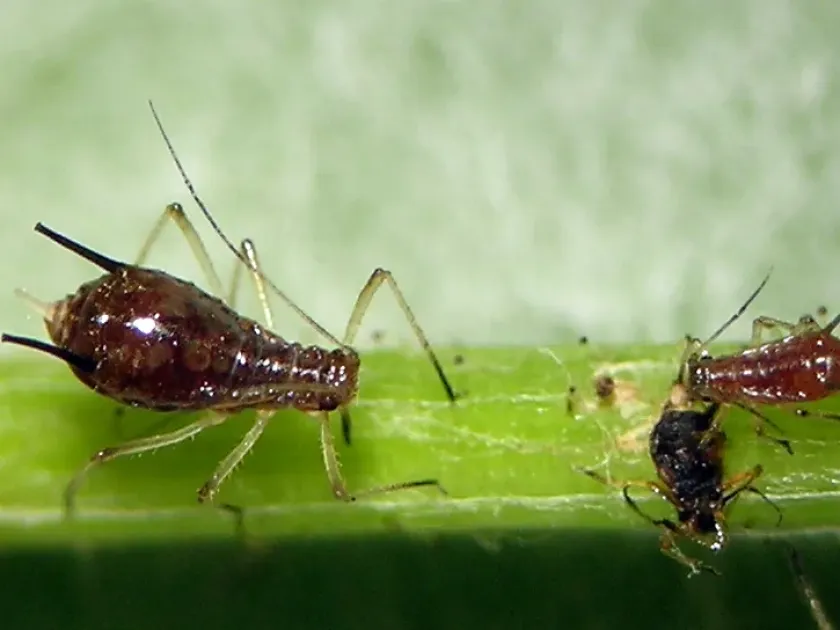
The goldenrod aphid (Uroleucon rudbeckiae) is a prominent member of the Aphididae family. It is easily recognized by its distinct reddish-brown or dark maroon coloration, standing out against the green foliage of its host plants.
Adult aphids typically measure between 2 and 4 mm in length. A key identification feature is the presence of long, dark cornicles (siphunculi) on the abdomen and a long, dark cauda (tail), which are characteristic of this species.
The colony structure includes both wingless asexual females, which dominate during the summer, and winged forms that facilitate migration to fresh, uncolonized host plants.
This species is highly specialized, primarily colonizing plants within the Asteraceae family. They are most frequently found clustering on the terminal shoots and flower buds where sap flow is most concentrated.
Due to their rapid reproductive cycle, Uroleucon rudbeckiae can form dense, visible colonies covering entire stems within a short period under favorable environmental conditions.
What it damages
The primary hosts for this aphid are goldenrod (Solidago) and rudbeckia (Rudbeckia). They thrive on these plants, causing significant physiological stress during the growing season.
Aphids feed by inserting their stylets into the plant's phloem to extract nutrient-rich sap. This constant drainage of resources results in stunted growth and weakened plant vigor.
The injection of toxic saliva during feeding causes the foliage to curl and twist. This physical deformation is a typical reaction of the plant to the aphid's feeding activity.
Beyond direct feeding damage, these aphids act as vectors for various plant viruses. The spread of these pathogens can cause necrotic spots and systemic decline of the ornamental host.
Heavy infestations often lead to the abortion of flower buds and the failure of blooms, which significantly diminishes the aesthetic value of ornamental gardens and perennial borders.
When it appears
The life cycle begins in early spring when overwintering eggs hatch into nymphs. These nymphs rapidly develop into adults to initiate the first generation of the season.
The peak population growth occurs during the warm summer months of June and July. During this period, reproduction is purely parthenogenetic, allowing the population to explode exponentially.
Mild and dry weather conditions are ideal for their development. In such climates, the interval between generations is short, enabling them to maintain persistent pressure on host plants throughout the summer.
As day length decreases and temperatures drop in the autumn, sexual forms are produced. These aphids mate and lay eggs that are resistant to winter cold, ensuring the continuation of the species.
Monitoring should be most intensive from late spring through late summer, specifically targeting the upper, succulent parts of the stems where aphids congregate.
Signs of infestation
The most obvious sign of infestation is the presence of dense clusters of dark red aphids on the tops of stems and directly beneath the flower heads of rudbeckia or goldenrod.
The appearance of sticky honeydew on the leaves is a hallmark of aphid presence. This substance often promotes the growth of sooty mold, which manifests as a dark, powdery layer on the foliage.
Leaf curling, yellowing, and distorted growth of terminal leaves are classic symptoms of localized aphid feeding that has been occurring for some time.
The presence of ants patrolling the stems is a strong indicator of an aphid colony. Ants protect these aphids to harvest the sugary honeydew they excrete during feeding.
Visually, infested flower stalks may appear stunted or bent. Flowers that do bloom might be discolored or deformed, indicating that the aphid colony disrupted the plant's nutrient allocation.
Control measures
Integrated pest management begins with cultural practices, such as removing plant debris and clearing nearby weeds that may serve as alternative hosts during the off-season.
For minor infestations, mechanical removal is effective. A sharp stream of water from a garden hose can physically dislodge aphids, and predatory insects like ladybugs often naturally control small populations.
Biological controls, including the application of neem oil or insecticidal soaps, are highly recommended. These products are generally effective against soft-bodied insects while being gentler on beneficial predators.
For more severe cases, systemic insecticides containing ingredients like imidacloprid can be used. These move through the plant tissue, providing protection against aphids feeding on the inner layers of the stem.
Always time chemical applications for early morning or late evening to minimize the impact on pollinating insects and to avoid potential phytotoxicity from midday heat.
Taxonomy
- Latin name
- Uroleucon rudbeckiae
- Order
- Hemiptera (bugs, aphids, leafhoppers)
- Family
- Aphididae
- EPPO code
- DACTRU
Discussion
No discussions yet — be the first.