
Long-tubed aphid
Uroleucon pachysiphon
Description
How to identify
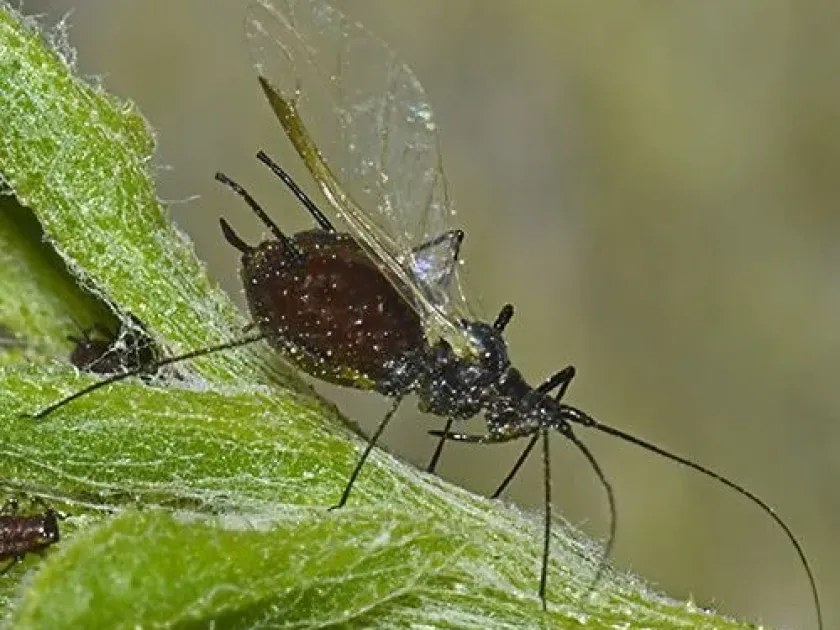
The long-tubed aphid (Uroleucon pachysiphon) is a member of the Hemiptera order and the Aphididae family. Its most distinctive feature, as the name suggests, is the presence of exceptionally long siphunculi (cornicles) compared to its body size.
Adult individuals typically exhibit a dark brown to reddish-brown coloration. This dark pigment allows them to blend in with the stems of their host plants, effectively camouflaging them from predators.
The antennae are notably long, often extending beyond the length of the body. This morphology helps in sensory perception, which is crucial for locating optimal feeding sites on the host plant.
The species lives in dense colonies. These groupings consist of individuals in various stages of development, from nymphs to reproductive adults, often concentrated on young, succulent plant tissues.
Reproduction is primarily parthenogenetic during the spring and summer, allowing for rapid colonization of host plants without the need for mating, which leads to exponential population growth.
What it damages
This pest species primarily targets herbaceous plants, particularly those within the Asteraceae family. In agricultural and horticultural settings, they can cause significant stress to ornamental plants and some crops.
Aphids feed by inserting their needle-like mouthparts into the phloem of the plant. They extract sap, which contains essential nutrients and sugars, causing the plant to weaken and lose vigor.
Feeding activities often lead to the secretion of honeydew. This sticky substance covers leaves and serves as an ideal growth medium for sooty mold, which blocks sunlight and interferes with photosynthesis.
Damage manifests as leaf curling, yellowing, and stunted growth of shoots. Heavily infested plants may show signs of premature senescence and reduced reproductive capacity or flower development.
Crucially, long-tubed aphids can act as vectors for various plant viruses. By transmitting these pathogens during feeding, they cause damage that extends far beyond the immediate physical injury of the plant tissue.
When it appears
The activity of these aphids follows a seasonal pattern dictated by temperature and host plant development. In early spring, nymphs hatch from overwintering eggs and begin colonizing newly developed leaves.
During the peak of the summer, the population reaches its zenith if conditions are favorable. High temperatures speed up the metabolic rate and reproductive cycle, leading to rapid generation turnover.
As autumn approaches and day length decreases, the aphid population produces sexual forms. These individuals mate and lay eggs, which serve as the overwintering stage for the species.
These eggs are typically deposited on the bark or near the base of the plant, ensuring survival through the cold winter months until the next growing season begins.
While extreme drought or heat can temporarily suppress local populations, the presence of irrigation or stable environmental conditions allows them to maintain high numbers throughout the summer.
Signs of infestation
The most obvious sign of infestation is the appearance of dark, dense clusters of insects on the growing tips and undersides of leaves. These colonies are often visible to the naked eye.
Leaf curling and deformation are primary indicators of stress. These physical changes occur because the aphids sap the nutrients needed for normal leaf expansion and development.
The presence of honeydew, a sticky, shiny residue on the foliage, is a major symptom of aphid activity. This residue often attracts ants, which provide protection to the aphids against natural enemies.
Yellowing (chlorosis) of the leaves, even in the absence of obvious colonies, may suggest that aphids have fed or are feeding on the plant, as they inject saliva that can be toxic to plant cells.
Stunted growth, lack of new vigor, and a general decline in the plant's health over a short period are definitive signs that the aphid colony has reached a damaging threshold.
Control measures
Effective pest management for this species requires a combination of monitoring, biological control, and targeted chemical applications to keep populations below economic injury levels.
- Implement regular field monitoring to detect colonies at the earliest possible stage.
- Physically remove or prune highly infested plant parts to reduce the initial population size.
- Encourage natural predators such as lady beetles, lacewings, and hoverfly larvae in the ecosystem.
- Apply systemic insecticides that are absorbed by the plant to provide long-lasting control of sap-feeding pests.
- Utilize biological insecticides or insecticidal soaps when appropriate to minimize environmental impact.
Taxonomy
- Latin name
- Uroleucon pachysiphon
- Order
- Hemiptera (bugs, aphids, leafhoppers)
- Family
- Aphididae
- EPPO code
- DACTPA
Discussion
No discussions yet — be the first.