
Centaurea aphid
Uroleucon jaceae
Description
How to identify
The Centaurea aphid (scientific name Uroleucon jaceae) is a member of the Aphididae family within the order Hemiptera. These insects are specialists that primarily feed on host plants within the Asteraceae family, particularly knapweeds.
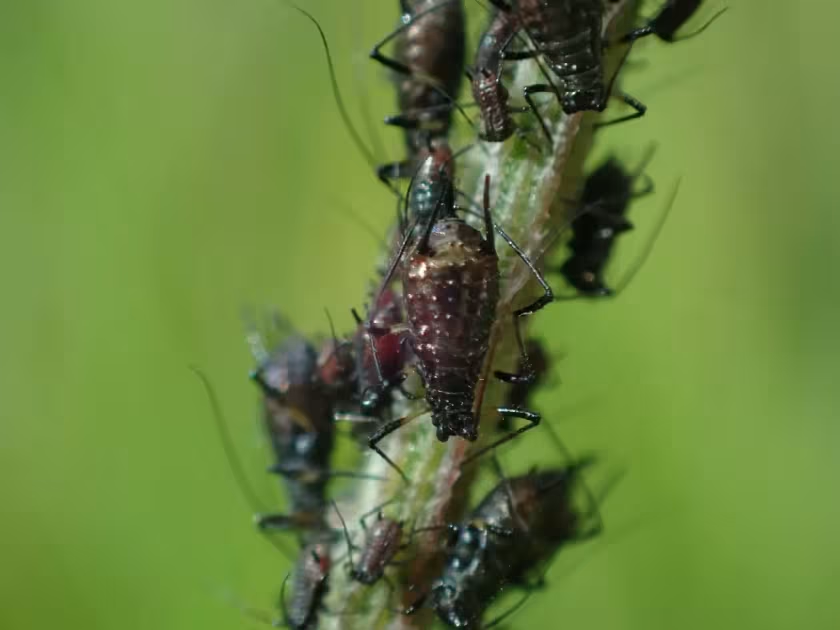
Adult aphids of this species are relatively large, measuring between 3 and 4 mm in length. Their body coloration ranges from reddish-brown to dark brown, providing excellent camouflage against the stems of their host plants.
Key morphological features include long, dark antennae and prominent, dark-colored siphunculi located at the end of the abdomen. The body shape is characteristically pear-like, which is common in many aphid species.
The life cycle involves both asexual reproduction (parthenogenesis), where females give birth to live nymphs, and sexual reproduction in the late autumn. This allows for rapid population expansion during the growing season.
The species survives the winter as eggs deposited on the remnants of host plants. These eggs are cold-hardy, ensuring that the pest population remains persistent in temperate climates throughout the following year.
What it damages
This aphid primarily attacks species of Centaurea, causing direct physiological stress to the host plants. By piercing plant tissues with their stylets, they extract vital phloem sap, which is essential for plant growth.
Typical symptoms of injury include stunted growth, chlorosis, and the curling of young leaves. If the infestation occurs during the budding phase, the flowers may fail to develop properly or become severely deformed.
Beyond nutrient depletion, the Centaurea aphid acts as a mechanical vector for several plant viruses. The introduction of these pathogens into the plant system often causes systemic mosaic diseases and overall decline.
The secretion of honeydew is another major issue. This sugary substance accumulates on the foliage, acting as a substrate for sooty mold fungi, which significantly reduces the leaf area available for photosynthesis.
Infested plants suffer from loss of vigor and aesthetic value, which is particularly problematic for nurseries, commercial floriculture, and gardeners who prize the health of their knapweeds.
When it appears
The cycle typically begins in the spring as temperatures rise, enabling the hatching of overwintered eggs. The first generation immediately settles on tender, emerging shoots of host plants.
Throughout the late spring and summer, multiple generations of aphids follow. High humidity and mild temperatures often lead to exponential population growth, with peaks in mid-summer.
As the colony density increases on a specific plant, winged forms are produced. These individuals migrate to colonize new, uninfested plants, effectively spreading the infestation across the garden or field.
As daylight hours decrease and temperatures drop in autumn, the population transitions to sexual reproduction. Females lay eggs that are designed to survive the harsh winter conditions.
Regular monitoring should be focused on the underside of leaves and near the flower buds, as these are the preferred feeding sites for this particular species of aphid throughout the season.
Signs of infestation
The presence of curled, yellowing, or distorted leaves is often the first visible symptom of an aphid infestation. Close inspection will usually reveal dense clusters of dark-bodied insects.
Ant activity is a very strong indicator of aphid presence. Ants protect aphids from natural predators because they harvest the honeydew, frequently patrolling plants infested with these pests.
Leaves and stems may appear sticky or glistening due to the honeydew excretion. Over time, this sticky coating often darkens as black sooty mold starts to colonize the surface.
Stunted development of flower buds or the sudden wilting of terminals are common signals that the aphid colony is large enough to impact the host's hydraulic balance.
The presence of shed white skins (exuviae) on leaves or the soil surface is a clear sign that the aphid population is currently in an active molting and growing stage.
Control measures
Cultural management starts with removing host plant debris and managing neighboring weeds that may harbor the aphids during off-seasons. Proper fertilization is also key, as excess nitrogen can trigger aphid outbreaks.
Biological control is highly effective for aphid management. Encouraging natural enemies like lady beetles, lacewings, and hoverflies can help suppress aphid numbers naturally without resorting to pesticides.
In cases where infestations exceed the economic threshold, systemic insecticides are often recommended. Application must be thorough, ensuring that the underside of leaves is treated for maximum effect.
It is important to rotate between different classes of insecticides to prevent the development of resistance within the aphid population, a common issue with repeated use of the same chemical mode of action.
- Regular inspection of knapweed plants.
- Installation of habitat for beneficial predatory insects.
- Use of horticultural soaps for early, localized infestations.
- Avoid excessive nitrogen-based fertilizers.
- Timely application of pesticides when necessary.
Taxonomy
- Latin name
- Uroleucon jaceae
- Order
- Hemiptera (bugs, aphids, leafhoppers)
- Family
- Aphididae
- EPPO code
- DACTJA
Discussion
No discussions yet — be the first.