
Formosan aphid
Uroleucon formosanum
Description
How to identify
The Formosan aphid (Uroleucon formosanum) is a member of the Aphididae family, primarily known for its association with plants of the Asteraceae family.
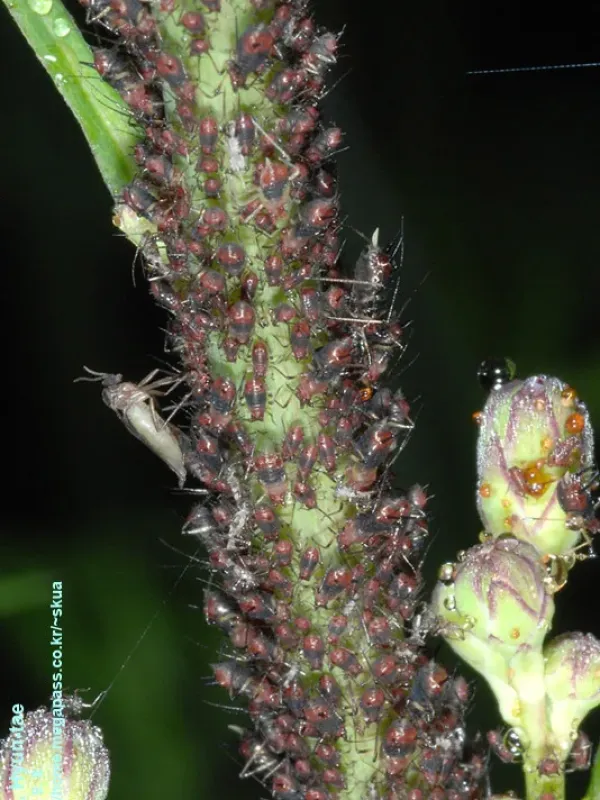
These insects exhibit an elongated body structure, usually in shades of reddish-brown or dark mahogany, which serves as camouflage against stems and leaf stalks.
A distinctive feature of this species is its exceptionally long siphunculi and antennae, which often exceed the length of the aphid's own body, aiding in accurate identification.
The life cycle involves complex transitions, including wingless asexual generations during the summer and potential winged forms that facilitate dispersal to new host plants.
Taxonomically, it belongs to the genus Uroleucon, which includes numerous species that are specialized in their dietary preferences for specific plant groups.
What it damages
The primary hosts for the Formosan aphid include various Asteraceae species, such as lettuce, chrysanthemums, asters, and several wild perennial plants.
By using their piercing-sucking mouthparts, these aphids drain nutrient-rich phloem sap, which leads to the structural weakening of the host plant.
Direct damage includes leaf curling, stunted growth of apical shoots, and severe distortion of flower buds, which significantly reduces the market value of horticultural crops.
Furthermore, Uroleucon formosanum can transmit various plant viruses during feeding, posing a secondary, more lethal threat to vegetable and ornamental production.
The accumulation of honeydew on the leaves blocks sunlight, thereby inhibiting photosynthesis and further stressing the infected plant.
When it appears
Activity typically begins in the early spring, as temperatures rise and overwintering eggs or individuals become active on early host vegetation.
The population experiences a significant peak during the mid-summer months when environmental conditions are optimal for the rapid asexual reproduction of the aphids.
During the peak season, aphid populations can multiply exponentially, quickly covering entire stems and creating dense clusters that are easily visible to the naked eye.
As autumn approaches and day length decreases, the population transitions toward the production of sexual forms to ensure survival through the winter period.
Local outbreaks are heavily influenced by temperature and humidity, with warm, dry periods often accelerating the spread of the colony throughout the garden.
Signs of infestation
One of the earliest signs of an infestation is the presence of sticky honeydew on the foliage, which often attracts ants and promotes the growth of sooty mold.
Infected plants show visible signs of distress, including drooping leaves, yellowing chlorotic patches, and the curling of terminal shoots where the aphids congregate.
Careful inspection of the undersides of leaves and the upper stems usually reveals dense clusters of dark-colored aphids tightly attached to the plant surface.
The development of a black, velvet-like fungal layer on the leaves is a strong indicator that aphids have been present for an extended period.
- Deformed and curled terminal growth.
- Presence of honeydew and secondary sooty mold.
- Increased ant activity around stems and buds.
Control measures
Effective management begins with regular monitoring of susceptible plants, particularly those belonging to the Asteraceae family, during the early growth stages.
Biological control, including the encouragement of natural predators like ladybugs, hoverflies, and lacewings, is often sufficient to keep populations below threshold levels.
If chemical intervention is necessary, the use of insecticidal soaps or neem oil is recommended, as these have lower toxicity profiles and are safer for beneficial insects.
Proper weed management is essential to remove alternative hosts that allow the aphid population to maintain its presence in the field throughout the season.
For significant infestations, systemic insecticides may be used, provided that the timing aligns with the pre-harvest intervals for the specific crop being treated.
Taxonomy
- Latin name
- Uroleucon formosanum
- Order
- Hemiptera (bugs, aphids, leafhoppers)
- Family
- Aphididae
- EPPO code
- DACTFO
Discussion
No discussions yet — be the first.