
Ambrosia aphid
Uroleucon ambrosiae
Description
How to identify
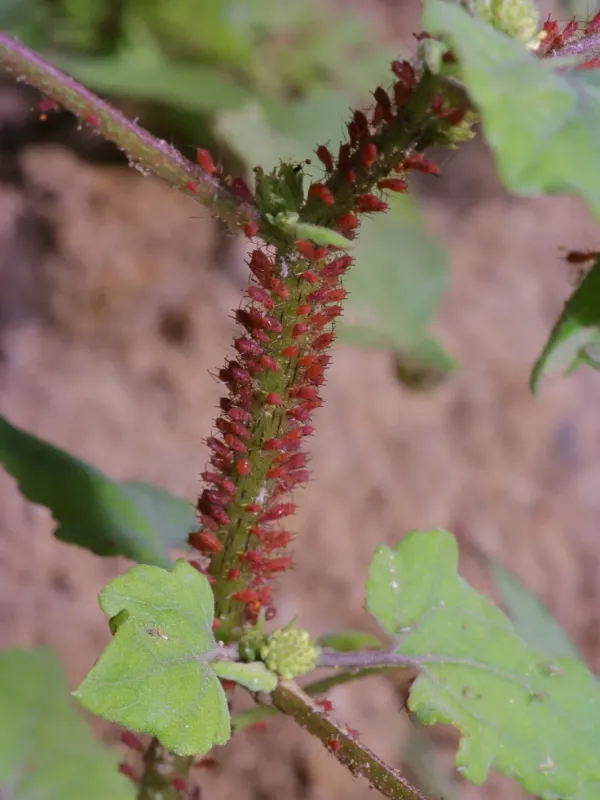
The Ambrosia aphid (Uroleucon ambrosiae) belongs to the order Hemiptera and the family Aphididae. Adult specimens typically have a dark brown or reddish-maroon body, measuring between 2 and 3.5 mm in length.
Key morphological features include long, dark, cylindrical siphunculi and a dark cauda. Their long legs, often with darkened joints, distinguish them from other common aphid species found in agricultural fields.
The life cycle encompasses both apterous (wingless) and alate (winged) forms. The winged individuals are crucial for the rapid dispersal and colonization of new host plants during the summer months.
Reproduction is primarily parthenogenetic throughout the season, allowing for an exponential increase in population size within a very short timeframe.
The species survives the winter mainly as eggs laid on host plant debris or at the base of perennial weeds, which makes late-season sanitation a vital component of integrated pest management.
What it damages
While their primary host is common ragweed (Ambrosia artemisiifolia), these aphids frequently migrate to cultivated members of the Asteraceae family, including sunflowers, Jerusalem artichokes, and various ornamentals.
They cause direct damage by feeding on phloem sap, which deprives the plant of essential nutrients needed for healthy growth and reproductive development.
Infested plants exhibit symptoms such as leaf curling, stunted growth, and the wilting of flower buds. In severe cases, high aphid density can significantly reduce overall crop yields.
Beyond direct feeding, Uroleucon ambrosiae is a known vector for various plant viruses, posing an indirect threat that can lead to systemic disease outbreaks within a field.
Their secretion of honeydew encourages the growth of sooty mold, which blocks sunlight and interferes with the plant’s photosynthesis process, further weakening the host.
When it appears
Initial colonization begins in late spring, generally when temperatures consistently rise above 15°C, aligning with the early germination and growth phases of host plants.
Peak population levels typically occur during mid-summer (June and July), when warm weather conditions facilitate rapid development and massive reproduction cycles.
Although extreme heat may slightly limit reproduction rates, the populations remain active and persistent until the onset of significantly cooler autumnal temperatures.
Migration to new host plants by alate forms occurs primarily during the summer, necessitating continuous monitoring throughout the entire growing season to prevent secondary infestations.
As autumn arrives, the aphids transition to the reproductive phase that results in the production of overwintering eggs on host plants or adjacent weeds.
Signs of infestation
The earliest signs of an infestation include the appearance of dark, dense clusters of aphids on the undersides of leaves and along the tender terminal stems of plants.
- Presence of sticky honeydew on the leaves and stems.
- Deformed, curled, or stunted terminal growth of plants.
- Yellowing of leaves followed by premature senescence.
- Frequent presence of ants farming the aphids for their honeydew.
- Growth of black sooty mold on the foliage surface.
Farmers should conduct regular field inspections, specifically focusing on the undersides of leaves and the growth points of sunflowers and other susceptible Asteraceae crops.
Control measures
Integrated control begins with the rigorous management and removal of ragweed and other weeds in and around fields to eliminate the primary sources of aphid populations.
Cultural practices, such as deep plowing after harvest, are effective in burying and destroying the overwintering eggs, thus reducing the initial pest pressure for the following season.
When thresholds are exceeded, the application of systemic insecticides is recommended to target the aphids feeding within the plant tissues effectively.
Conservation of natural enemies, such as lady beetles, lacewings, and parasitic wasps, can provide significant biological suppression of aphid numbers in fields with low-to-moderate infestations.
To ensure long-term effectiveness, it is essential to rotate between different insecticide classes to prevent the development of resistance within the aphid populations.
Taxonomy
- Latin name
- Uroleucon ambrosiae
- Order
- Hemiptera (bugs, aphids, leafhoppers)
- Family
- Aphididae
- EPPO code
- DACTAM
Discussion
No discussions yet — be the first.