
Uroleucon aphid
Uroleucon
Description
How to identify
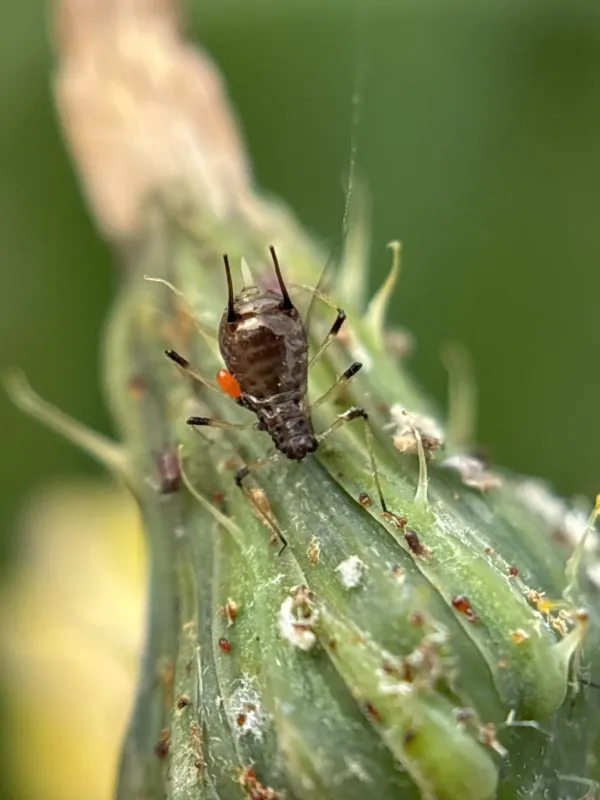
The Uroleucon genus belongs to the Aphididae family. These aphids are relatively large, reaching 3–4 mm in length. Their coloration ranges from reddish-brown to dark burgundy or nearly black.
A key morphological feature is their notably long, dark, and often reticulated siphunculi (tubes on the end of the abdomen). Their antennae are also quite long, frequently exceeding the total length of the insect's body.
Systematically, this genus encompasses many species that specialize primarily on plants within the Asteraceae family. Depending on the life stage and environmental conditions, both winged and wingless forms can be found within a colony.
To identify them in the field, agronomists look for their specific location on the plant's terminal shoots or flower buds and examine the structure of their siphunculi using a magnifying glass.
Due to their high reproductive rate through parthenogenesis, a single colony can rapidly expand to cover the entire upper portion of a host plant in just a few days.
What it damages
The primary hosts for Uroleucon aphids are plants from the Asteraceae family. Crops such as sunflower, safflower, chicory, and various ornamental plants are frequently affected by these pests.
The aphids feed on plant sap, targeting tender young shoots, buds, and leaves. Large colonies drain the plant's energy, causing stunted growth and significant stress to the host.
Damage symptoms include curling, deformation, and yellowing of the leaves. Furthermore, the loss of nutrients significantly reduces the yield and quality of seeds or flowers, depending on the crop type.
Beyond direct damage, these aphids act as vectors for various plant viruses. As they feed, they inject saliva containing viral particles, which can lead to systemic disease throughout the crop.
The excretion of honeydew promotes the growth of sooty mold, which coats the leaves, blocks photosynthesis, and further diminishes the overall health of the plant.
When it appears
Activity of Uroleucon aphids typically begins in spring once average daily temperatures rise above +12°C. Peak population numbers generally occur during the budding and flowering stages of the host plants.
The life cycle is characterized by rapid generations throughout the spring and summer. During this time, they reproduce asexually, allowing for exponential growth under favorable weather conditions.
As autumn approaches and daylight decreases, sexual individuals emerge. After mating, females lay overwintering eggs, typically on the base of stems or plant debris, which serve as the source of infestation for the following season.
Weather plays a crucial role in population dynamics; dry and hot weather promotes rapid outbreaks, while heavy rainfall can physically wash the aphids off the plants and reduce their density.
Monitoring the timing of life cycles is essential for implementing timely protective measures before the infestation threshold is exceeded.
Signs of infestation
The most obvious sign of an infestation is the presence of dense clusters of insects covering the flower buds and the tips of the shoots. Often, the stems appear completely wrapped by the aphids.
Visible deformation of leaves is common, as they become curled, puckered, and may show signs of chlorosis. Careful observation reveals discarded white skins (exuviae) left behind by molting nymphs.
The presence of ants is a reliable indicator of an aphid colony, as ants feed on the honeydew produced by the aphids and actively defend them against natural predators.
A sticky residue on the foliage is a primary symptom of active feeding. Over time, this honeydew turns black due to the development of sooty mold, which is easily visible to the naked eye.
Severely infested plants often display bud drop, incomplete head formation in sunflowers, or overall poor development, leading to significant economic losses for farmers.
Control measures
Cultural control measures involve the removal of host weeds belonging to the Asteraceae family, which often act as primary reservoirs for the aphids before they migrate to crops.
Biological control relies on encouraging natural predators such as lady beetles, lacewings, hoverflies, and parasitoid wasps, which can effectively suppress aphid populations if their habitat is protected.
Chemical control is applied when the economic threshold is reached. Systemic insecticides are generally the most effective, as they are absorbed into the plant and provide long-lasting protection against internal feeders.
It is critical to schedule chemical treatments during the early morning or late evening to minimize harm to beneficial pollinators that may also be visiting the crops.
To avoid the development of insecticide resistance, it is recommended to rotate products with different modes of action throughout the growing season.
Taxonomy
- Latin name
- Uroleucon
- Order
- Hemiptera (bugs, aphids, leafhoppers)
- Family
- Aphididae
- EPPO code
- URLCSP
Discussion
No discussions yet — be the first.