
Confused flour beetle
Ulomoides dermestoides
Description
How to identify
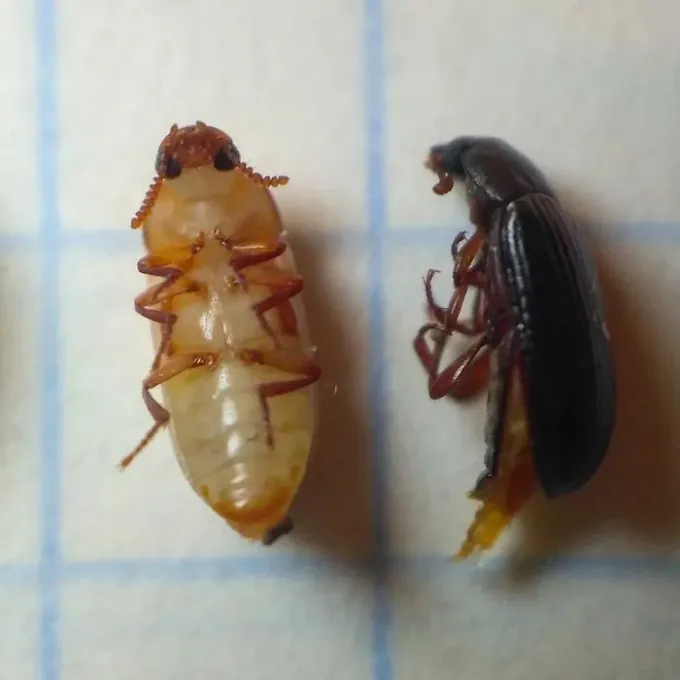
The confused flour beetle is a member of the Tenebrionidae family within the order Coleoptera. Adult beetles are small, measuring approximately 3–4 mm in length, with a flattened, reddish-brown, elongated body.
Larvae are roughly 6–7 mm long, cylindrical in shape, and pale yellow in color. A distinguishing feature is that their head and the terminal abdominal segment are darker than the rest of the body.
The eggs are microscopic, white, and sticky, often covered with flour particles, making them extremely difficult to detect in raw grain or flour substrates during standard inspections.
Pupae are white, gradually darkening as they develop into adults. They are free-living and do not spin cocoons, often found near the surface of the infested material.
An important biological identifier is the secretion of a pungent-smelling liquid from abdominal glands, which gives infested food products an unpleasant odor when populations are dense.
What it damages
This beetle is a primary pest of stored products, commonly found in flour, cereals, bran, pasta, and even dried fruits and nuts. It thrives in mills, warehouses, and domestic pantries.
In large-scale storage facilities, these beetles attack grains that have been pre-damaged by other insects or those with higher moisture content, as they are unable to damage intact, hard kernels.
The damage is severe not only because of direct consumption of the product but also due to the contamination of the grain mass with insect parts, feces, and webbing produced by larvae.
Infested commodities suffer from degraded quality, losing their commercial value. The unpleasant odor produced by the beetles renders flour and other ingredients unsuitable for human consumption.
In addition to physical damage, the presence of these beetles facilitates the growth of mold and other pathogens, which can lead to further spoilage and potential health hazards in the stored goods.
When it appears
The beetle's life cycle is heavily influenced by environmental temperature and moisture levels. The species thrives in warm conditions, with an optimal temperature range of +25°C to +30°C.
In climate-controlled warehouses or food processing facilities, the confused flour beetle can reproduce continuously throughout the year, causing ongoing damage to stored inventories.
Under optimal conditions, the life cycle from egg to adult is completed in 30 to 40 days, allowing for several generations to emerge annually if the temperature remains high.
While development slows down significantly in unheated spaces during winter, the beetles are resilient and can survive in cracks, crevices, and deep grain masses until warmer conditions return.
Infestation is typically initiated through the introduction of contaminated products, infested packaging materials, or machinery that has not been properly cleaned between storage cycles.
Signs of infestation
The presence of adult beetles near the surface of the flour or grain mass, especially when disturbed, is the most common indication of an infestation in a storage facility.
A noticeable change in the physical properties of the flour or grain — such as clumping, the presence of fine webbing, and a musty or pungent smell — strongly suggests a high infestation level.
Small particles of debris, shed larval skins, and darkened feces are often found at the bottom of bins, in floor cracks, and behind equipment, indicating long-term colonization.
- Visible adult beetles on storage surfaces.
- Accumulation of "dust" and insect fragments in bags.
- Development of a rancid odor in the stored product.
During quality checks, sifting of grain samples will frequently yield larvae, confirming the reproductive status of the population within the product batch.
Control measures
Sanitation is the cornerstone of pest management. Keeping storage areas clean, removing spilled grain, and vacuuming cracks and crevices eliminates breeding grounds for the beetles.
Physical control measures, such as mechanical aeration of grain to reduce temperature and moisture, or utilizing cold/heat treatments, can effectively kill all life stages of the beetle.
Fumigation of empty warehouses and infested bulk commodities using professional-grade pesticides is necessary to reach beetles hiding in structural voids or deep within grain stacks.
Implementing a strict "first-in, first-out" inventory policy and inspecting all incoming raw materials helps prevent the introduction of the beetle into clean storage environments.
Continuous monitoring using pheromone traps can help detect early infestations, allowing for targeted interventions before the beetle population reaches uncontrollable numbers.
Taxonomy
- Latin name
- Ulomoides dermestoides
- Order
- Coleoptera (beetles)
- Family
- Tenebrionidae
- EPPO code
- ULMDDE
Discussion
No discussions yet — be the first.