
Flour mite
Tyrophagus similis
Description
How to identify
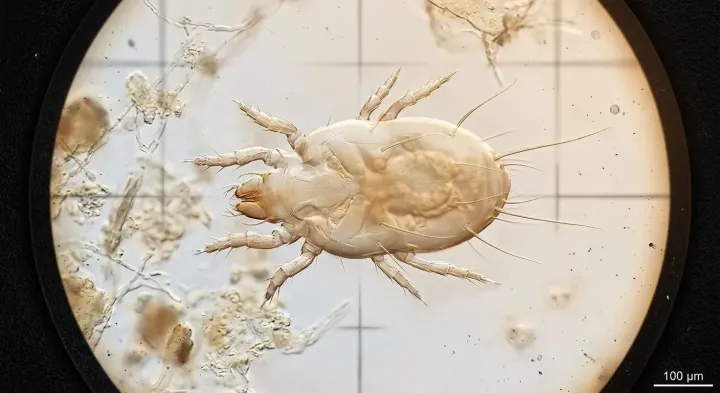
The flour mite (Tyrophagus similis) is a member of the Acaridae family, class Arachnida. These are microscopic pests that are difficult to detect without specialized equipment, typically measuring less than 0.5 mm in length.
They possess a translucent, creamy-white or pale yellow body. Long sensory setae cover their bodies, allowing them to navigate within grain masses and detect changes in their environment effectively.
The lifecycle of the flour mite consists of several stages: egg, larva, protonymph, deutonymph (hypopus), and adult. The hypopus stage is particularly resilient, allowing the species to survive harsh conditions.
They are extremely sensitive to humidity levels, which serve as a primary limiting factor for their population growth. In dry environments, they can remain dormant for extended periods until moisture conditions improve.
Diagnosis in agricultural settings is performed by sieving samples of grain and examining the sifted material under a microscope. Their presence is often confirmed by observing their characteristic movement patterns.
What it damages
Flour mites primarily target stored grains, pulses, and oilseeds. Common food sources include wheat, barley, corn, flour, processed cereals, and various animal feed formulations.
By consuming the germ of the seed, they significantly reduce the germination potential of grain meant for planting. In commercial storage, this damage leads to substantial economic losses.
Beyond direct feeding, mites facilitate the growth of molds and fungi. They transport fungal spores on their bodies, accelerating the degradation of the storage environment.
Grain contaminated by mites develops a characteristic stale or "minty" odor, making it unfit for human consumption. This off-odor is caused by the release of specific chemicals during mite metabolism.
Large infestations lead to grain clumping and moisture accumulation, which initiates self-heating processes within the grain silo. This creates a feedback loop that promotes further pest reproduction.
Signs of infestation
A primary indicator of infestation is a distinct, sweet or musty odor emanating from the grain storage unit. This smell becomes more pronounced as the mite population density increases.
Visual inspection may reveal a dusty appearance on the surface of the grain pile. Upon closer examination, this "dust" is revealed to be a moving mass of microscopic mites.
Infected batches often exhibit signs of clumping or "caking," where grains adhere to each other due to the moisture produced by the mites. This interferes with proper ventilation.
Laboratory testing of seeds often shows a dramatic drop in viability. Germination assays confirm that the embryo of the seed has been consumed or destroyed by the infestation.
Samples taken from contaminated grain will display mite presence across different life stages when viewed under a microscope. Infested flour will appear darker and may show signs of fermentation.
Control measures
Maintaining grain moisture levels below 14% is the most effective preventative measure. Flour mites struggle to survive and reproduce in dry, well-ventilated storage conditions.
Regular sanitation of warehouses and silos is essential. Removing spilled grain, dust, and debris eliminates breeding sites for the mites before they can establish large colonies.
Active aeration systems should be used to manage the temperature and moisture content within grain bins. Lowering the temperature suppresses the rate of mite development.
For severe infestations, fumigation using phosphine-based products is the standard industry practice. This gas penetrates deep into the grain mass to reach and eliminate the pests.
Continuous monitoring using probes and routine laboratory inspections is critical. Early detection allows for targeted interventions, which prevent the need for more costly mass fumigation.
Taxonomy
- Latin name
- Tyrophagus similis
- Order
- Mites
- Family
- Acaridae
- EPPO code
- TYROSI
Discussion
No discussions yet — be the first.