
Aleuroglyphus mite
Aleuroglyphus
Description
How to identify
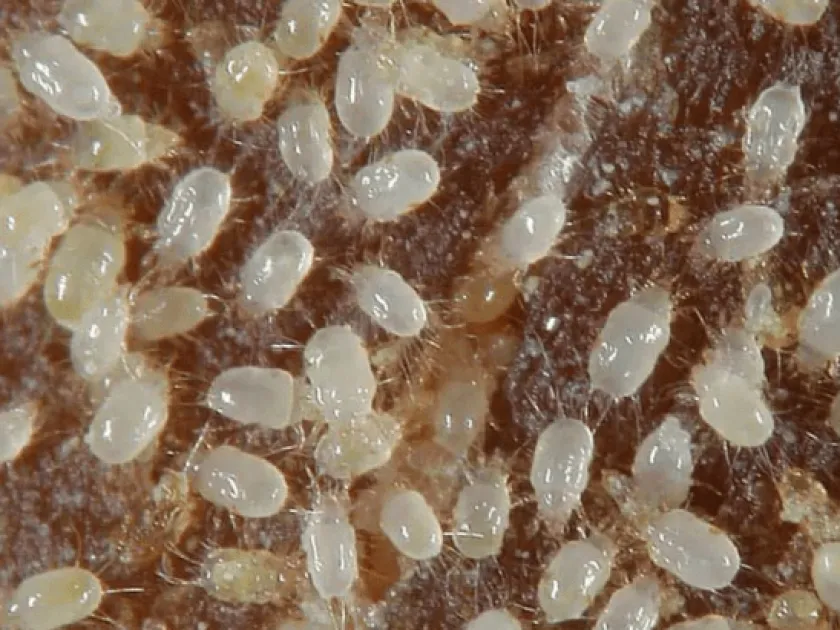
The Aleuroglyphus mite, specifically Aleuroglyphus ovatus, belongs to the family Acaridae. These are microscopic arachnids with a pale, oval-shaped body, typically measuring between 0.3 and 0.7 mm in length.
They possess four pairs of legs, with the first pair noticeably thicker than the others. They lack visual organs and rely entirely on sensory bristles distributed across their bodies to navigate the grain mass and find food sources.
The life cycle encompasses egg, larva, protonymph, deutonymph, and adult stages. They reproduce rapidly under favorable conditions, completing a generation in less than two weeks if humidity and temperature are high.
Under adverse conditions, they can produce a specialized developmental stage known as a hypopus, which is highly resistant to desiccation, chemical treatments, and food scarcity.
These mites are highly sensitive to moisture levels and thrive in environments where relative humidity exceeds 60-70%, often found in poorly ventilated storage facilities.
What it damages
Aleuroglyphus mites primarily infest stored plant products with high nutritional value, such as wheat, rye, barley, and various types of grain-based flours and animal feeds.
The mites are known for feeding on the germ of the seeds, which completely destroys the germination capacity of the grain and lowers its nutritional value significantly for processing.
Extensive feeding leads to physical destruction of the product, turning it into a mass of fine dust. This causes substantial financial losses for grain distributors and food producers.
Beyond physical damage, the mites contaminate storage stocks with feces, molted skins, and carcasses, which introduce various pathogenic microorganisms and mold spores into the grain bulk.
The metabolic activity of the mite colony creates heat and humidity, leading to the self-heating of grain piles, which creates a positive feedback loop for rapid pest proliferation.
Signs of infestation
The most common indicator of an infestation is a distinct, sweetish "honey-like" or "minty" odor emanating from the stored grain or flour storage area.
A fine, dusty-looking layer on the surface of the grain pile, which appears to move or ripple, is a visual confirmation of high-density mite populations.
Laboratory analysis of grain samples, often using sieving techniques or microscopic examination, is the gold standard for identifying the presence of Aleuroglyphus in stored stocks.
Damaged kernels often show hollowed-out embryos. If the grain is sifted onto a flat surface, the mites will appear as tiny, whitish, moving specks visible to the naked eye under good lighting.
Accumulation of "grain dust" mixed with fine mite debris is a clear sign that the colony has established itself deep within the commodity, potentially causing internal damage.
Control measures
The most important control measure is maintaining grain moisture content below 13-14%. Dry grain is significantly less susceptible to colonization by stored-product mites.
Rigorous sanitation of storage facilities is crucial. This involves the complete removal of residues, thorough cleaning of conveyors and elevators, and the application of residual insecticides.
Aeration systems used during cooler weather can lower the temperature within the grain mass, effectively suppressing the mite's metabolic rate and reproductive capacity.
Chemical fumigation remains the most effective method for eradicating heavy infestations. This must be carried out by trained professionals to ensure efficacy and operator safety.
Continuous monitoring using temperature probes and regular sampling is essential for early detection, allowing for small-scale interventions before an entire inventory becomes compromised.
Taxonomy
- Latin name
- Aleuroglyphus
- Order
- Mites
- Family
- Acaridae
- EPPO code
- ALEGSP
Discussion
No discussions yet — be the first.