
Flour mite
Acarus
Description
How to identify
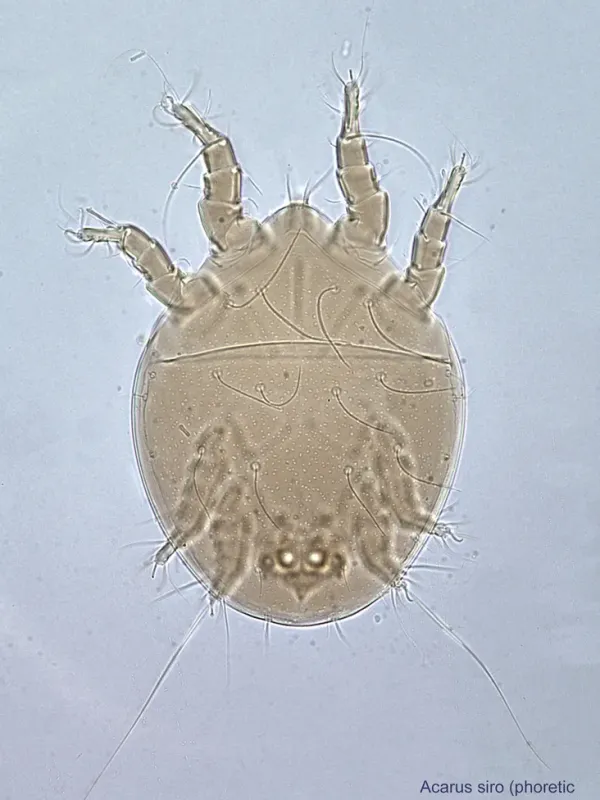
The flour mite (Latin name Acarus siro) is a microscopic pest belonging to the family Acaridae in the order Acariformes, commonly found in storage facilities worldwide.
Adult mites are extremely small, measuring about 0.5 mm in length, with an oval, translucent body that varies from white to pale yellow in appearance.
They possess eight legs and have long, sparse hairs on their bodies that facilitate movement across grain surfaces and into tight spaces within the storage structure.
The mite's life cycle is remarkably rapid, consisting of eggs, larvae, nymphs, and adults, which allows populations to explode in numbers within just a few weeks under optimal conditions.
During unfavorable environmental conditions, such as dry spells or lack of food, these mites can enter a specialized resting stage known as a hypopus, which increases their survival rate.
What it damages
Flour mites infest a vast range of stored products, including wheat, barley, rye, legumes, oilseeds, flour, animal feed, and various high-protein plant products.
They cause severe damage to the grain embryo, which significantly decreases the germination percentage and overall quality of seed material stored for future planting.
Beyond consuming the grain, these pests contaminate the product with their shed skins, dead bodies, and excrement, which may cause allergic reactions in humans and livestock.
Infestation by these mites is usually accompanied by the growth of molds and fungi, as they introduce spores to the grain surface, leading to rapid deterioration of the crop.
Large-scale infestation often results in a musty or honey-like odor, leading to the devaluation of the grain and making it unfit for processing into human food products.
When it appears
Flour mites remain active throughout the entire year within storage environments, provided that the temperature remains above freezing and moisture is present.
The ideal conditions for rapid development are a temperature range of +20°C to +25°C and a moisture content in the grain exceeding 14–15%.
In winter months, if the grain bulk is not properly cooled, mites can persist deep within the grain mass where temperatures remain stable and protected from outside cold.
Infestation usually begins through the introduction of contaminated equipment, dirty storage sacks, or by bringing already infested grain into the warehouse.
As long as the storage facility maintains high humidity and stable temperatures, the flour mite population will continue to grow without a specific seasonal break.
Signs of infestation
A distinctive sweet, musty odor is the most common early indicator of a flour mite infestation, often confused with the smell of fermenting or molding grain.
Upon closer inspection, the surface of the grain mass may appear to have a fine, dusty layer, which is actually composed of mites and their metabolic waste products.
Mite presence can be confirmed using the sieving technique, where grain samples are sifted onto a dark surface to reveal the tiny, moving white specks of the mites.
Localized heating (hot spots) within the grain bulk is a critical symptom, as the metabolic activity of a large mite colony generates enough heat to raise the temperature of the grain.
The formation of clumps or the loss of grain flowability during handling is a strong indicator that a significant colony of pests has developed within the pile.
Control measures
The most effective strategy is the maintenance of strict environmental control: keeping grain moisture content below 13% and grain temperature low via active ventilation.
Sanitation is paramount; warehouses must be thoroughly cleaned of all old grain dust, debris, and residues before any new harvest is accepted for storage.
Regular monitoring of grain moisture and temperature sensors is essential to detect early warning signs of mite development before the infestation becomes critical.
If an infestation is confirmed, fumigation of the grain mass using professional-grade phosphine-based products is the standard industry practice to eradicate the pest.
- Maintaining grain moisture below 13% for long-term storage.
- Using aeration systems to cool grain stacks to inhibit mite growth.
- Strict hygiene protocols for cleaning transport trucks and silos.
- Professional pest control using authorized fumigation methods.
Taxonomy
- Latin name
- Acarus
- Order
- Mites
- Family
- Acaridae
- EPPO code
- ACARSP
Discussion
No discussions yet — be the first.