
Japanese peacock mite
Tuckerella japonica
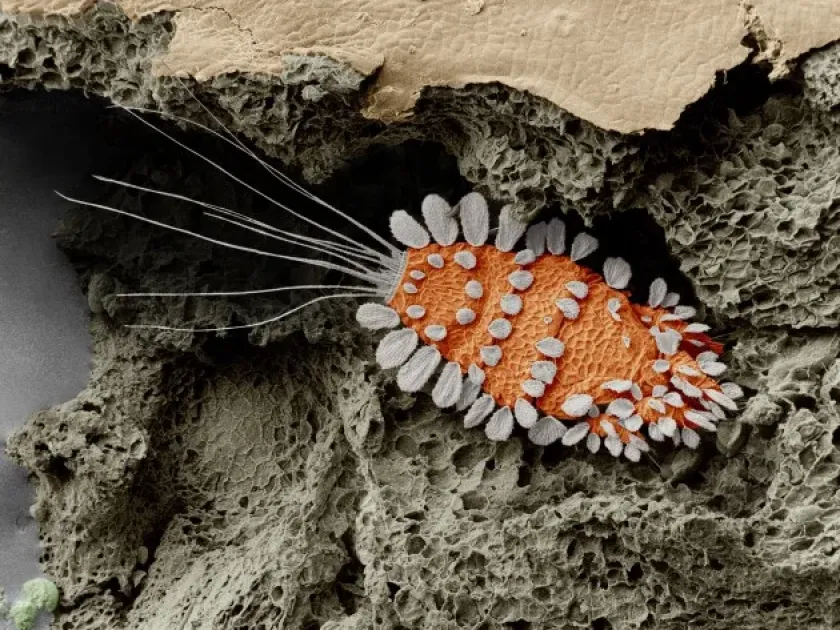
Description
How to identify
The Japanese peacock mite (Tuckerella japonica) is a tiny phytophagous mite belonging to the family Tuckerellidae. Adults are distinctively oval-shaped and possess long, ornate setae on the posterior of the abdomen, which resemble a peacock's tail.
The coloration of these mites ranges from bright red to deep maroon. Measuring roughly 0.3–0.4 mm in length, they are extremely difficult to detect with the naked eye, requiring magnification to be identified correctly on host plant surfaces.
Taxonomically, the species is placed within the order Trombidiformes. Their unique morphology includes specialized structures that allow them to maintain a firm grip on the waxy cuticle of fruits and leaves, preventing dislodgement.
Populations are predominantly female-based, and reproduction typically occurs through sexual mating. These mites prefer protected micro-habitats, such as the crevices near fruit stems or beneath bark scales, avoiding direct exposure to the environment.
A key diagnostic feature is the presence of white, thread-like exudates and molted skins, which create a dusty or web-like appearance on the surface of colonized fruits and leaves.
What it damages
The primary hosts for the Japanese peacock mite are citrus species, including lemons, oranges, and mandarins. However, it is also known to infest various ornamental shrubs common in subtropical and tropical gardening regions.
This pest targets both foliage and fruit. The damage to fruit is particularly significant, as the mite feeds on the epidermal cells of the peel, causing discoloration and surface damage that drastically reduces the market value of the produce.
Other host plants, such as tea bushes, have been reported in various literature sources. While the mite shows a strong preference for citrus, it may occupy other woody perennials, serving as a reservoir for further infestations.
Mites use their chelicerae to pierce plant cells and extract sap. This process causes localized necrosis and disrupts the plant's natural cuticle layer, potentially facilitating the entry of secondary fungal or bacterial pathogens.
Heavy infestations can weaken the entire tree, resulting in stunted shoot growth and premature leaf drop. In extreme cases, the overall health and vigor of the citrus trees are severely compromised over time.
When it appears
Activity levels of the Japanese peacock mite are closely tied to temperature and humidity. Warm conditions with temperatures ranging from +20°C to +28°C significantly accelerate the mite's life cycle, leading to multiple generations per year.
In regions with mild winters, the mite can remain active throughout the year, surviving on evergreen citrus foliage. During cold spells, they enter a state of reduced metabolic activity, sheltering in bark cracks or protected crevices.
Spring marks the beginning of high activity as temperatures rise and new plant growth emerges. Mites migrate to fresh buds and tender leaves to feed and deposit eggs, establishing the foundation for future seasonal populations.
Summer and autumn often see the highest population density, especially during periods of low rainfall. Drought conditions are highly favorable for this mite, as they thrive while the host plant's resistance is lowered by water stress.
As autumn transition temperatures decline, the rate of development slows down. Nevertheless, the mites continue to feed until cold weather forces them into their overwintering sites, where they remain until the next favorable season.
Signs of infestation
The most visible symptom is a silvery or greyish discoloration on the surface of the fruit peel. This occurs because the mite removes cellular contents, leaving the epidermis looking washed-out and bleached.
On leaves, the presence of the mite manifests as tiny yellow or necrotic stippling marks. As the colony grows, these marks coalesce, leading to widespread yellowing and, in severe cases, leaf chlorosis and drop.
The presence of fine, white, string-like structures on the fruit calyx is a definitive sign. These are often the discarded skins of the mites and are easily visible under a hand lens during routine orchard inspections.
Affected fruit often becomes firm and loses its natural gloss, making it more prone to dehydration during post-harvest storage. This degradation is a major quality issue for commercial fruit growers.
When inspecting for the pest, look closely at the junctions between the fruit stem and the tree branch, as well as the underside of leaves. The presence of small, moving red mites confirms the infestation.
Control measures
Effective control of the Japanese peacock mite relies on the strategic application of acaricides. It is essential to use products with systemic activity to ensure that mites hidden in bark crevices are also reached and neutralized.
Horticultural mineral oils are highly effective for management. They act by creating a physical film over the mites and their eggs, suffocating them and preventing further development without the need for toxic chemicals.
- Implement regular pruning to improve orchard airflow.
- Maintain optimal tree hydration to improve natural stress resistance.
- Introduce predatory phytoseiid mites as a biological control agent.
- Clear debris and weeds around the base of trees to eliminate reservoirs.
Integrated Pest Management (IPM) is the most sustainable approach. This involves periodic monitoring of mite populations and applying chemical interventions only when threshold levels are exceeded, preserving beneficial insect populations.
Always adhere to the specific pre-harvest intervals for any applied pesticides. Proper timing ensures that the fruit remains safe for consumption while maximizing the efficacy of the treatment against the mite population.
Taxonomy
- Latin name
- Tuckerella japonica
- Order
- Mites
- Family
- Tuckerellidae
- EPPO code
- TUCKJA
Discussion
No discussions yet — be the first.