
Peacock mite
Tuckerella ablutus
Description
How to identify
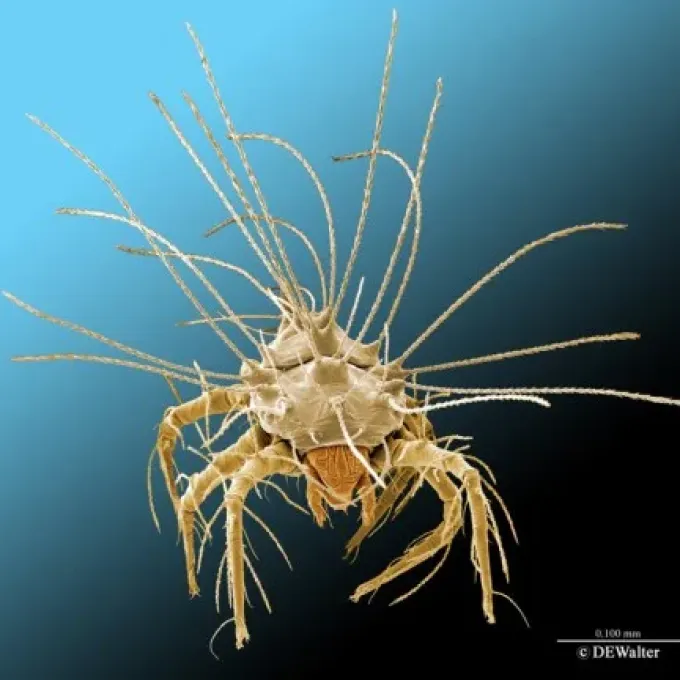
The peacock mite (Tuckerella ablutus) belongs to the Tuckerellidae family (order Trombidiformes). This microscopic pest gets its common name from the long, fan-like setae on the posterior of its body, which resemble a peacock's tail.
Adults are typically bright red or orange, making them visible under magnification against green foliage. Their bodies are flattened and oval-shaped, measuring approximately 0.3 mm in length.
The life cycle consists of egg, larva, protonymph, deutonymph, and adult stages. Unlike many other mite species, Tuckerella species generally have slower development, which limits their population explosion during a single season.
Females lay their eggs directly on leaf surfaces, twigs, or fruits, often securing them with fine silk threads. Dry and warm weather conditions are most favorable for their reproduction and development.
This mite leads a rather cryptic life, preferring to settle in leaf axils, bark crevices, and near the fruit stalks, which makes early detection difficult during routine orchard inspections.
What it damages
The peacock mite is a polyphagous pest that primarily causes significant economic damage to subtropical and tropical crops, with citrus plantations being particularly susceptible to infestations.
Besides citrus, this pest has been recorded on tea plants, grapes, and various ornamental species. The mites feed by sucking cell sap, which disrupts the normal metabolic processes of the plant.
The most critical impact is seen on fruit, where even low mite populations can ruin the aesthetic appearance of the produce by causing necrotic spots and discoloration on the rind.
Infested young shoots exhibit stunted growth and brittleness; in cases of severe infestation, premature leaf drop and a significant decline in overall yield are commonly observed.
Chronic feeding by these mites weakens the plant, making it significantly more susceptible to secondary fungal and bacterial pathogens that enter through the feeding lesions.
Signs of infestation
The first signs of a Tuckerella ablutus infestation include yellowish spots or chlorosis on the leaves, which gradually coalesce as the mite colony expands and continues to feed.
Characteristic silvery or brown patches appear on the fruits due to the breakdown of the epidermis and subsequent oxidation of the plant tissues at the feeding sites.
Upon closer inspection of the twigs with a hand lens, one can often detect fine, silken webbing that the mites use to anchor themselves to smooth surfaces like leaves and stems.
Leaves may show signs of deformation and curling, accompanied by tiny puncture marks on the underside, often resulting in distinct color changes along the leaf veins.
If the population density reaches high levels, a dust-like film becomes visible on the surface of fruits and leaves, composed of shed larval skins (exuviae) and mite excreta.
Control measures
The primary control strategy involves regular monitoring of plantations to detect the presence of the mite before it reaches levels that cause significant economic harm.
The application of contact and systemic acaricides is the most effective approach for managing populations during the growing season when the economic threshold has been surpassed.
It is crucial to rotate pesticides from different chemical classes to prevent the development of resistance within the mite population, a common challenge in intensive fruit production.
Cultural practices, such as proper pruning and canopy thinning, are essential to improve air circulation, thereby reducing humidity levels that are favorable for mite proliferation.
Biological control using natural predators, such as predatory mites (phytoseiids), has proven highly effective in greenhouse environments and integrated pest management programs.
Taxonomy
- Latin name
- Tuckerella ablutus
- Order
- Mites
- Family
- Tuckerellidae
- EPPO code
- TUCKAB
Discussion
No discussions yet — be the first.