
Thuja mite
Trisetacus thujivagrans
Description
How to identify
The Thuja mite (Trisetacus thujivagrans) is a member of the Eriophyidae family, commonly known as gall or rust mites. These pests are extremely small, measuring approximately 0.2 mm, making them invisible to the naked eye.
They possess a worm-like, elongated body that is typically pale yellow or translucent. A defining feature of these mites is the presence of only two pairs of legs, located at the anterior end of their body, which is a key characteristic of the Eriophyidae family.
Unlike spider mites, the Thuja mite does not produce webbing. They lead a cryptic life, nesting deep within the scales of the foliage, buds, and the axils of young shoots. This hidden lifestyle makes them challenging to detect until damage becomes significant.
The life cycle is tightly synchronized with the host plant's phenology. Reproduction occurs throughout the growing season, with eggs deposited in concealed spots, ensuring the survival and spread of the population across the tree.
Overwintering occurs as adults and nymphs sheltered in buds or beneath bark scales. As spring temperatures rise, the mites emerge from their dormancy and resume feeding on the sap of newly developing plant tissues.
What it damages
The primary host for this pest is Thuja occidentalis (Arborvitae), though it can also infest various juniper and cypress species. Plants under environmental stress, such as drought or poor soil conditions, are particularly susceptible to severe infestations.
The mites feed by piercing plant cells and extracting sap. During this process, they inject saliva containing enzymes that interfere with cell development, leading to stunted growth and abnormal formation of the foliage.
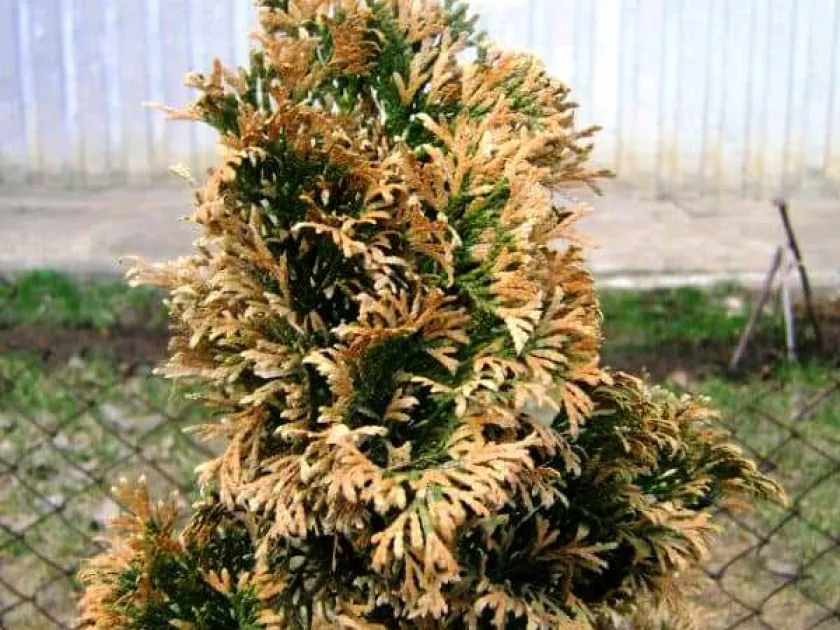
Continued feeding causes the foliage to lose its natural green luster, eventually turning yellow and brown. This damage not only ruins the plant's aesthetic appearance but also leads to premature needle drop and twig dieback.
Severe infestations weaken the tree significantly, making it vulnerable to secondary infections, such as fungal pathogens. In nursery settings, the mite can cause substantial economic losses due to the stunted and deformed growth of young stock.
Because the mites are dispersed by wind and insect vectors, they can spread rapidly through closely planted hedges or nurseries, creating localized hotspots of infection that require immediate attention.
Signs of infestation
Early symptoms of a Thuja mite infestation often manifest as localized discoloration of the foliage. The needles may turn pale green or yellow, often mistaken for natural senescence or minor environmental stress.
A distinctive sign is the distortion of young shoots, which may appear curved or thickened. This occurs because the mites specifically target the active growth points, disrupting the normal elongation process of the twigs.
Under magnification, affected foliage may look dry and brittle even when the plant has received adequate water. Unlike fungal infections, which often show visible spores or mycelium, mite damage is characterized by clean but deformed tissue.
The lack of webbing helps differentiate this pest from common spider mites. If the inner foliage shows symptoms of thinning and yellowing while the outer tips remain stunted, a Thuja mite presence is highly probable.
- Pale yellowing or browning of foliage tips.
- Stunted growth of the current season's shoots.
- Distorted or curved appearance of young branches.
- Premature needle fall.
- General loss of density in the plant canopy.
Control measures
Effective control requires the use of specialized acaricides. Standard insecticides are often ineffective against eriophyid mites. Products containing active ingredients like abamectin or spirodiclofen are generally recommended for professional management.
Systemic products are most effective as they move within the plant tissues, providing longer-lasting protection against the mites that are hiding deep within the foliage scales.
A multi-application schedule is essential. Because eggs are often protected from chemical contact, treatments should be spaced 10–14 days apart to target emerging nymphs and ensure the entire life cycle is interrupted.
Cultural practices play a crucial role in management. Pruning and disposing of heavily infested branches can significantly reduce the mite population. Ensuring proper irrigation and nutrition helps the tree recover and strengthens its natural defenses.
Early detection is the key to minimizing damage. Gardeners should monitor their evergreens regularly during the spring and summer, especially after warm winters, as these conditions favor rapid mite reproduction.
Taxonomy
- Latin name
- Trisetacus thujivagrans
- Order
- Mites
- Family
- Phytoptidae
- EPPO code
- TRSETH
Discussion
No discussions yet — be the first.