
Spruce needle mite
Nalepella tsugifoliae
Description
How to identify
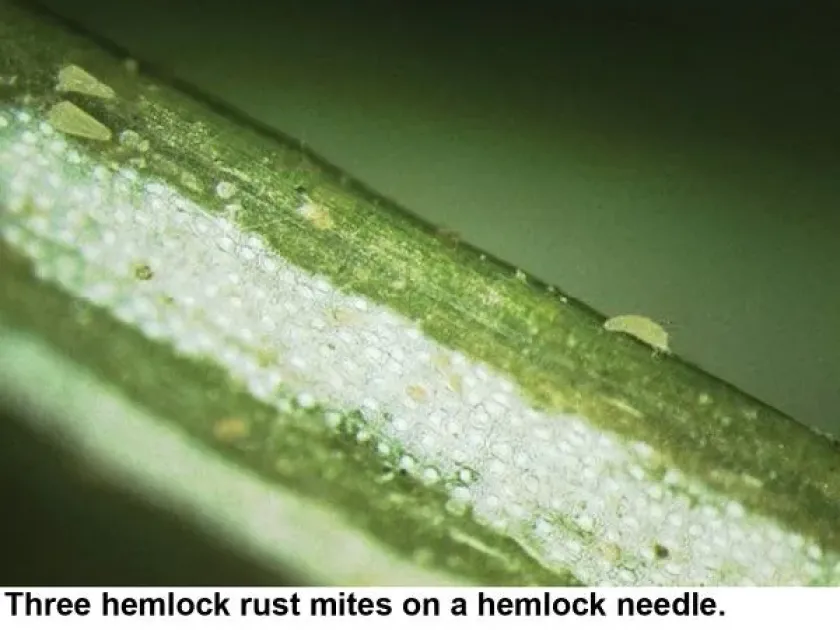
The spruce needle mite (Nalepella tsugifoliae) belongs to the family Eriophyidae, known as gall or rust mites. It is a microscopic pest that cannot be seen with the naked eye due to its extremely small size.
The body of the mite is worm-like, elongated, and typically yellowish-white or cream in color. Unlike spider mites, they possess only two pairs of legs located at the front of the body, which is a key diagnostic feature of eriophyid mites.
Their life cycle consists of egg, larva, nymph, and adult stages. All development occurs directly on the needles, where these pests feed on plant juices by piercing the epidermis.
These mites lead a secretive lifestyle, often hiding at the base of the needles or under bud scales, which makes early detection difficult during standard visual inspections.
For accurate identification, agronomists use the "beating" method over a white sheet of paper or examine needles under a microscope or a 10x magnification lens to observe the movement of the mites.
What it damages
The primary hosts for this mite are trees in the genus Tsuga (hemlock), but it can also cause significant damage to various species of spruce (Picea).
The mite tends to target weakened specimens or trees growing in suboptimal environmental conditions. Nursery stock and ornamental garden plantings are particularly susceptible to infestations.
Damage is caused by the systemic depletion of the plant. As mites feed, they remove cellular contents, which disrupts photosynthesis and overall metabolism within the needle tissues.
Severe infestations lead to premature needle drop, which critically weakens the tree, reducing its aesthetic value and increasing its susceptibility to secondary diseases and pests.
In large parks or plantations, widespread mite populations can cause partial crown dieback, requiring professional intervention to manage the spread.
When it appears
Activity of Nalepella tsugifoliae begins in early spring as soon as average daily temperatures become consistently positive. It is one of the first pests to emerge in the growing season.
The population peak usually occurs during the period of active sap flow and the development of new shoots, when mites transition to fresh, nutrient-rich foliage.
During hot and dry summer months, development may slow down or enter a state of dormancy, as high temperatures and moisture stress inhibit the activity of many eriophyid species.
A second, less intense wave of activity may be observed in the autumn as the mites prepare for the upcoming winter.
Adult females typically overwinter in sheltered locations, such as bark crevices, bud axils, or at the base of the needles, remaining viable until the following spring.
Signs of infestation
The first sign of infestation is a change in needle color: it becomes dull, yellowish-brown, or rusty, starting from the lower part of the crown or inner shoots.
Distortion of young shoots and partial dieback are common symptoms, resulting from the toxic effect of the mite's saliva injected into the plant tissue during feeding.
Upon closer inspection, a light gray, dusty layer may be visible on the needles, which consists of waste products and cast-off skins (exuviae) left behind by the mites.
- Yellowing and premature shedding of needles.
- Reduced shoot growth in the current season.
- Curling or deformation of young needles.
- General loss of plant vigor and turgor.
- Presence of microscopic organisms visible under 10x magnification.
If left unmanaged, the aesthetic quality of the plant is permanently compromised, and severe cases may result in the death of individual branches or the entire tree.
Control measures
Controlling Nalepella tsugifoliae requires a targeted approach, as standard insecticides are often ineffective against this specific type of mite.
It is necessary to use specialized acaricides with systemic or contact action. Rotating products with different active ingredients is crucial to prevent the development of pesticide resistance.
Good cultural practices are essential: ensure optimal watering, apply balanced fertilizers, and perform timely pruning of infested branches to improve air circulation within the crown.
Preventive spraying should be conducted in early spring, before bud break, to significantly reduce the overwintering female population.
Biological control methods, such as encouraging natural predators (e.g., phytoseiid mites), can be effective in sustainable landscapes and organic plant nurseries.
Taxonomy
- Latin name
- Nalepella tsugifoliae
- Order
- Mites
- Family
- Phytoptidae
- EPPO code
- NALETS
Discussion
No discussions yet — be the first.