
Pine bud mite
Trisetacus strobiphagus
Description
How to identify
The pine bud mite is a microscopic arachnid belonging to the family Phytoptidae, part of the Eriophyoidea superfamily of plant-inhabiting mites.
Measuring only about 0.2 to 0.3 millimeters in length, these pests are invisible to the naked eye and require specialized equipment for accurate identification.
They possess a worm-like, elongated body with a pale or yellowish appearance, characterized by having only two pairs of legs situated near the front of the body.
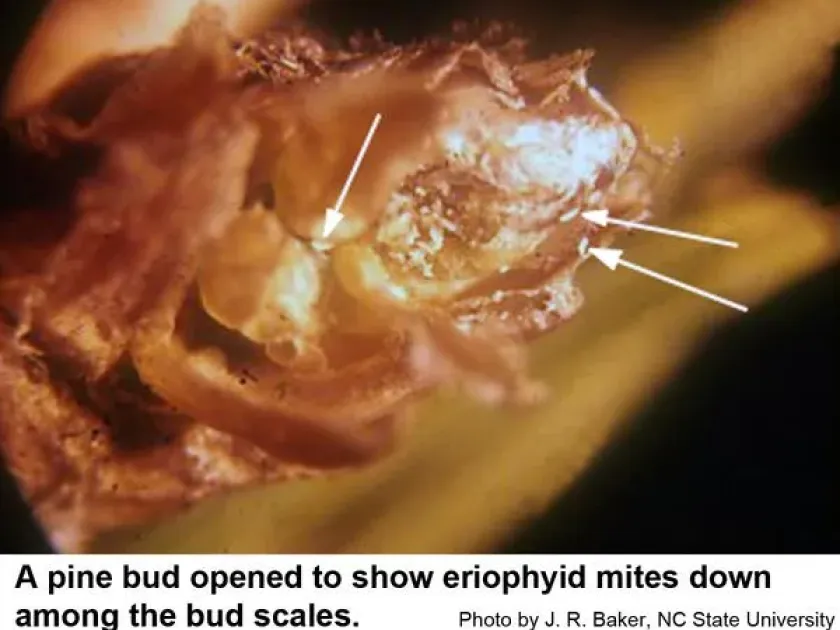
These mites are highly specialized to reside and feed within the protected spaces between the scales of pine buds, which serves as their primary habitat.
Their biology is closely tied to the host plant, as they depend entirely on the sap and cellular contents of the developing pine bud tissues for survival.
What it damages
The pine bud mite primarily attacks various pine species, including both native and ornamental varieties found in forestry and landscape settings.
By feeding on the bud tissues, they disrupt normal hormonal growth processes, leading to the distortion and retardation of shoot elongation.
Heavy infestations can cause significant stunting of young trees, resulting in reduced height, loss of vigor, and a diminished commercial or aesthetic value.
In ornamental gardens, affected trees exhibit unsightly, deformed growth patterns that significantly detract from their natural beauty and healthy appearance.
Persistent infestations compromise the overall health of the tree, creating entry points for secondary pathogens and making the plant vulnerable to environmental stress.
When it appears
Activity typically begins in the early spring, as temperatures rise and the pine tree resumes metabolic activity, prompting the buds to start swelling.
The mite completes several generations throughout the growing season, which allows the population to multiply rapidly under favorable spring and summer conditions.
The migration phase, when mites move between buds, often coincides with the period of spring bud expansion, which is a critical window for control measures.
As autumn approaches, the mites seek refuge deeper within the bud scales to overwinter, remaining dormant until the return of warmer weather conditions.
Mild and humid spring weather often accelerates the life cycle of the mites, potentially leading to more severe damage later in the growing season.
Signs of infestation
A primary symptom of infestation is the development of deformed, enlarged, or bulbous buds that fail to open normally during the growing season.
Affected shoots often show reduced needle length, chlorosis, or a twisted appearance due to the internal damage inflicted on the meristematic tissues.
A lack of annual shoot growth is frequently observed on infested branches, which eventually leads to the dieback of terminal and lateral buds.
Examining the scales of the bud under a microscope reveals the presence of mite colonies, which is the most reliable way to confirm the cause of the damage.
Over time, the tree crown may appear sparse and distorted, with a high incidence of dead bud sites that inhibit the formation of healthy new growth.
Control measures
The most effective management approach involves early detection through regular scouting, particularly in nursery environments where young pines are concentrated.
Chemical control usually requires the application of systemic acaricides capable of penetrating the bud scales to reach the hidden mite populations.
Sanitation practices, such as pruning and destroying heavily infested branches during the dormant season, can significantly reduce the overwintering population.
Maintaining optimal tree vigor through proper irrigation and nutrition helps the plants withstand mite-induced stress and facilitates better recovery.
- Apply approved acaricides during the spring migration period.
- Avoid over-fertilizing with nitrogen, which can encourage mite reproduction.
- Use clean, certified nursery stock to prevent introducing the pest.
- Conduct regular monitoring to time control applications effectively.
Taxonomy
- Latin name
- Trisetacus strobiphagus
- Order
- Mites
- Family
- Phytoptidae
- EPPO code
- TRSESR
Discussion
No discussions yet — be the first.