
Juniper eriophyid mite
Trisetacus neoquadrisetus
Description
How to identify
The juniper eriophyid mite (Trisetacus neoquadrisetus) belongs to the Eriophyidae family within the order Acariformes. These pests are extremely small, usually measuring between 0.2 and 0.3 millimeters, and have a distinct worm-like body structure.
Unlike common spider mites, these organisms possess only two pairs of legs situated near the head. Their microscopic size and lack of webbing make them difficult to detect during the early stages of infestation.
Their life cycle is highly specialized, confined primarily to the tender tissues of juniper species. The mites overwinter within the buds or beneath the scales of the needles, becoming active as temperatures rise in the spring.
As a highly host-specific pest, the juniper eriophyid mite has evolved to thrive on specific coniferous hosts. They reproduce rapidly, often completing several generations within a single growing season under favorable conditions.
Identification is best confirmed through microscopic examination, as visual symptoms are often confused with other abiotic stressors or fungal pathogens that affect the foliage of conifers.
What it damages
This mite primarily infests various species of juniper. They specifically target young shoots and developing buds, which provide the essential nutrients required for their survival and reproduction.
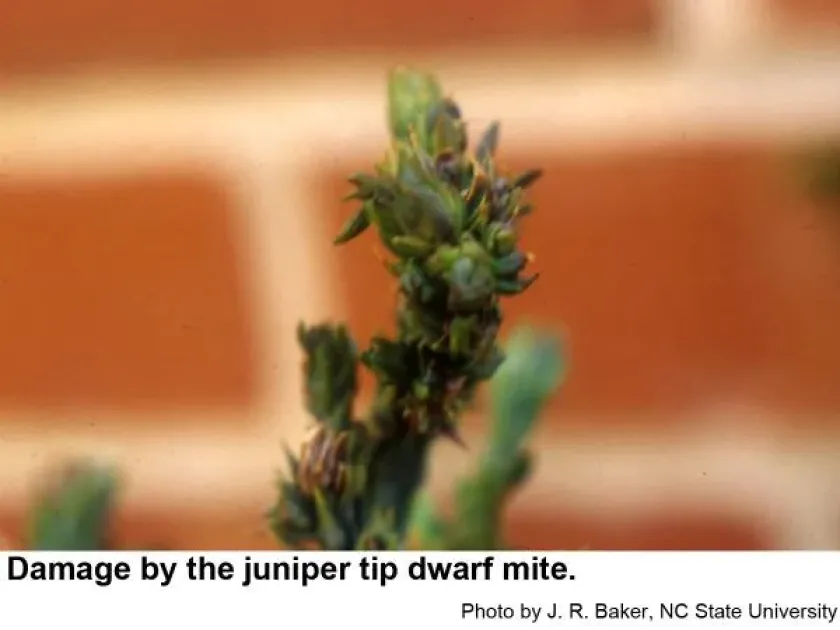
Feeding activity induces abnormal cell growth, resulting in the formation of galls. These structures provide a sheltered environment for the mites, allowing them to remain protected from predators and external environmental impacts.
The damage caused by these mites manifests as stunted growth, twisted needles, and overall loss of plant vigor. The foliage becomes deformed, leading to a significant decrease in the aesthetic value of the ornamental bushes.
In severe infestations, the cumulative damage can lead to branch dieback. The plant loses its ability to photosynthesize effectively, making it highly susceptible to further decline or secondary infections by opportunistic pathogens.
In nursery settings, the economic impact is high because infested stock is often unsalable due to the permanent disfigurement caused by the galls and needle yellowing.
Signs of infestation
The most common sign of infestation is the cessation of growth in terminal shoots during the spring. Buds may fail to open, appearing swollen, clumped, or deformed.
Needles on affected twigs undergo discoloration, shifting from deep green to pale yellow or brownish shades. Eventually, the needles dry out and drop, leaving the interior of the plant canopy thin and ragged.
A characteristic symptom is the development of "witches' broom" formations or compact needle rosettes at the tips of the shoots. This is a clear indicator of physiological stress caused by the mites feeding on the meristematic tissues.
Using a hand lens, you may observe the mites themselves gathered at the base of the needles or inside the deformed buds. They typically appear as tiny, translucent, or yellowish moving dots.
Initial signs often start from the inner parts of the shrub, spreading outward. If not addressed, the entire crown of the plant may lose its characteristic healthy shape and color within one or two seasons.
Control measures
Effective control requires a multi-faceted approach. Cultural practices, such as the pruning and immediate disposal of heavily infested branches, are essential to reduce the overall mite population in the garden.
Chemical control is challenging because the mites are hidden within the plant tissues. The use of systemic acaricides is recommended, as these chemicals are absorbed by the plant and kill the mites upon feeding.
Applications should be timed to coincide with the periods of maximum mite migration. Two to three sprays spaced several weeks apart are usually necessary to effectively break the life cycle of the pest.
Maintaining plant health through proper irrigation and fertilization improves the host's natural defenses, making it more resilient to mite attacks and faster to recover from minor damage.
- Prune and destroy all visibly infested twigs.
- Apply systemic acaricides during the active growing season.
- Monitor young shoots regularly for signs of deformation.
- Avoid over-fertilizing, which can encourage the soft growth favored by the mites.
Taxonomy
- Latin name
- Trisetacus neoquadrisetus
- Order
- Mites
- Family
- Phytoptidae
- EPPO code
- TRSENE
Discussion
No discussions yet — be the first.