
Larch bud mite
Trisetacus laricinae
Description
How to identify
The Larch bud mite (Trisetacus laricinae) is a microscopic pest belonging to the Eriophyidae family. Due to its extremely small size, it is virtually invisible to the naked eye.
Adult mites are worm-like in shape, measuring approximately 0.2 mm in length, and possess only two pairs of legs, which is typical for this specific family of mites.
These pests inhabit the internal scales of larch buds, where they are protected from environmental fluctuations, predators, and conventional surface pesticide treatments.
Taxonomically, they are specialized herbivores that have evolved to live within the tissues of specific coniferous hosts, often causing developmental abnormalities.
Field identification is difficult and typically requires microscopic examination of the bud scales to confirm the presence of the mite colonies.
What it damages
The primary hosts for this pest are Larch trees (Larix), where mites feed on the succulent tissues inside the buds, affecting both vegetative and generative growth.
Feeding activity disrupts the development of the bud meristem, often resulting in deformed buds that fail to open correctly during the spring season.
Heavy infestations can significantly stunt the annual growth of branches, leading to a loss of vigor and reduced overall aesthetic appeal of the tree.
In nursery settings, damage to terminal buds is particularly detrimental, as it causes crooked growth and may lead to the loss of the tree's apical dominance.
Chronic infestation weakens the tree, making it more susceptible to secondary environmental stresses and potential colonization by opportunistic fungal pathogens.
When it appears
The life cycle of the Larch bud mite is strictly synchronized with the phenology of the Larch tree, beginning its activity in early spring as temperatures rise.
The most critical period for dispersal occurs during late spring, when mites migrate from old, damaged buds to newly formed ones to establish new colonies.
Throughout the summer months, the mites undergo several generations of development, maintaining a persistent presence within the bud tissues.
As autumn approaches and dormancy begins, the mites retreat deeper into the developing buds, where they will spend the winter protected from cold weather.
Warm, dry spring conditions generally favor the survival and reproduction of the mite population, leading to higher infestation levels in the subsequent season.
Signs of infestation
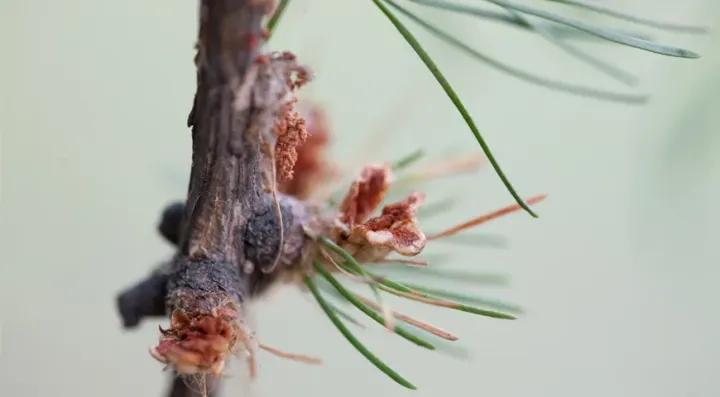
Early symptoms of an infestation include the failure of buds to open in spring, or their appearance as stunted, shriveled, or abnormally shaped growths.
Damage often manifests as discolored or darkened bud scales, which stand out when compared to the healthy, vibrant buds on the same branch.
- Delayed or incomplete bud break in spring.
- Distorted or curved shoots on young branches.
- Premature needle drop near infested bud sites.
- Reduced growth rate of the canopy.
- Increased presence of secondary fungal growth on damaged tissue.
Under magnification, one can observe high concentrations of mites residing within the crevices of the scales and feeding on the soft internal tissue.
Visual signs are often overlooked until the tree exhibits noticeable growth loss, making periodic monitoring of larch plantations essential for early detection.
Control measures
Controlling the Larch bud mite is challenging because the mites are sheltered within the bud scales for the vast majority of their life cycle.
The most effective strategy involves the application of systemic acaricides during the specific period when mites are migrating between buds in early spring.
Cultural practices, such as the pruning and destruction of heavily infested branches, help to reduce the overall mite population in the immediate area.
Maintaining high tree vitality through appropriate watering and fertilization programs can help the larch tolerate mite feeding better than stressed trees.
It is recommended to use diverse control methods and avoid over-reliance on a single pesticide to prevent the development of acaricide resistance within the mite population.
Taxonomy
- Latin name
- Trisetacus laricinae
- Order
- Mites
- Family
- Phytoptidae
- EPPO code
- TRSELA
Discussion
No discussions yet — be the first.