
Conifer mite
Trisetacus
Description
How to identify
The conifer mite belongs to the Eriophyidae family, also known as eriophyid or gall mites. These are extremely small pests, invisible to the naked eye.
Their bodies are elongated and worm-like, usually pale white or yellowish. A distinctive taxonomic feature is having only two pairs of legs situated anteriorly.
The biological cycle of Trisetacus is strictly linked to plant tissues. They reside and feed under needle scales or deep within the plant buds.
Due to their sheltered habitat, they are well-protected from direct exposure to contact insecticides and environmental fluctuations.
Professional identification requires microscopic examination, as the symptoms caused by these mites can easily be mistaken for physiological disorders.
What it damages
Conifer mites primarily infest various Cupressaceae species, with Juniperus, Thuja, and Taxus being the most common hosts.
They feed on sap by piercing plant tissues, which disrupts the normal development of needles and shoots during the growing season.
The infestation is often localized at first, but if left unmanaged, it can spread throughout the entire tree crown over several seasons.
Damage includes stunted growth, needle discoloration, and the development of abnormal, deformed shoot structures known as galls.
Chronic infestation weakens the plant significantly, making it susceptible to secondary pathogens and reducing its overall aesthetic appeal.
When it appears
Activity begins in early spring as temperatures rise, signaling the mites to emerge from their overwintering sites in buds.
Multiple generations occur throughout the year, with the population density peaking during the warm and active vegetative growth phase.
Peak damage is typically observed during late spring and early summer when the soft, succulent tissues of new growth are most accessible.
As autumn approaches, mites move back into the protective niches of the buds to enter a state of dormancy during the winter months.
Hot and dry weather conditions are highly conducive to rapid multiplication, often leading to significant outbreaks in nurseries and landscape plantings.
Signs of infestation
Early symptoms include a subtle lack of vigor and a transition from vibrant green to a dull, yellowing or bronzed appearance of the needles.
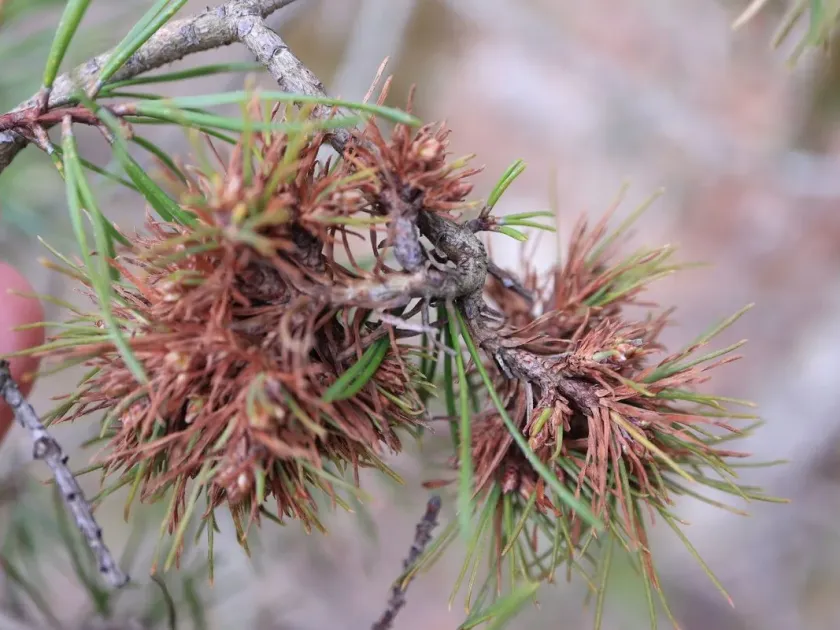
Shoot distortion is a hallmark sign, where new growth becomes twisted, shortened, or exhibits an abnormal, bushy appearance.
The presence of small, woody galls or localized proliferation of stems, often referred to as "witch's brooms," is a strong indicator of mite activity.
Progressive dieback of branch tips often occurs, leading to a thin, sparse crown that significantly diminishes the plant's health and beauty.
Unlike spider mites, conifer mites do not produce visible silk webbing, which often causes the pest to go unnoticed until extensive damage is present.
Control measures
Effective control requires the use of specific acaricides, as many standard contact insecticides fail to manage eriophyid mite populations.
Systemic products are preferred, as they are translocated within the plant tissues where the mites dwell, ensuring better mortality rates.
- Apply treatments systematically, with 2-3 applications spaced 10–14 days apart to target different life stages.
- Prune and destroy heavily infested branches to reduce the overall population pressure in the garden.
- Ensure plants are well-watered and fertilized to enhance their natural resistance and recovery capability.
Monitoring for initial signs of distortion in early spring is crucial for implementing timely treatments and preventing long-term damage.
Taxonomy
- Latin name
- Trisetacus
- Order
- Mites
- Family
- Phytoptidae
- EPPO code
- TRSESP
Discussion
No discussions yet — be the first.