

Description
How to identify
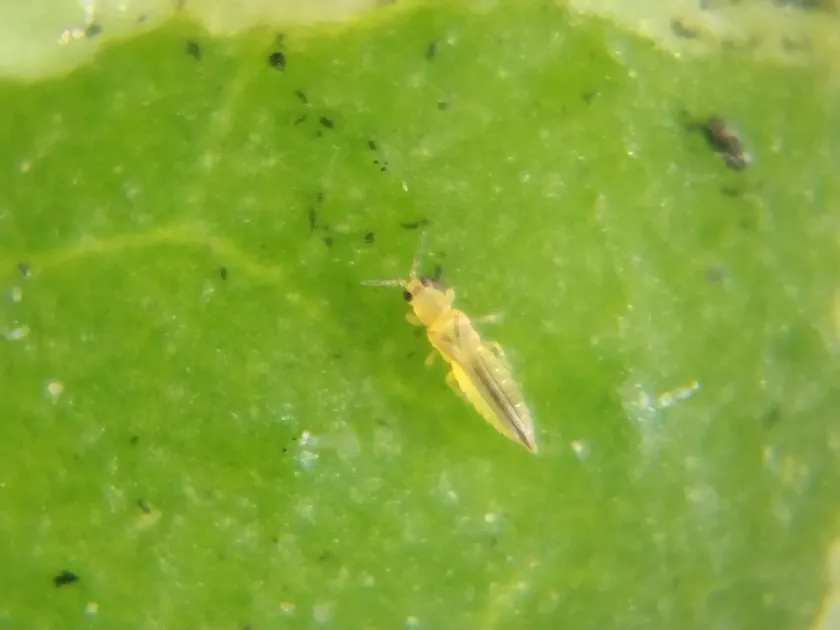
Thrips, belonging to the order Thysanoptera, are tiny, slender insects measuring between 0.5 and 2 mm in length. They typically possess two pairs of long, thin wings fringed with hairs, which gives them their scientific name. Their coloration varies from pale yellow to dark brown or black.
The life cycle of a thrips consists of several stages: egg, larva, prepupa, pupa, and adult. Unlike many other insects, the pupal stages of many thrips species often occur in the soil, making them difficult to target during the development cycle.
They overwinter as adults in protected environments, such as deep in the soil, under plant debris, or within the bark of trees. As temperatures rise in spring, they emerge to infest young plant tissues and begin their reproductive phase.
Thrips have piercing-sucking mouthparts that they use to puncture plant cells and extract the sap. This method of feeding destroys the cellular structure of leaves and buds, causing significant physiological stress to the host plant.
Due to their high reproductive rate and short generation time—often just two weeks in warm conditions—thrips populations can explode in a very short period, making them a major challenge for agricultural and horticultural production.
What it damages
Thrips are polyphagous pests that attack a wide variety of crops, including vegetables like peppers and tomatoes, ornamental flowers such as roses, and numerous fruits. Their feeding behavior results in stunted growth and deformed plant parts.
Beyond direct physical damage, thrips are notorious vectors for various plant viruses, particularly tospoviruses. These viruses can cause systemic infections that stunt plant growth and drastically reduce fruit quality and quantity.
Feeding on leaves causes a silvery or bleached appearance as air enters the empty plant cells. This reduces the leaf surface area capable of photosynthesis, which weakens the plant and lowers its overall vigor and potential yield.
When thrips infest flowers, they cause discoloration, streaks, and deformities on petals. In extreme cases, the buds may fail to open entirely, resulting in total loss of the flower crop for commercial growers.
Fruit damage manifests as scarring or "crusty" patches on the surface, which significantly lowers the market value of the produce. These damaged areas can also serve as entry points for secondary bacterial or fungal pathogens.
Signs of infestation
The earliest sign of thrips infestation is the presence of small, light-colored streaks or silvery stippling on the leaves. These patches are caused by the insect draining the sap from individual cells.
Small, black spots, which are the fecal droppings of the thrips, are a reliable indicator of their presence on the underside of leaves. You may also find tiny shed skins from the larval stages near the feeding sites.
Leaf curling, crinkling, and distortion of the growing tips are common signs of heavy infestation. Plants infested early in their growth cycle often show significant developmental delays compared to healthy specimens.
Flower petals may show brown necrotic spots or uneven streaking. These cosmetic defects are often the first sign noticed by growers in ornamental greenhouses, signaling that a large population has already established.
Sticky traps, particularly blue-colored ones, are highly effective for detecting and monitoring adult thrips. They provide a clear visual indication of how severe an infestation is in a field or greenhouse setting.
Control measures
Effective thrips management relies on integrated pest management (IPM) practices. This involves sanitation, such as removing weeds and plant debris that harbor overwintering populations, to break the pest's life cycle.
Greenhouse hygiene is paramount. After harvesting, deep cleaning and soil sterilization are essential to eliminate pupae hiding in the ground, preventing the next generation from attacking the new crop.
Biological control agents, such as predatory mites (Amblyseius spp.) and minute pirate bugs (Orius spp.), are highly effective at suppressing thrips populations naturally without the need for synthetic chemicals.
Chemical control should be implemented using systemic insecticides that penetrate plant tissues where thrips hide. It is critical to rotate between different chemical classes to prevent the development of resistant populations.
- Regular monitoring with sticky traps.
- Proper irrigation to maintain plant vigor.
- Use of insect-proof netting in greenhouses.
- Prompt removal and destruction of heavily infested plants.
- Consistent application of bio-insecticides when populations are low.
Content graph
Connections · Thrips
Most often together:
Marketplace
Products · 185


Biology
Taxonomy
- Latin name
- Thysanoptera
- Order
- Thrips
- EPPO code
- 1THYSO
Community
Discussion
No discussions yet — be the first.