
Black flour beetle
Tribolium madens
Description
How to identify
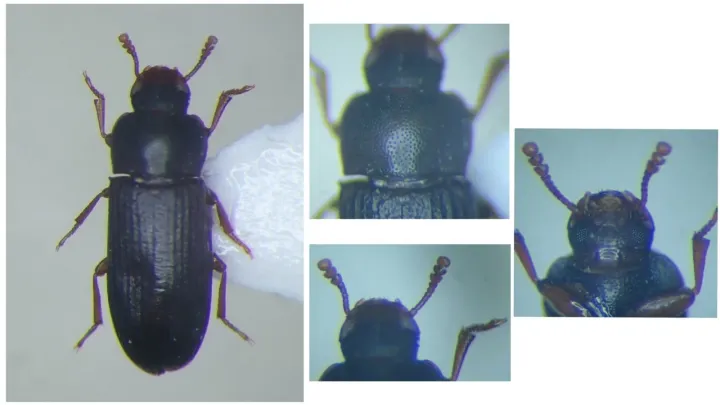
The Black flour beetle (Tribolium madens) belongs to the Tenebrionidae family and is a significant pest of stored grain products worldwide.
Adult beetles are approximately 4–5 mm long, with a robust, elongated body that ranges from dark reddish-brown to deep black in color.
The larvae are cylindrical and yellow-white, reaching about 6–7 mm in length; they are often found deep within the grain mass or flour piles.
The life cycle undergoes complete metamorphosis, consisting of the egg, larva, pupa, and adult stages, with development highly dependent on temperature and humidity levels.
These insects are elusive, preferring dark, sheltered environments where they can feed and reproduce undisturbed within grain silos or warehouses.
What it damages
This pest primarily attacks milled grain products, including flour, bran, and various types of grain kernels like wheat, barley, and corn.
Larval feeding causes the most severe damage as they consume the endosperm and germ of the grain, leading to weight loss and degradation of grain quality.
Beyond direct consumption, their presence leads to significant contamination through feces, shed larval skins, and webbing, which ruins entire stockpiles.
Contaminated grain often develops a foul odor and becomes susceptible to secondary infestation by fungi and moisture accumulation due to metabolic activity.
High infestation levels render grain unsuitable for milling or baking purposes, resulting in substantial financial losses for grain producers and distributors.
When it appears
The Black flour beetle is most active during the warmer months when ambient temperatures inside storage facilities remain between 25°C and 30°C.
In temperature-controlled storage or areas where grain piles heat up, the beetle can maintain a continuous breeding cycle throughout the year.
Peak migration and dispersal occur in the spring, as adults emerge from overwintering sites to seek new sources of food and suitable habitats.
During winter months, activity significantly slows down, though the beetles are resilient and can survive in structural gaps or grain residues in dormant states.
Sanitation practices during the off-season are critical, as neglected grain residues serve as the primary reservoir for the following year's pest population.
Signs of infestation
The most reliable sign of an infestation is the presence of floury dust on the surface of stored grain, created by the larvae as they feed.
One may notice adult beetles congregating near walls, equipment crevices, or areas where grain dust and debris have been allowed to accumulate.
- A noticeable musty or disagreeable odor emanating from the stored commodity.
- Clumping of flour or cereal products, which indicates larval activity and moisture presence.
- The presence of cast-off larval skins and insect excrement within the grain mass.
- Detection of living adult beetles during standardized sampling using sieves.
- A localized increase in the temperature of the grain bulk, often detected via sensors.
Control measures
Rigorous sanitation of storage facilities is the most effective preventative measure: cleaning all grain residues and dust before stocking new harvests.
Implementing cold storage or utilizing freezing temperatures during winter is highly effective in controlling populations without the use of synthetic chemicals.
If an infestation is detected, mechanical cleaning and screening of the grain are essential to separate the beetles and larvae from the healthy kernels.
Chemical control usually involves fumigation with phosphine-based agents, which must be performed by certified professionals following safety regulations.
Maintaining low grain moisture content (below 13%) is a crucial agronomic practice to suppress the growth rate of the beetle population and ensure long-term stability.
Taxonomy
- Latin name
- Tribolium madens
- Order
- Coleoptera (beetles)
- Family
- Tenebrionidae
- EPPO code
- TRIBMA
Discussion
No discussions yet — be the first.