
Confused flour beetle
Tribolium confusum
Description
How to identify
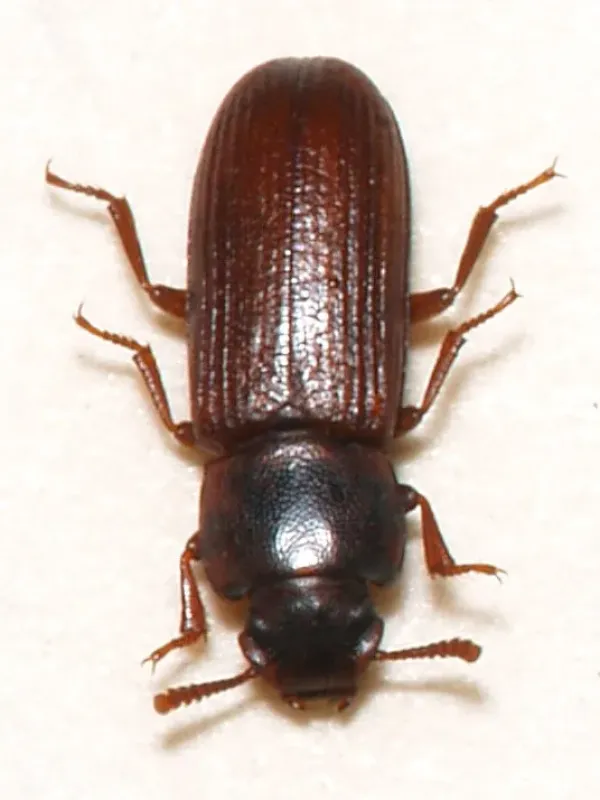
The confused flour beetle is a member of the darkling beetle family (Tenebrionidae). Adult beetles are small, measuring approximately 3–4 mm in length, with a flat, elongated, and reddish-brown body.
The name "confused" refers to the scientific classification confusion with other similar species. They are best identified by their antennae, which gradually enlarge toward the tip, forming a distinct 4-5 segmented club.
Larvae are cylindrical, yellowish-white in color, and reach about 6 mm in length. The terminal abdominal segment features two small, hook-like appendages directed upward, a key trait for accurate identification.
Pupae are white and soft, eventually turning darker as they mature. The species undergoes a complete metamorphosis, with the entire cycle occurring hidden within food supplies or warehouse debris.
The population can increase rapidly under favorable conditions. A single female can lay hundreds of eggs, and the generation time can be as short as one month in warm environments.
What it damages
This beetle is a serious pest of stored products, especially cereal grains, flour, and processed grain products. It is commonly found in flour mills, bakeries, and food processing plants.
They feed on a wide variety of materials including wheat, corn, barley, oats, bran, dry pet food, and spices. They are unable to feed on sound, undamaged whole grain but easily infest broken or milled kernels.
Feeding by larvae and adults causes substantial economic losses by reducing the weight of products and contaminating them with excreta, cast skins, and fragments of dead beetles.
Infested food develops an unpleasant, pungent odor caused by quinones secreted by the beetles, which can affect the quality of flour and baking properties.
In addition to food, this pest contributes to the heating and moisture buildup in bulk grain, which often leads to the growth of molds and further microbial degradation of the stored stock.
When it appears
The confused flour beetle is a cosmopolitan indoor pest. Since it thrives in heated buildings, it does not experience a seasonal cycle in the traditional sense.
Development is continuous throughout the year in warehouses, mills, and homes as long as temperature and moisture levels are maintained above their lower thresholds.
The optimal temperature for rapid growth and reproduction is around 25-27°C. Under these conditions, the insect completes its life cycle very efficiently.
Winter dormancy does not occur in heated facilities; however, if the temperature drops below 10°C, all metabolic activity and reproduction of the beetles cease.
Migration between facilities typically occurs during the transportation of contaminated goods, raw materials, or reused packaging, allowing the pest to spread across different regions.
Signs of infestation
The most obvious sign of infestation is the presence of adult beetles crawling on the surface of flour, cereal bags, or inside storage containers.
A persistent, moldy, or pungent odor is a strong indicator of a high infestation level within a food storage area, signaling that the product quality is degraded.
Small clumps of flour or grain that stick together indicate larval activity, as larvae produce secretions that cause the fine particles to aggregate into clusters.
In mills and warehouses, accumulation of dust and fine particles in machinery gaps, floor crevices, and under equipment serves as a primary reservoir for the pest.
In grain silos, heating pockets within the grain mass are common signs that an insect infestation, including confused flour beetles, may be present and active.
Control measures
Sanitation is the most critical measure for preventing infestations. Regular cleaning of storage areas, removal of dust, and disposal of spilled grain help eliminate breeding sites.
- Applying residual insecticides to surfaces and cracks in empty warehouses.
- Using aerosol treatments to control flying adults in grain processing facilities.
- Ensuring proper moisture and temperature management in grain storage to discourage pest development.
- Implementing a rigorous inspection program for all incoming goods and transport vehicles to prevent introduction.
- Using professional fumigation techniques for sealed environments when heavy infestations are detected in grain stocks.
Taxonomy
- Latin name
- Tribolium confusum
- Order
- Coleoptera (beetles)
- Family
- Tenebrionidae
- EPPO code
- TRIBCO
Discussion
No discussions yet — be the first.