
American black flour beetle
Tribolium audax
Description
How to identify
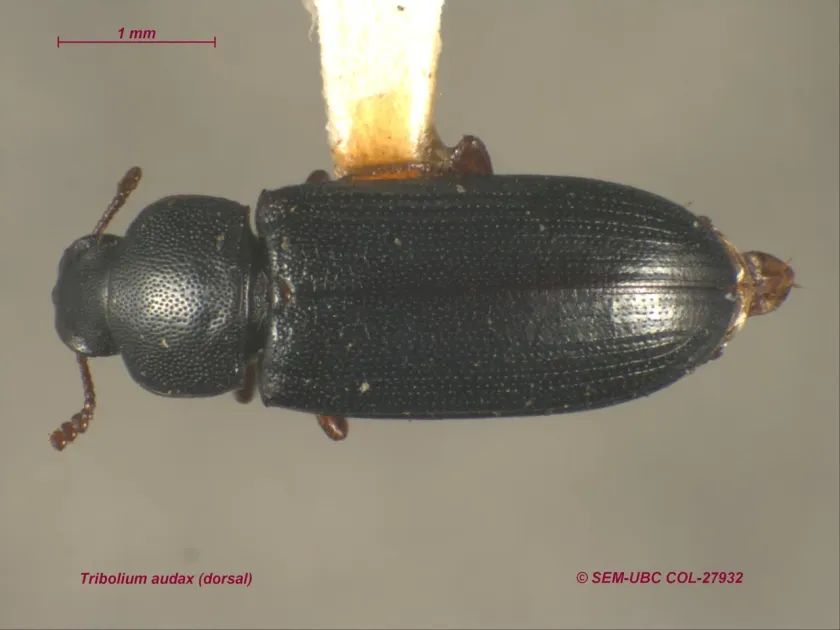
The American black flour beetle (Tribolium audax) is a member of the family Tenebrionidae, order Coleoptera. It is a small insect, typically measuring 3–4 mm in length, with an elongated body that varies in color from dark brown to reddish-brown.
A primary diagnostic characteristic of this species is its antennae, which terminate in a distinct three-segmented club. The surface of the beetle's body is covered in fine punctures, and the elytra feature longitudinal ridges or striae.
The larvae are worm-like, ranging from yellow-white to cream in color, and reach lengths of 5–6 mm. A key identification feature is the presence of two small, thorn-like projections (urogomphi) on the final abdominal segment.
The life cycle includes four stages: egg, larva (undergoing 5 to 8 instars), pupa, and adult. In optimal environmental conditions of 25–30 °C, one generation can be completed in approximately 40–50 days.
Unlike some other related species, Tribolium audax is primarily an indoor pest, frequently found in flour mills, warehouses, and storage facilities, where it seeks shelter in dark, undisturbed areas.
What it damages
The American black flour beetle is a significant stored-product pest that feeds on processed grain products and cereal residues. It causes direct economic loss by damaging the structural integrity and quality of the stored goods.
The beetle primarily infests wheat, rye, barley, oats, and maize, along with their derived products such as flour, bran, and various semolina types. It is also known to infest dry animal feed, oilseeds, and nuts.
Beyond cereals, this pest can consume dried fruits, legumes, and confectionery products. The feeding activity of the larvae results in the pulverization of the material and significant weight loss of the stored commodities.
The presence of these beetles leads to massive contamination of the product with frass, larval shed skins, and dead insect carcasses. This degradation significantly reduces the commercial grade and usability of the affected batches.
High population densities can cause localized heating and increased moisture in stored grain, which subsequently promotes the growth of mold and the secondary colonization by other fungal-feeding pests.
Signs of infestation
Visual identification of adults on the surface of grain piles or near warehouse equipment during evening hours is the most common indicator of an infestation. The beetles are often more active under artificial lighting.
Infested flour or grain products often develop a characteristic off-flavor or musty, pungent odor caused by the secretions from the insect's abdominal glands, which can easily be detected upon inspection.
The physical degradation of the product, such as the clumping of flour or the presence of "dusty" residues consisting of fragmented particles and waste, is a clear sign that a colony is well-established.
Inspectors often find clusters of larvae in concealed areas, such as floor crevices, seams in storage bags, or gaps in machinery, where organic dust and debris accumulate, providing refuge for the pest.
In larger storage structures, localized warm spots in the grain mass often indicate that the beetle population is actively feeding and reproducing, which requires immediate diagnostic investigation.
Control measures
The first line of defense is rigorous sanitation: cleaning spills, removing grain dust, and eliminating residues from all machinery and corners of the warehouse are essential to prevent the pest from finding a habitat.
Temperature management is a highly effective control measure. Maintaining storage temperatures below 12 °C significantly inhibits the development of the beetles and prevents the exponential growth of their population.
For established infestations in storage buildings, professional fumigation using phosphine-based treatments is standard practice. It is crucial to ensure that fumigation is performed by trained personnel to guarantee efficacy.
Preventive residual spraying of empty storage surfaces with approved insecticides is recommended to create a chemical barrier against potential re-infestation after the structure has been cleaned and aerated.
- Ensure grain moisture content remains below 14% at all times.
- Use airtight containers or sealed storage environments.
- Implement pheromone-based monitoring to detect early population spikes.
- Conduct strict quality control inspections for all incoming goods.
Taxonomy
- Latin name
- Tribolium audax
- Order
- Coleoptera (beetles)
- Family
- Tenebrionidae
- EPPO code
- TRIBAU
Discussion
No discussions yet — be the first.