
Whitefly Trialeurodes vitrinellus
Trialeurodes vitrinellus
Description
How to identify
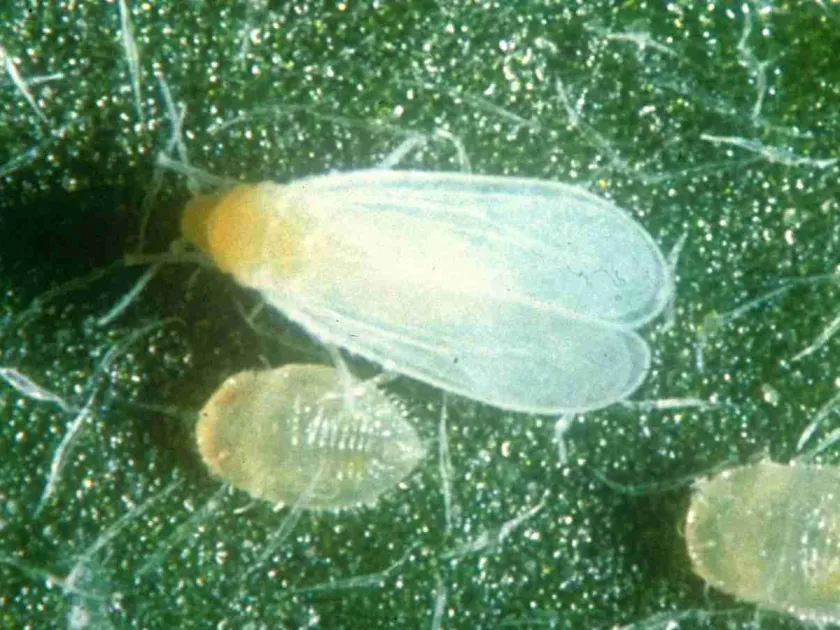
Trialeurodes vitrinellus is a small insect belonging to the whitefly family (Aleyrodidae) within the order Hemiptera. Adult individuals possess a characteristic waxy coating on their wings, which gives them a milky-white appearance.
The body length of the adults typically ranges from 1 to 1.5 mm. The wings are held horizontally while at rest, serving as a critical morphological feature for distinguishing this species from others within the family.
The larval stages undergo several instars; nymphs often exhibit an oval shape and are firmly attached to the undersurface of the leaf, becoming almost immobile after the first instar.
This species displays high adaptability to various microclimatic conditions, allowing it to thrive successfully in both open-field environments and greenhouse operations.
For accurate identification, experts analyze the puparium shape, as the cuticle structure at this developmental stage serves as the primary taxonomic marker.
What it damages
This pest prefers a wide range of herbaceous plants, including many vegetable and ornamental crops. Significant damage typically occurs during periods of active plant growth.
The insects extract cellular sap from leaf tissues, which disrupts the plant's physiological balance and slows down the process of photosynthesis.
In addition to direct mechanical damage, the whitefly acts as a potential vector for dangerous plant viruses transmitted through its feeding activity.
During feeding, these pests excrete honeydew, which becomes a perfect substrate for the growth of sooty mold, coating the leaves in a black, sticky film.
Severe infestations lead to leaf deformation, yellowing, premature leaf drop, and a dramatic decrease in the marketable quality of the crop.
When it appears
Population activity is directly dependent on temperature and air humidity. Optimal conditions for reproduction occur at temperatures above +20–25°C.
In greenhouse settings, the life cycle continues year-round, allowing the pest to produce multiple generations within a single season.
In open fields, population peaks are observed in mid-summer when weather conditions become most favorable for adult activity and egg-laying.
Overwintering of the species is possible in the egg or larval stage on plant debris, or in greenhouses on living host plants.
The pest spreads throughout the area through both active flight of adult individuals and passive movement via air currents or infested planting material.
Signs of infestation
The primary sign of whitefly presence is a cloud of tiny white insects rising from the undersides of leaves when the plant is even slightly disturbed.
On the underside of the leaf, one can detect microscopic translucent or yellowish larvae resembling scales, pressed firmly against the epidermis.
The appearance of a sticky, shiny layer of honeydew on the leaf surfaces below the infestation zone signals a high population density of the pest.
The development of secondary fungal infection as dark spots of sooty mold is a later sign, indicating the prolonged presence of insect colonies.
Leaf chlorosis and general plant wilting or weakness are also secondary symptoms that confirm the crop is being drained by the pest.
Control measures
Management strategies include the use of yellow sticky traps for monitoring population levels and capturing adults, allowing for timely intervention.
Agronomic methods include effective weed control, as weeds often serve as reservoirs for infection and refuges for the pest during the off-season.
The use of biological control agents, such as parasitoids (e.g., wasps from the genus Encarsia), has proven highly effective in greenhouse environments.
Chemical control relies on the application of systemic insecticides; however, it is crucial to rotate products to prevent the formation of resistant populations.
- Use of certified, pest-free planting material
- Regular disinfection of greenhouse structures
- Ensuring optimal ventilation to reduce humidity levels
- Strict adherence to quarantine measures when introducing new seedlings
Taxonomy
- Latin name
- Trialeurodes vitrinellus
- Order
- Hemiptera (bugs, aphids, leafhoppers)
- Family
- Aleyrodidae
- EPPO code
- TRIAVI
Discussion
No discussions yet — be the first.