
Tobacco whitefly
Trialeurodes tabaci
Description
How to identify
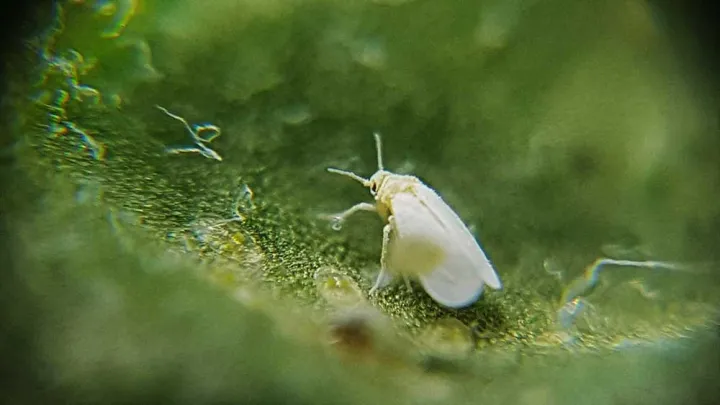
The tobacco whitefly, Trialeurodes tabaci, is a small insect belonging to the Aleyrodidae family. Adult individuals are typically 1 to 1.5 mm long, with white wings and a pale yellow body often covered with a fine waxy powder.
Eggs are small, oval, and pale yellow, darkening as they mature. The first instar larvae, often called 'crawlers', move across the leaf surface until they find a suitable spot to settle and begin feeding.
A quick way to detect their presence is to gently tap the plants; adults will fly up in a cloud, making them easily visible against the green background of the leaves.
Identification is best performed by observing the underside of leaves, where all stages of the insect—eggs, nymphs (puparia), and adults—are usually found together.
Because they reproduce rapidly via parthenogenesis, even a few individuals can lead to a massive infestation in a short period, especially in a protected environment.
What it damages
This pest is a major polyphagous insect that attacks hundreds of plant species. Primary targets include vegetables such as tomatoes, cucumbers, peppers, and beans.
Ornamental plants, including poinsettias, chrysanthemums, and hibiscus, are also highly susceptible, often resulting in significant economic losses for commercial nurseries.
The tobacco whitefly causes damage by sucking phloem sap, which deprives the plant of essential nutrients and leads to stunted growth and reduced vigor.
Heavy infestations are common in greenhouses, where the absence of natural predators and favorable temperatures allow the population to thrive year-round.
Beyond direct feeding damage, they contaminate plants with honeydew, which serves as a substrate for sooty mold, reducing the photosynthetic capacity of the leaves.
When it appears
In outdoor environments, activity begins when temperatures consistently rise in late spring and early summer. The life cycle is temperature-dependent, with the fastest development occurring at 25–28°C.
In greenhouses, the pest can remain active throughout the winter months if heating is provided. There is no natural diapause under consistent indoor conditions.
A single generation can complete its development in as little as 15–20 days, resulting in multiple generations overlapping throughout the growing season.
Hot, dry weather patterns during mid-summer often lead to population explosions, as these conditions are ideal for whitefly reproduction and migration.
As temperatures drop in late autumn, outdoor populations may migrate into adjacent greenhouses or seek shelter on weeds that remain green throughout the winter.
Signs of infestation
One of the earliest signs is the presence of honeydew on the leaves, which creates a sticky, shiny surface. This substance quickly becomes infested with black sooty mold.
Plants affected by the whitefly often exhibit chlorosis (yellowing), leaf curling, and premature leaf drop, which significantly weakens the overall structure of the plant.
Crucially, the tobacco whitefly is a highly efficient vector for numerous plant viruses, such as tomato yellow leaf curl virus, which can cause total crop failure.
A physical inspection of the underside of leaves reveals stationary, scale-like nymphs. If left unmanaged, the plant will appear severely stunted and discolored.
In cases of severe infestation, fruit development is compromised, resulting in smaller, misshapen produce that fails to meet quality standards for the market.
Control measures
Managing the tobacco whitefly requires an integrated pest management (IPM) approach that combines physical, biological, and chemical strategies.
Biological control using parasitoids such as Encarsia formosa is highly effective in greenhouse settings. These natural enemies target whitefly larvae and reduce the need for chemicals.
Chemical control must be handled with care to prevent the development of pesticide resistance. Rotation of different chemical classes is essential for sustainable management.
Good agricultural practices include removing weeds that serve as alternate hosts and ensuring that new plant material is inspected before being introduced to a facility.
- Use yellow sticky traps for monitoring populations.
- Install fine-mesh screens on ventilation windows.
- Implement strict sanitation measures after harvesting.
- Apply entomopathogenic fungi like Beauveria bassiana.
Taxonomy
- Latin name
- Trialeurodes tabaci
- Order
- Hemiptera (bugs, aphids, leafhoppers)
- Family
- Aleyrodidae
- EPPO code
- TRIATA
Discussion
No discussions yet — be the first.