
Whitefly Trialeurodes porosus
Trialeurodes porosus
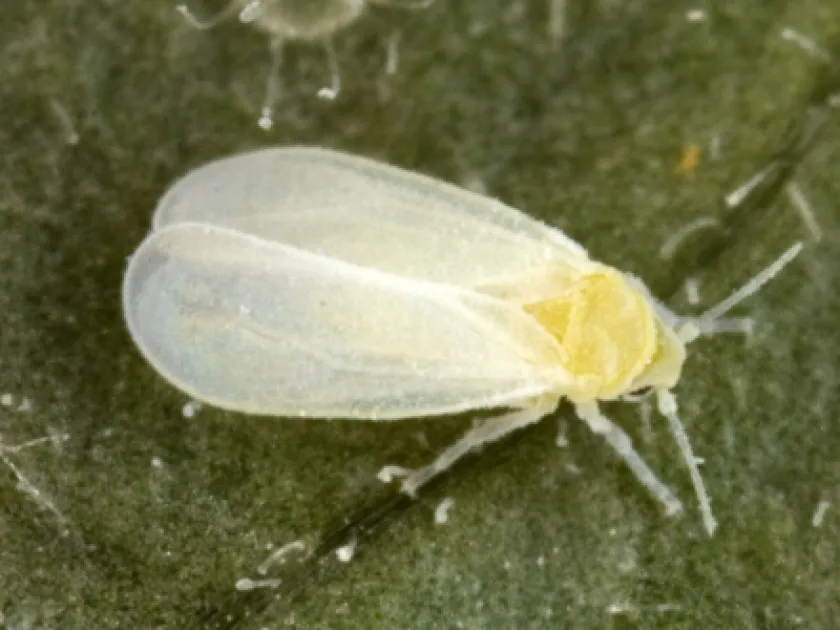
Description
How to identify
Trialeurodes porosus is a species of small insect belonging to the family Aleyrodidae, within the order Hemiptera. These insects are commonly known as whiteflies due to the waxy white powder covering their wings.
Adults typically measure between 1 to 1.5 mm in length. Their bodies and wings are covered in a fine, flour-like dust, which aids in protection and camouflage on host leaves.
The insects possess two pairs of wings that are held roof-like over the body when at rest. The compound eyes are often divided, a key morphological feature for expert identification.
Nymphs go through several instars. The early stages are mobile, while later instars become sessile and develop a flattened, scale-like appearance on the underside of leaves.
Accurate identification of Trialeurodes porosus usually requires microscopic analysis of the puparial structures to differentiate it from other related species.
What it damages
This species is a known polyphagous pest, capable of damaging a wide variety of cultivated crops, especially those grown in greenhouses or subtropical climates.
Significant infestations have been observed on vegetable crops such as tomatoes, peppers, and cucumbers, as well as on various ornamental plants.
The damage is caused by both adults and nymphs extracting sap from the phloem, which stunts plant growth, causes chlorosis, and leads to reduced overall vigor.
Furthermore, Trialeurodes porosus acts as a vector for various plant viruses, causing systemic infections that can devastate an entire harvest if not managed properly.
The physiological stress caused by the feeding insects makes the plants more susceptible to other environmental stressors and secondary pathogenic infections.
When it appears
In greenhouse environments, the pest can thrive and reproduce year-round, provided the temperature remains within an optimal range of 22–26°C.
In open fields, the pest's activity is highly dependent on climate, typically starting in late spring as temperatures rise and persisting until autumn.
The life cycle is rapid; under favorable conditions, the development from egg to adult can take as little as three to four weeks, leading to overlapping generations.
High humidity combined with warm temperatures creates an ideal breeding environment, causing rapid population spikes during the mid-summer months.
The pest survives the winter in various stages, often hiding in crop residues, on perennial weeds, or within protected structures like greenhouses.
Signs of infestation
The most obvious sign of infestation is the sudden appearance of small white insects flying in a cloud when the leaves of the infested plant are disturbed.
Infested leaves begin to show yellowing (chlorosis), which eventually leads to curling, deformity, and, in severe cases, premature leaf drop.
The insects excrete a sticky substance known as honeydew, which accumulates on the leaves and stems, creating a breeding ground for sooty mold fungi.
Sooty mold manifests as a black, powdery layer covering the leaf surface, significantly blocking sunlight and hindering the plant's ability to photosynthesize.
Visible decline in plant health, stunted growth, and a reduction in fruit quality are reliable indicators that the whitefly population has reached a damaging level.
Control measures
An effective control program starts with monitoring using yellow sticky traps, which attract and capture adult whiteflies, allowing for early detection.
Cultural management is crucial, including the thorough removal of weeds that serve as alternative hosts and the sanitation of greenhouses after the growing season.
Biological control methods involve releasing natural enemies, such as parasitic wasps (e.g., Encarsia spp.) or predatory beetles, to naturally suppress populations.
Chemical intervention should prioritize systemic insecticides that reach the plant sap, providing long-lasting protection against both adults and nymphs.
- Implement strict sanitation measures in greenhouses.
- Rotate insecticides with different modes of action to prevent resistance.
- Use biological control agents during early stages of infestation.
- Maintain optimal environmental conditions to avoid excessive humidity.
Taxonomy
- Latin name
- Trialeurodes porosus
- Order
- Hemiptera (bugs, aphids, leafhoppers)
- Family
- Aleyrodidae
- EPPO code
- TRIAPO
Discussion
No discussions yet — be the first.