
Pergande's whitefly
Trialeurodes pergandei
Description
How to identify
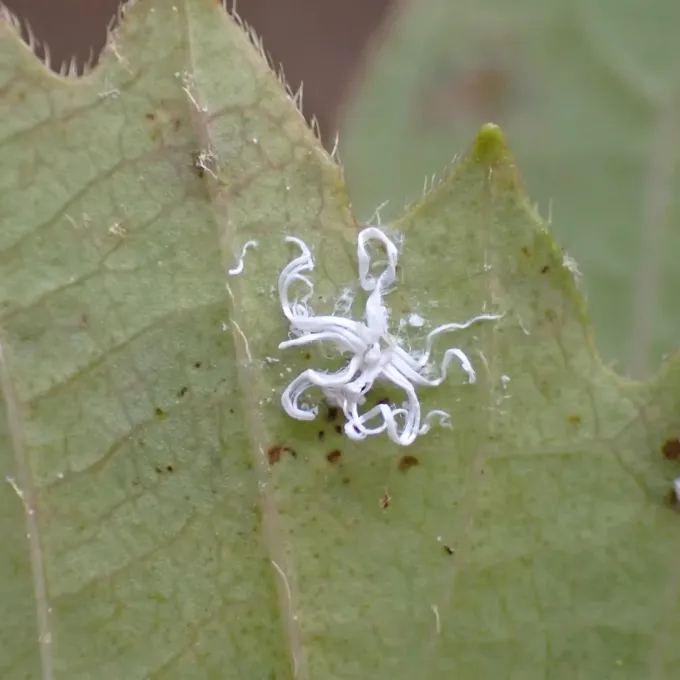
Pergande's whitefly (Trialeurodes pergandei) is a member of the Hemiptera order and the Aleyrodidae family. It is a tiny insect known for its white, waxy wings that cover the body of the adult.
The life cycle consists of the egg, several larval instars, and the puparium stage. The puparium is a critical taxonomic feature used by specialists to identify this particular whitefly species.
Adults are small, typically measuring between 1 and 1.5 mm. They are highly active during warm weather and are often found in colonies on the underside of leaves.
These insects thrive in warm, humid conditions, making them particularly problematic in greenhouse environments where year-round reproduction is possible.
Spread usually occurs through the movement of infested plant material or via the flight of adults within localized areas during favorable temperatures.
What it damages
This species is a polyphagous pest that feeds on a wide range of agricultural and ornamental plants, extracting phloem sap from the host tissue.
Direct damage manifests as yellowing leaves (chlorosis), leaf curling, and overall stunted growth due to the loss of plant nutrients.
The accumulation of honeydew secreted by the nymphs promotes the growth of sooty mold, a black fungal layer that inhibits photosynthesis and plant respiration.
In addition to direct physiological stress, Trialeurodes pergandei serves as a potential vector for various plant viruses, which can cause devastating economic loss.
Heavy infestations can lead to premature leaf drop and may significantly decrease the yield or market quality of the affected crops.
When it appears
Adult activity peaks during the spring and summer months when temperatures allow for rapid developmental cycles.
In outdoor conditions, populations are most prominent in mid-to-late summer, coinciding with the peak vegetative growth phase of host plants.
During the autumn, the pest often seeks refuge in greenhouses, where higher temperatures permit continued breeding and survival throughout the winter.
The time taken for one generation to complete depends on thermal conditions and humidity, with faster cycles observed in hot, humid environments.
Overwintering typically occurs in the pupal or larval stage on plant debris or in soil cracks protected from frost.
Signs of infestation
The most recognizable sign is the presence of tiny white insects that take flight in a cloud when the plant is disturbed or shaken.
Sticky, shiny residue on leaves, often followed by a black, dusty appearance from sooty mold, indicates an established whitefly population.
Curled, yellowed, or otherwise deformed new leaves on the terminal growth are frequent indicators of severe localized infestation.
A general lack of vigor and wilting, despite adequate watering, may suggest that the plant is heavily stressed by sap-feeding insects.
Closer examination reveals small, flat, translucent scales (puparia) adhering firmly to the undersides of leaves.
Control measures
Yellow sticky traps are a primary tool for monitoring population density and reducing the number of adult whiteflies in an infested area.
Biological control methods involve the introduction of natural enemies, such as parasitic wasps (e.g., Encarsia spp.) which specifically target the larval stages.
Cultural practices include the systematic removal of weeds and debris, which serve as reservoirs for the pest, and maintaining optimal crop spacing for air circulation.
Chemical intervention should rely on systematic insecticides applied when economic thresholds are exceeded, while rotating active ingredients to manage resistance.
- Implement monitoring with sticky traps.
- Release beneficial biological control agents.
- Sanitize greenhouses after each harvest.
Taxonomy
- Latin name
- Trialeurodes pergandei
- Order
- Hemiptera (bugs, aphids, leafhoppers)
- Family
- Aleyrodidae
- EPPO code
- TRIAPE
Discussion
No discussions yet — be the first.