
Strawberry whitefly
Trialeurodes packardi
Description
How to identify
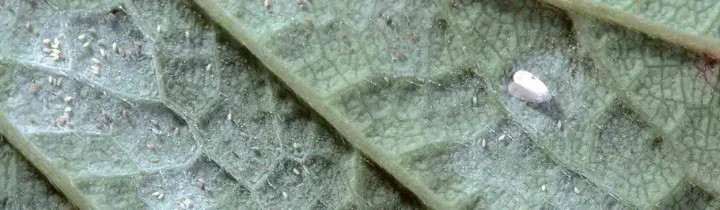
The strawberry whitefly (Trialeurodes packardi) belongs to the order Hemiptera and the family Aleyrodidae. These are tiny insects, with adults measuring about 1–1.5 mm, characterized by their wings covered in a white, powdery wax.
The life cycle includes the egg, three larval stages, the puparium, and the adult. Females lay tiny, yellowish eggs on the underside of leaves, securing them with small stalks.
The first larval instar, known as a "crawler," is mobile and actively searches for a feeding site. Once they begin feeding, they lose their mobility, flatten, and become transparent, blending into the leaf surface.
The puparium stage is distinct due to its convex body and the presence of wax filaments along the edges, which serve as essential diagnostic features for identifying this specific species.
The duration of the life cycle is highly dependent on temperature. In controlled environments like greenhouses, the pest can reproduce continuously, completing several generations throughout the season.
What it damages
The primary host is the garden strawberry. Both adults and larvae cause damage by sucking sap from the plant's vascular system, which disrupts nutrient transport and growth.
The whiteflies prefer young foliage, clustering on the undersides of leaves. High population densities result in significant nutrient depletion and stunted plant development.
In addition to sap extraction, these insects act as vectors for various plant viruses. Furthermore, they secrete "honeydew," which promotes the growth of sooty mold that clogs leaf stomata.
Infested plants exhibit leaf curling, yellowing, and premature senescence. This drastically reduces the plant's photosynthetic capacity, leading to weakened growth.
Heavy infestations impact yield significantly, resulting in smaller, malformed berries and reduced overall plant vitality, often leading to susceptibility to other pathogens.
Signs of infestation
The most obvious sign of infestation is a cloud of small white insects taking flight when the strawberry plants are disturbed or shaken during routine maintenance.
Closer inspection of the leaf underside reveals numerous translucent, immobile larvae and pupae that resemble tiny scales stuck to the leaf tissue.
The presence of a sticky, glistening substance known as honeydew on the leaves is a hallmark sign, often followed by the appearance of dark, sooty mold patches.
Plants may show signs of overall distress, including stunted growth, distorted new leaf development, and chlorotic spotting or general paleness of the foliage.
Poor fruit set, withered flower stalks, or the production of unmarketable, undersized berries are common outcomes of sustained feeding by the whitefly population.
Control measures
Cultural practices include rigorous weed management, as many weeds act as alternative hosts for the pest, and ensuring proper plant spacing to improve airflow.
Biological control involves the introduction of beneficial insects, such as predatory bugs or parasitic wasps, which can naturally suppress whitefly numbers in the field.
Chemical control strategies utilize systemic insecticides that target both larvae and adults. It is crucial to use products that interfere with insect growth or nervous system function.
Rotating chemical classes is essential to manage potential resistance, as whiteflies can develop tolerance to frequently used active ingredients over time.
When applying pesticides, thorough coverage of the leaf undersides is mandatory for effectiveness, as the majority of the insect population resides in these protected areas.
Taxonomy
- Latin name
- Trialeurodes packardi
- Order
- Hemiptera (bugs, aphids, leafhoppers)
- Family
- Aleyrodidae
- EPPO code
- TRIAPA
Discussion
No discussions yet — be the first.