
Florida whitefly
Trialeurodes floridensis
Description
How to identify
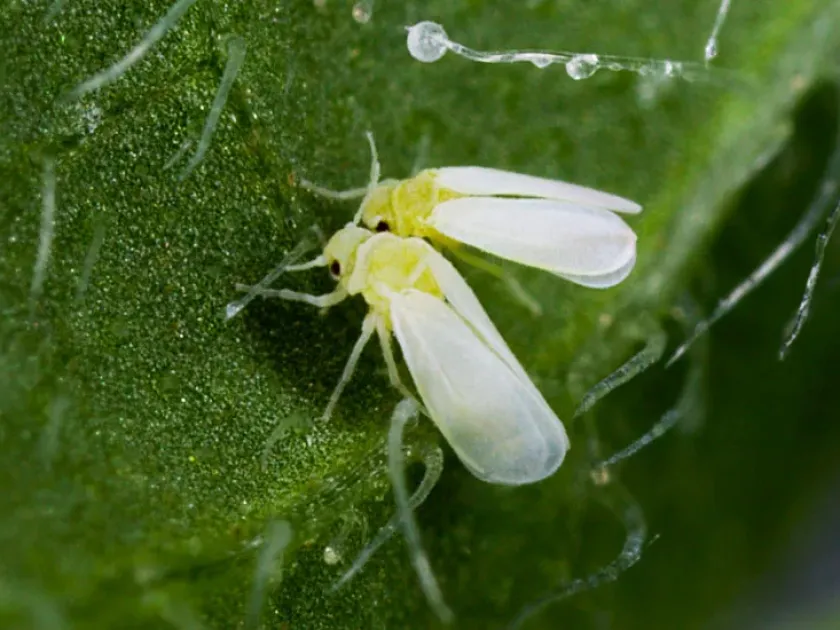
The Florida whitefly (Trialeurodes floridensis) belongs to the order Hemiptera and the family Aleyrodidae. These are tiny insects characterized by wings covered in a white, powdery wax secretion.
The life cycle consists of the egg, three larval stages, the puparium, and the adult (imago). The adult whiteflies are primarily found on the undersides of leaves, where they feed and lay eggs.
The larval stages are sedentary, appearing as small, flat, translucent, or yellowish discs. Because they blend into the leaf surface, they are often difficult to detect during the early stages of infestation.
Reproduction is rapid, especially in protected environments like greenhouses. A single female can produce many eggs, leading to explosive population growth if environmental conditions are conducive.
These insects are highly sensitive to microclimatic factors. They prefer warm, humid, and stagnant air, which allows them to colonize and spread across host plants with minimal disruption.
What it damages
The Florida whitefly primarily infests a range of fruit-bearing and ornamental plants, including citrus, avocado, and various tropical greenhouse species. The damage is caused by both nymphs and adults feeding on sap.
As they feed, the insects deplete the plant of essential nutrients, leading to yellowing, leaf distortion, and stunted growth. Severe infestations can cause leaf drop and significantly weaken the host plant.
A major indirect impact is the secretion of honeydew. This sticky substance serves as a substrate for sooty mold, a fungus that covers the leaf surface and blocks photosynthesis, further stressing the plant.
In addition to physiological damage, the aesthetic value of ornamental plants is destroyed by the presence of whiteflies and the subsequent black fungal layer covering the leaves.
Plants affected by the whitefly are more susceptible to secondary viral and fungal infections. The overall reduction in plant vigor leads to poor quality fruit and lower total yields in commercial crops.
When it appears
In outdoor environments, the Florida whitefly is most active during the warmer months of the year, with population spikes occurring during the summer when temperatures are consistent.
In greenhouses, the pest can thrive throughout the year, provided that temperatures remain within the optimal range of 20 to 28 degrees Celsius, which allows for continuous breeding cycles.
The transition from winter to spring is a critical time for monitoring. Rising temperatures stimulate the development of surviving larvae and eggs that may have persisted on host plants.
The number of generations per year is dependent on temperature; in hot climates or heated greenhouses, the whitefly can complete 5 to 7 cycles, making consistent control essential.
While cold autumn temperatures may slow adult activity, the pest does not necessarily die off. It can survive in protected spots, ready to resume reproduction once warmer conditions return.
Signs of infestation
The most immediate sign of an infestation is the presence of white adults that scatter like a cloud when the plant is disturbed or shaken. They quickly return to settle on the undersides of leaves.
Careful inspection of the lower leaf surfaces reveals small, oval, motionless nymphs and eggs often deposited on tiny stalks. Over time, affected leaves may show chlorotic spots or yellowing.
The presence of honeydew and the secondary development of black sooty mold are clear indicators that the whitefly population has reached a significant size and has been active for some time.
Affected plants often show signs of overall stunted development, including shortened internodes and deformed new growth, as the insect saps the vitality from the growing points.
Yellow sticky cards are highly effective diagnostic tools. By placing them near the host plants, growers can detect the arrival of adult whiteflies long before visible damage becomes widespread.
Control measures
Effective management of the Florida whitefly relies on an Integrated Pest Management (IPM) approach that combines cultural, biological, and chemical strategies for long-term control.
- Utilizing beneficial insects like parasitic wasps or predators.
- Removing and destroying heavily infested plant material.
- Applying systemic insecticides during periods of peak adult activity.
- Using yellow sticky traps to monitor and reduce adult populations.
- Improving greenhouse ventilation to disrupt the pest's favored microclimate.
Chemical control is often necessary for severe outbreaks, with systemic insecticides being particularly effective as they are absorbed by the plant and target the nymphs feeding on sap.
Biological control, using natural predators, provides a sustainable solution in protected environments, reducing the reliance on chemical treatments and minimizing residue issues.
Strict sanitation protocols, including the removal of weed hosts and proper disinfection of greenhouse equipment, are vital to prevent the reintroduction of the pest into the production area.
Taxonomy
- Latin name
- Trialeurodes floridensis
- Order
- Hemiptera (bugs, aphids, leafhoppers)
- Family
- Aleyrodidae
- EPPO code
- TRIAFL
Discussion
No discussions yet — be the first.