
Bandedwing whitefly
Trialeurodes abutiloneus
Description
How to identify
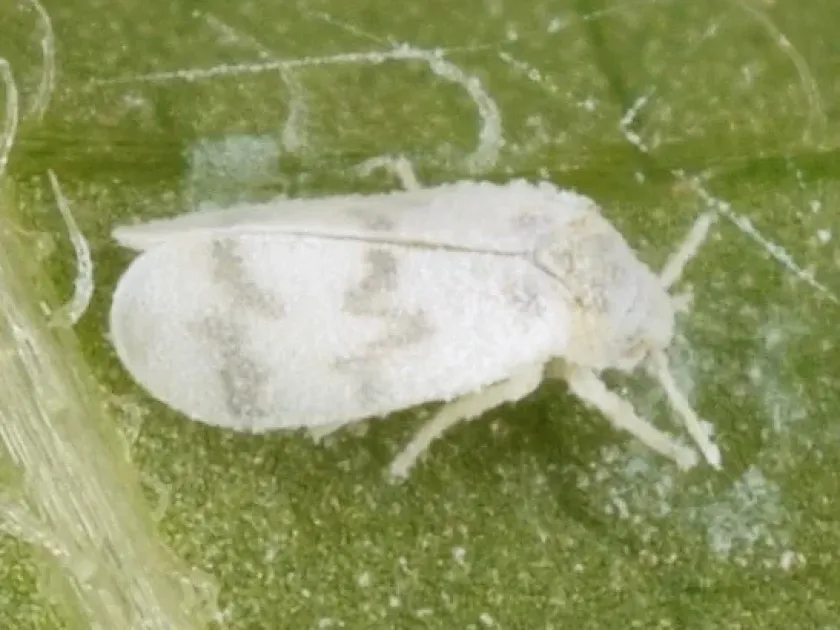
The bandedwing whitefly (Trialeurodes abutiloneus) is a significant insect pest belonging to the Aleyrodidae family. Adult individuals are characterized by their distinct appearance, featuring banded patterns on their wings, which distinguishes them from other common whitefly species.
The development cycle consists of the egg stage, four larval instars (nymphs), and the adult stage. The duration of each phase is strictly dictated by ambient temperature, with warmer conditions significantly accelerating the maturation process.
The nymphs are sessile, typically found on the undersides of leaves. They are flattened and translucent, often appearing as small, waxy scales that remain stationary throughout their development until the final pupal stage.
Adult whiteflies are highly mobile and easily distributed by wind currents. They prefer the cooler, shaded environments found in the lower canopy of host plants, which makes detection early in an infestation difficult.
Accurate species-level identification usually requires a microscopic examination of the pupal case, as adult morphology can be highly variable and confusing compared to other related species.
What it damages
This pest has a broad host range, causing substantial economic damage to various crops, including cotton, soybeans, tomatoes, and numerous leguminous vegetables.
The bandedwing whitefly is frequently found on various weed species, particularly velvetleaf (Abutilon theophrasti), which acts as a critical reservoir for the pest in agricultural landscapes.
In greenhouse settings, the environment supports continuous breeding cycles, leading to explosive population growth if left unmanaged, which can cause total crop failure.
Damage occurs when both adults and nymphs pierce plant tissues to extract phloem sap, which deprives the plant of essential nutrients and disrupts its physiological processes.
Persistent feeding leads to stunted growth, leaf yellowing, and a significant decrease in overall yield and product quality, rendering crops unmarketable.
Signs of infestation
The most evident sign of a whitefly infestation is the accumulation of honeydew on the leaf surfaces, which is a sticky excretion produced by the larvae during feeding.
Honeydew serves as a growth medium for sooty mold, a fungus that covers the foliage in a dark, unsightly coating, further reducing the plant's ability to photosynthesize effectively.
Infected plants may exhibit chlorosis, appearing mottled or generally yellowed. Heavy infestations often cause premature leaf senescence and may even lead to plant death in severe cases.
An easy way to verify an infestation is to gently shake the plant; a sudden "cloud" of tiny, white adults flying upward indicates an established population.
Whiteflies are also known to be vectors for various plant viruses, so the appearance of systemic viral symptoms on the host plant is a secondary indicator of whitefly presence.
Control measures
Integrated Pest Management (IPM) strategies for the bandedwing whitefly utilize yellow sticky cards to monitor adult flight activity and density levels throughout the growing season.
Biological control agents, such as predatory mites, lacewings, and specific parasitic wasps (like Encarsia species), are highly effective at reducing nymphal populations when released early.
Chemical control should focus on systemic insecticides that provide long-lasting protection. It is crucial to rotate chemical groups to prevent the development of resistance in the whitefly population.
Cultural practices, specifically the removal and destruction of host weeds like velvetleaf, are essential for eliminating refuge sites for the whitefly between planting seasons.
Improving greenhouse ventilation and maintaining optimal spacing between plants can create a less favorable microclimate for whitefly reproduction and facilitate better spray coverage.
Taxonomy
- Latin name
- Trialeurodes abutiloneus
- Order
- Hemiptera (bugs, aphids, leafhoppers)
- Family
- Aleyrodidae
- EPPO code
- TRIAAB
Discussion
No discussions yet — be the first.