
Brown Thrasher
Toxostoma rufum
Description
How to identify
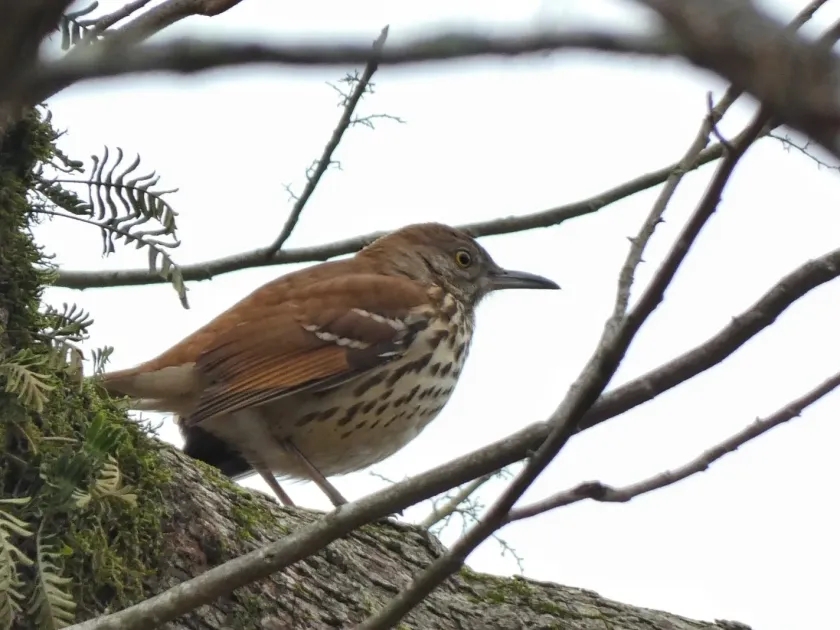
The Brown Thrasher (Toxostoma rufum) is a medium-sized songbird in the Mimidae family, characterized by a long, slightly decurved bill and a very long, rounded tail.
Adults exhibit a rich reddish-brown upper plumage with white wing bars and a heavily streaked white breast. This coloration provides excellent camouflage within the dense shrubbery and thickets they inhabit.
The bird's bill is adapted for foraging; it uses a sweeping motion to toss aside leaf litter and debris to uncover insects and seeds, often causing disturbance to the soil surface.
They are primarily solitary birds that exhibit strong territorial behavior, particularly during the nesting season, when they may claim areas of orchards or berry fields as their own.
While often shy, their adaptive nature allows them to thrive on the edges of agricultural landscapes where food sources are diverse and easily accessible.
What it damages
The Brown Thrasher becomes an agricultural pest primarily due to its feeding habits on cultivated soft fruits, including raspberries, blackberries, strawberries, and cherries.
Feeding damage occurs when the birds peck at ripening fruits, piercing the skin and consuming the pulp. This renders the produce unmarketable and vulnerable to secondary rot.
In addition to fruit consumption, they can be a nuisance in early spring by foraging in seedbeds, where they may dig up newly planted seeds and disturb delicate seedling root systems.
The extent of damage is often correlated with the bird population density in the immediate vicinity and the availability of natural food sources during the crop maturation phase.
Their presence can lead to significant economic losses in small-scale berry production, as a few individuals can damage a substantial portion of the crop within a short time frame.
When it appears
The period of concern for farmers begins in the early spring, coinciding with seed germination and initial planting, and continues through the peak fruit harvest season.
Late spring and summer represent the highest risk period, as the birds actively forage to support their offspring and exploit the abundance of seasonal soft fruits.
During the harvest months of June and July, migratory patterns and nesting cycles often align with the peak ripeness of commercial berry varieties in many regions.
Activity remains steady throughout the autumn as the birds utilize remaining orchard fruits and seeds to prepare for their seasonal movements or wintering periods.
Effective pest monitoring should begin before the onset of flowering to ensure that protective measures are installed in time to prevent initial crop exposure.
Signs of infestation
Evidence of Brown Thrasher damage includes precise, puncture-like holes in berries, often clustered on the side of the fruit or near the stem where the bird has sampled the juice.
Signs of digging in the mulch or topsoil under berry bushes are common indicators of their foraging activity, as they clear large patches of debris with their bills.
Damaged berries often show signs of rapid decay or desiccation, as the breach in the skin allows environmental pathogens and insects to compromise the fruit's integrity.
Persistent presence in the orchard, characterized by short, low flights between bushes and distinct vocalizations, indicates that the birds have established the area as a feeding site.
Droppings found on foliage or plastic mulch near heavily damaged sections of a field provide clear evidence of consistent bird activity in that location.
Control measures
The most reliable method for crop protection is the use of exclusion netting, which physically prevents birds from reaching the berries while allowing for pollination and light penetration.
Visual deterrents, such as scare-eyes, reflective tape, or mobile predator decoys, can be deployed to create an environment perceived as unsafe by the birds.
Acoustic deterrent systems that broadcast predator calls or distress signals can be highly effective when rotated regularly to prevent habituation to the sounds.
Cultural control strategies, such as meticulous harvesting of ripe fruit and the prompt removal of "dropped" or overripe produce, reduce the incentive for birds to remain in the fields.
Maintaining buffer zones of native shrubs or less desirable wild fruit varieties on the periphery of the farm can help divert the birds away from high-value commercial crops.
Taxonomy
- Latin name
- Toxostoma rufum
- Family
- Mimidae
- EPPO code
- TOXSRU
Discussion
No discussions yet — be the first.