
Torymus exilis
Torymus exilis
Description
How to identify
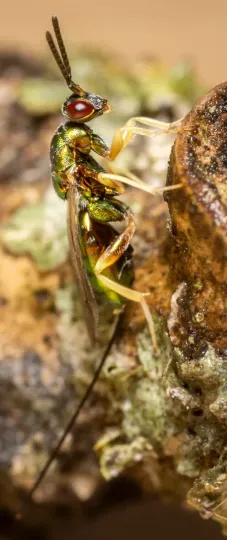
Torymus exilis is a small insect belonging to the order Hymenoptera and the family Torymidae. This species is a type of parasitoid wasp known for its metallic body, which typically displays brilliant green or bronze hues.
Adults possess a long ovipositor, an anatomical feature that allows the female to penetrate the tough exterior of developing fruits to lay eggs deep within the tissues. The adult size is generally small, often measuring only a few millimeters in length.
The larvae are white, legless grubs that spend their entire development cycle hidden inside the fruit. This endophagous lifestyle makes them particularly difficult to detect in the early stages of infestation.
Significant sexual dimorphism exists within the species, affecting body structure and coloration, which often requires a trained entomologist to accurately distinguish between genders in the field.
As a specialized insect, its life cycle is deeply interconnected with specific host plants. It is often found associated with trees that produce nut-like fruits, where it finds both shelter and a food source for its offspring.
What it damages
Torymus exilis primarily targets the fruit of nut-bearing trees, such as chestnuts. The larvae are the main source of damage, as they feed on the developing kernel inside the shell.
By consuming the kernel, the larva renders the nut entirely hollow and destroys its commercial value. The interior becomes a mixture of debris and excrement, making the fruit useless for both human consumption and commercial production.
Heavy infestations frequently cause premature fruit drop, leading to significant yield losses in managed orchards. This damage is often not apparent until the harvest, when the reduction in weight and quality becomes obvious.
Secondary infections are a major risk, as the exit holes created by emerging adults provide a pathway for various fungi and bacterial pathogens to infiltrate the nut, further spoiling the stored crop.
The economic impact is exacerbated by the fact that the pest remains hidden during the growing season, preventing farmers from implementing timely curative actions.
When it appears
The life cycle of this pest is strictly synchronized with the phenology of its host plant. Adult emergence typically occurs in the spring, timed perfectly with the development of young fruit buds.
The mating and egg-laying period takes place during the warm spring and early summer months. During this time, female wasps actively forage to locate suitable fruits for oviposition.
Larval development is the longest phase, spanning the duration of the summer and autumn. During this time, the larvae grow within the host fruit, eventually preparing for a dormancy period as temperatures drop.
Torymus exilis overwinters as a diapausing larva inside the infested fruit, which may remain on the branch or fall to the orchard floor. When spring arrives, the cycle begins anew with pupation and emergence.
Depending on the climatic zone, the pest usually completes a single generation per year, though environmental shifts can occasionally lead to variations in the emergence timeline.
Signs of infestation
The most reliable sign of an infestation is the appearance of tiny, circular exit holes on the outer shell of the nut, signifying that a new generation of adults has successfully emerged.
When suspecting an infestation, cracking open several nuts will reveal internal galleries or hollowed-out sections filled with frass, which is a clear indicator of larval activity.
Premature ripening or unexpected shedding of young fruit often points to high pest pressure within an orchard. If these signs are observed in conjunction with holes in the fruit, intervention is necessary.
A noticeable decrease in the average weight of harvested nuts compared to healthy crops is a quantitative indicator of internal feeding damage that might not be visible from the outside.
Monitoring the presence of adult wasps on the canopy during the flowering stage is a proactive method for predicting the severity of the upcoming pest season.
Control measures
Managing Torymus exilis requires a multi-faceted strategy that prioritizes orchard sanitation and careful monitoring to keep populations below economic thresholds.
- Strict collection and removal of all fallen nuts and debris from the orchard floor to destroy the overwintering larvae.
- Systemic insecticide applications timed to coincide with the period of peak adult activity during the spring.
- Maintaining healthy tree vigor through proper irrigation and fertilization, which can help trees better tolerate pest pressure.
- Deploying pheromone or colored sticky traps to monitor for adult presence and determine the exact timing for protective treatments.
Biological control efforts often focus on encouraging natural enemies, including other parasitoid wasps and predators, which help regulate the population density in nature.
Because the larvae are protected inside the fruit for the majority of their cycle, chemical control is largely limited to the adult stage, requiring strict adherence to pre-harvest intervals to ensure safety.
Taxonomy
- Latin name
- Torymus exilis
- Order
- Hymenoptera
- Family
- Torymidae
- EPPO code
- TORYEX
Discussion
No discussions yet — be the first.