
Fir seed chalcid
Megastigmus atedius
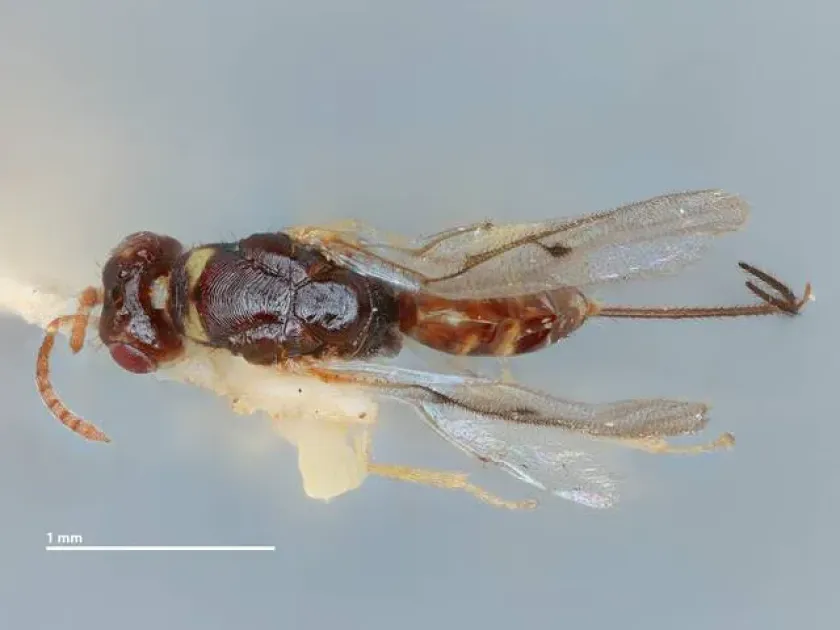
Description
How to identify
The fir seed chalcid, scientifically known as Megastigmus atedius, is a small Hymenopteran insect belonging to the family Torymidae. These insects are specialized seed predators that target various species of the Abies genus.
Adults are tiny, slender wasps measuring approximately 3 to 5 mm in length. They are typically brownish or yellowish in color, often exhibiting a subtle metallic luster on their bodies.
The females are equipped with a prominent ovipositor, which is used to pierce through the developing cones of the fir trees to deposit eggs directly into the seeds. The wings are clear, with a vein structure characteristic of chalcid wasps.
Larvae are legless, white, and dwell entirely within the seed. Their development is cryptic, meaning the damage remains hidden from view until the adult insect emerges from the mature seed.
As a member of the superfamily Chalcidoidea, this pest is highly specialized. It relies strictly on the availability of receptive fir cones to complete its life cycle and maintain its population levels.
What it damages
The primary damage is caused by the larval stage, which consumes the embryo and endosperm of the fir seed. This process effectively kills the seed, rendering it completely infertile for nursery planting.
Because the damage occurs internally, infected seeds look identical to healthy ones. This creates significant challenges for foresters who rely on visual inspection to estimate the quality of a seed lot.
In high-infestation years, the fir seed chalcid can cause catastrophic yield losses. This significantly hinders reforestation efforts and increases the cost of acquiring viable seed material.
The insect does not damage the vegetative growth of the tree, such as the foliage or branches. Therefore, its impact is exclusively limited to the reproductive output of the stand.
Persistent infestations over several seasons can lead to a decline in natural regeneration capacity within the affected fir forest, necessitating active management interventions.
When it appears
The life cycle of the fir seed chalcid is perfectly synchronized with the phenology of the host tree. Adults typically emerge in the spring when young cones are at the ideal stage for oviposition.
Following mating, females lay their eggs inside the developing ovules. The larvae then spend the entire summer feeding and growing within the protective casing of the seed.
Most individuals remain in the larval stage during the winter, safely tucked inside the seeds on the forest floor or in stored cones. Pupation occurs in the following spring, leading to the emergence of the next generation.
The species generally follows a univoltine life cycle, meaning there is only one generation per year. Weather conditions during the early spring directly affect the timing of adult activity.
Monitoring the flight period is essential for effective pest management. By timing the emergence correctly, forest managers can deploy control measures before the females begin their egg-laying process.
Signs of infestation
The most reliable sign of an infestation is the presence of small, circular emergence holes on the surface of the cone scales. These holes indicate that an adult chalcid has recently exited the seed.
Upon dissecting a suspected seed, one will find it hollowed out, often containing the shed skin of the larva or waste material. The embryo will be completely missing or necrotic.
Infested seeds are generally lighter than healthy ones. This weight difference is often used in seed processing plants to separate damaged seeds from viable ones using water flotation or air density separators.
In cases of heavy infestation, cones may appear slightly deformed or show premature browning, although these symptoms are not exclusively diagnostic for this specific pest.
- Circular emergence holes (approx. 1 mm) on cone scales.
- Hollow interior of seeds upon cutting.
- Reduced viability in seed germination tests.
- Floating seeds when placed in water.
Control measures
Management strategies primarily focus on preventing the emergence of the next generation. Harvesting cones immediately upon maturity is a key practice to stop the life cycle.
Storing harvested cones in specialized structures that prevent the exit of emerging adults can help minimize the spread. Fumigation of seed lots is another highly effective method to kill internal larvae.
In seed orchards, applying systemic insecticides during the peak flight period can significantly reduce the number of eggs laid, thereby protecting the current season's crop.
Biological control remains an area of interest, involving the preservation of natural parasitoids that prey on the chalcid larvae. Maintaining biodiversity in forest stands helps stabilize these natural predator populations.
Seed sorting technology, including sophisticated optical scanners and density-based separators, is crucial for nurseries to ensure that only viable, pest-free seeds are used for reforestation projects.
Taxonomy
- Latin name
- Megastigmus atedius
- Order
- Hymenoptera
- Family
- Torymidae
- EPPO code
- MEGSZW
Discussion
No discussions yet — be the first.